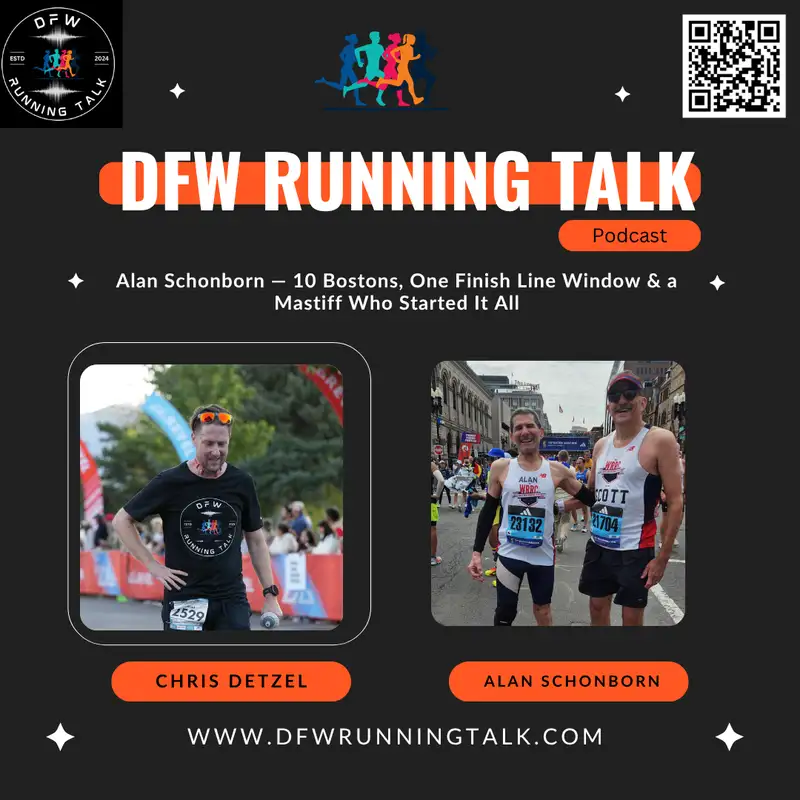
DFW Running Talk: Alan Schonborn - Boston
===
Chris Detzel: [00:00:00] Welcome to DFW Running Talk. I'm Chris Detzel, so let's get started.
Hey, real quick, wanted to shout out to the Panther City Ultra. Coming up now on May 16th at Marion Sanso Park in Fort Worth. So quick backstory, this one was originally scheduled for April, but it got moved due to weather to May. So good news is there's still time to sign up. This race is put on by Rise Racing Co, that you probably know as.
The sponsor of this show, they've got four distances, 5K, 10 K, 20 5K, and a 50 k. ~Running through natural trails with the rocky terrain, elevation changes some steep climbs, especially down near the river and waterfall areas.~ If you're newer to trails to 5K, 10 K, or solid entry points, if you want, ~you know, ~a real challenge, ~you know,~ move it up to the 20 5K or~ you know,~ 50 K.
One thing I love about this race is ev. Everyone finishes with a metal and swag, so no matter the distance, keep in mind. It's capped at 300 runners, so spots are limited. Use code DFW for registration for 10% off. So it's Marion Sanso Park, Fort Worth, Texas May [00:01:00] 16th. Links from the show notes. Go check it out.
All right. Welcome to another DFW Running Talk. I'm Chris Tetzel. And before we get to our special guest today, we are gonna have 11 episodes. Five have already dropped, and probably by the time you listen to this, all of them would've dropped already. So it's just to get the experience of some of these Boston Marathon runners and just to get the excitement going for if you haven't ran it, to maybe wanna run it.
And then for those that are running it, just to get you pumped up and ready to go. Today's special guest is Alan Schoenberg. Did I say that right, Alan? Yep. Sean Borden, my bad. Alan, how are you?
Alan Schonborn: I'm good. It's great to see you, Chris, as always.
Chris Detzel: It's good to see you, man. And one of the things that you've been a staple of the Dallas-Fort Worth running kind of community for many years.
I know you've moved to Boston recently, but I wanted to get your. Your story. You've been a big part of the White Rock running co-op. So tell me a little bit about your background about running in Dallas and how you got with White Rock running co-op and then we'll get to your first [00:02:00] Boston, if that's fair.
Alan Schonborn: Like many of us, I stumbled in backwards into running mostly because I realized I couldn't keep up with drinking beer and eating ice cream too. Of things I was fond of without doing something active. And so I started running mostly with my dog, had a mastiff. We eventually, oh wow. Rescued a number of mastiffs, but this one was actually a mix, not nearly as big as the English Mastiffs that we later rescued over and over again.
But at one point I was running through Lakewood and with the Mastiff and didn't know why there were crowds on the street and cones blocking the street. Found it was the marathon.
Chris Detzel: Did Dallas. Dallas Marathon or
Alan Schonborn: Yeah, Dallas Marathon and folks coming up from the lake and a Lakewood Boulevard or whatever it was, and everybody wanted to stop and get a picture with this large dog.
Chris Detzel: That's great.
Alan Schonborn: Not the front of the Packers, but the middle and the back of the Packer's throat that he was gorgeous and he was my training partner. Yeah. He did all my miles with me. I'd go to the lake and do a couple loops and he [00:03:00] wouldn't allow me to put 'em in the car if I thought I was going too long.
He wanted to be a part of all of that, so That's
Chris Detzel: great. Such a big dog doing the runs that, that's crazy.
Alan Schonborn: Yeah. The vet said it's amazing and people who have big dogs know this, that they wanna just lay on your lap. Yeah. All day long. Or on the couch. But he lasted a very long time. I think he was 18 when he died, and the vet said he extended his life because he ran like all of us.
He's
Chris Detzel: a runner.
Alan Schonborn: Yeah. Like all of us,
Chris Detzel: the headlines to this is gonna be dog led, the long life because of running.
Alan Schonborn: That.
And I'm a cautionary tale because I was always doing, I was always running because I was trying to avoid something or trying to stay in shape. My wife used to say, when we'd have some tension between us, she'd look at me and say, did you get your running today?
Because I was one of those folks who really needed it. And I was a daily runner, but short mileage way back [00:04:00] when MU Track used to be open to the public 24 hours a day. Yeah. And I'd be out there at midnight 'cause that's when I could squeeze in the run. That's no longer the case, but had a demanding job.
And so running came second. And I was mostly just, again, a solitary runner, found community with DRC. And
Chris Detzel: Oh, okay.
Alan Schonborn: Really enjoyed their training programs for a time. Ended up having some good training periods or cycles with Paul Ada, especially leading us and Carrie Cron and ended up qualifying while I was still with DRC, but made the switch over to White Rock running co-op about the time they started, but within, towards the end of the first year or so.
Chris Detzel: Okay.
Alan Schonborn: That's a great group, as and full of community lots of support and really enjoyed that. But my first qualifying run for the marathon was at Dallas, again, white Rock at the time. And I'd run a race up in, I think it was Grapevine, with that was called the Metric Halff. I didn't pay [00:05:00] attention to where a metric calf was.
It's not 13.1. And so I met a fellow who took off when I thought there was a lot more to go. We became fast friends. Bob Jacobs ended up, qualified me for the marathon. He was running it on a regular basis by running backwards from the finish line until he caught me, and that happened to be at the Dolly Parton Hills.
And then he ran me in from there. He, at one point, took my watch from me and said, you're paying too much attention to that. Give it to me.
Chris Detzel: That's right.
Alan Schonborn: And he got me qualified. But before that, I'd see people ringing the bell and doing that kind of stuff. I had no clue what. Boston was about, so
Chris Detzel: Wow. So when you qualified, you didn't know much about it or the first time?
Alan Schonborn: I knew at that point that I was trying to qualify but prior to that, like most of us, my first marathon I laid down right after the Dolly Parton Hills, 'cause I was gassed later, did I learn about these things called gels? You're supposed to take [00:06:00] nutrition while you're running.
Yeah,
Chris Detzel: that's right. None of us know. All of us.
Alan Schonborn: That's right.
Chris Detzel: By the way, Dolly Parton is that. Is that the right thing to call it nowadays? I don't want us to get in trouble here.
Alan Schonborn: That's right. We'll have to reach out to her and ask her what she thinks. I That's a good question. Exactly.
They, I Dolly
Chris Detzel: Parton Hills,
Alan Schonborn: do they still dress up as Dolly Parton? Because there used to be three or four guys who would do that.
Chris Detzel: I've heard about that and I don't know, I never run the marathon I don't know. That's a good question.
Alan Schonborn: You have to ask Leah. I'm sure she. I seen them. It's, they're standing out there, I'm sure
Chris Detzel: she has.
Alan Schonborn: Trying to get people to drink beer holding cups as you run past.
Chris Detzel: Yeah, I dunno. That's a good question. I dunno, do they still run by There is the question anyways, so we digress a little bit.
Alan Schonborn: So the, so Bob got me to qualify and actually a year or two later we stayed good friends. A year or two later he got married and he was the very first wedding on the course.
Marcus allowed him to get married, literally just beyond the starting line. So we had the ceremony. [00:07:00] There's something called a wedding running minister, I think was her name. She advertised online and they hired her. And she showed up in sneakers and we had the wedding. Why not just adjacent to the starting line and then they didn't finish it.
The ceremony moved us to be right behind the elites. The starting gun went off and then, oh, 50 yards or so beyond the starting line, we peeled off and they got married. The final steps, groom and the bride kissed and they had velcroed pieces of it. Velcroed his tux. So he could just do this and peel it off.
Yeah,
Chris Detzel: take it off.
Alan Schonborn: That's right. He still ran with his bow tie. I believe she ran with her tiara and everybody cheered for them on the course.
Chris Detzel: That's awesome. That's pretty cool. That's a good little story. I like it. Thank for sharing. Alright, you qualify for Boston Marathon through the Dallas Marathon.
What was your time when you ran the Dallas Marathon to qualify? Do you remember?
Alan Schonborn: I don't remember probably. Okay. If I recall correctly, it was three [00:08:00] 30 or thereabouts.
Chris Detzel: Okay. Yeah.
Alan Schonborn: As a as a cautionary tale, again, I ran a lot of three thirties, three 20 nines. 3 28. Yeah. 3 20, 3 30 twos because I wasn't training.
With a program, and as most of us know, you just don't get a whole lot better if you do the same thing over and over again.
Chris Detzel: Yep. Yeah, that's right. You gotta make those adjustments, along the way. That's right. When you start hitting those three thirties or whatever it is, continuously. All right.
You get to Boston. What were you thinking? What was your kinda, mindset?
First time.
Alan Schonborn: Just finishing and recognizing that it was quite an achievement to get there. I cried when I crossed the finish line, felt all the emotion. I basically let myself experience it because
Chris Detzel: yeah,
Alan Schonborn: there's no reason to ignore how big of an accomplishment it is.
Yes, people do it repeatedly. Including me, but it's a big deal to do that. And the next time that I got emotional was when I'd had an injury and didn't know if I'd run again competitively. And when [00:09:00] I crossed the finish line, somebody came over to me, one of the volunteers, and said, are you okay? Are you okay?
Because I was, I don't think I was crying, but I was on the verge and I said, yeah, this, I just didn't know I'd be here again. Because we all have those kinds of difficulties with injuries that we don't know that we can come back from.
Chris Detzel: And I forget to ask, how many Bostons have you run approximately? I
Alan Schonborn: I think this is gonna be 10.
Chris Detzel: Okay.
Alan Schonborn: I believe it's 10.
Chris Detzel: You've run a lot of marathons
Alan Schonborn: yeah, I did what? Oh, white Rock did Dallas a dozen times. And I think Boston was the first out of town marathon that I did actually just did a lot of Bostons
Chris Detzel: And do you remember what your best time ever is in the marathon? I'm just curious 'cause I don't even know.
Alan Schonborn: Yeah, I don't know. It's in the, it's in three twenties something.
Chris Detzel: Okay.
Alan Schonborn: But I,
Chris Detzel: alright.
Alan Schonborn: Honestly don't know. I should know.
Chris Detzel: You're just a very consistent runner, and they've done a lot of marathons. So before I get to kinda what this marathon means to you overall and then 2026 looks [00:10:00] like coming up one of the things that I appreciate about you is that.
Leah and I go out there every year and a lot of people do and a lot of people know you and you take us to this nice restaurant. We all have dinner after the marathon and hopefully we'll get to do it this year again. And so I appreciate you doing that. You take the time, like I watch you when people come from Dallas, you'll take 'em different places within Boston, to show 'em the different.
Places you'll sometimes host them at your house. The things that you're doing to me is just amazing for the community. And the heart that you have, for for the people or just people in general is just amazing to me. So I wanna say thank you for that and I want you to know that I've seen that and watched it, and I always tell Leo's alan, man, that guy is just so kind and so nice and and it shows. So I appreciate that. Just wanted you to know that we truly believe, and a lot of people do, like obviously, when I talk about you sometimes during a run and somebody, yeah, Alan, oh my God, he is just so cool and nice, so it's always like that.
So
Alan Schonborn: that's only [00:11:00] if Andy is not speaking or telling a joke or a story.
Chris Detzel: Yeah. Andy talks a lot, but he's still a great guy.
Alan Schonborn: He's absolutely, he's the best.
Chris Detzel: So what does Boston Marathon mean to you? And you've done it 10 times going into to this next one. What does it look like for you?
What does it mean you live there now, kind. What's that culture like there? Just curious.
Alan Schonborn: It would be easy. If you, for those coming in from around the world, it would be easy to assume that like the Rose Bowl, 'cause that doesn't leave Pasadena or other things that don't move about. With the March Madness, it's a different city with the qualifying for the Olympics that moves to a different city for the road races, because this is here all the time.
It would be easy to assume that there is not a lot of appreciation or emotional response to folks about the marathon, but actually there is. It's all year long. I mentioned to Marcy, my wife, that I was out on a run a couple of weeks, three [00:12:00] weeks ago, maybe four, and two or three different times. Little old ladies or older men gave me a thumbs up as I ran past or told me, attaboy a great job or something like that.
Today when I. When I went out on a hard run, I was catching my breath after an interval and a guy stopped who I'd passed once before. He, we were going opposite directions and he wanted to make sure that he thought I was doing a great job pushing hard. That is seemingly all year long. It's such a great city for the running community.
Chris Detzel: Yeah.
Alan Schonborn: And we're fortunate with the various schools. I don't live as far from the Esplanade, the Charles River. And so a lot of runs are looping that. That path. And on the Harvard MIT side, there's always fast runners that you can see and catch, try to catch up with or use 'em as rabbits to try to chase 'em.
But that's something that's so unique to this city. Not that others don't have storied running paths, but I clearly see that here.
Chris Detzel: That's awesome. [00:13:00] Do you whatcha looking forward to the most as you start running? The marathon on that Monday?
Alan Schonborn: It's a great question. My, my training program was disrupted my block, so I had to take three weeks off and then came back for two and then had to take another week off.
And initially I wasn't sure what that would be like coming back. I know my speed is down, but my aerobic capacity seems to be fine. I'm just going to soak it in and enjoy it. Frankly, I'm gonna push hard. I run with Achilles, which is Achilles International is for handicapped or disabled folks who are supported to get out there and run or cycle.
And I run with them every week and I offered the coordinator, Joe, that if he wanted to plug me in to guide somebody. Because I generally guide a fair the blind runners in Achilles. If he needed somebody at the last minute, he could tap me because I already had a bib and be happy to do that.
I'm at that point where, as we both know, I'm still a lot older than you, but at this point I'm not chasing the [00:14:00] times that I thought I could achieve in my twenties or early thirties. But I love the community, the running community, and what it means, especially for people who. Who are challenged.
I'd encourage everybody who sees the bright green Achilles shirts on the course to say something to them, to encourage them to tell 'em how great it is. I've just learned a lot running as a Guide to Blind Runners, the idea of traversing 26.2 miles without seeing the course and relying on your guide, telling you, okay, we're gonna turn to the right here about.
About 120 degrees or whatever it might be. That just is a phenomenal achievement to me. So I've seen them in plant and as we, most of us have in other races, and I've come to really appreciate their achievement.
Chris Detzel: How are you young?
Alan Schonborn: I'm 67.
Chris Detzel: Okay. You took a second to say that. So
Alan Schonborn: that's 'cause my wife was laughing in the background.
Marcy's still laughing.
Chris Detzel: Shocked that I asked the question, huh?
Alan Schonborn: Yeah.
Chris Detzel: Runners, we can ask that question because we post it everywhere, [00:15:00] right? You can go look it up and I could go find it. So it's not really that difficult. Anything else that you wanted to say about the marathon, about race day, about maybe the weekend?
Before we go.
Alan Schonborn: Yeah I think some of my, what I've heard some of the other folks say is very meaningful, and that's a, if it's your first, soak it in. Don't try to make more of it than what's realistic. Don't miss opportunities to have great memories. Connect with people. People who are coming in or they live here are wanting the same thing from you, so turn to somebody beside you and strike up a conversation.
Chris Detzel: So easy. There's
Alan Schonborn: thousands
Chris Detzel: of people there.
Alan Schonborn: Absolutely. Absolutely. And everybody wants to meet somebody when they're here. Don't think you're a weirdo because you strike up a conversation. Yeah. And as a result, I've got some good friendships from folks in lots of other places. I'd suggest that people leave lots of time if they're taking the buses.
Because there, there have been occasional hiccups with rival times. I think it's important to be sure that they're [00:16:00] not. Cutting it too closely if they're taking the buses outta the Boston Common, as you've spoken about with somebody else previously. The expo is not what it used to be. One of the, one of the unfortunate things the sponsors now, the primary sponsor gets to decide if a competitor to what they offer can be in.
And mostly that decision is, nope, we don't want to let the other shoe companies or garment companies or the that's right. So what happens is, as I've heard you say, they moved out to popups and that's now in my mind as good or better an experience. Yeah,
Chris Detzel: 5%. I agree. I hate that the expo, it's not just Boston, every single race seems to do the same thing or big races, but what Boston does very nicely, or the vendors, they just pop up the, places and you can go to different places outside of the expo and just see.
It's just really cool, and I'm glad that they did that.
Alan Schonborn: Yeah. Absolutely.
Chris Detzel: Great, Alan, go ahead one more time.
Alan Schonborn: I'm excited to, to see you and Leah, as she'll recall, because I live right around the corner from the finish line, [00:17:00] which is also on the course for the get what they call it, the miracle mile or the high schoolers and college kids and middle schoolers, I believe all running a loop.
It goes, all of those go right past my building and day. A few years ago when I looked out the window and same time Leah looked up and we spotted each other.
Chris Detzel: She told me
Alan Schonborn: this, one of my great memories that could never have happened for her choosing to stand there.
Chris Detzel: I think she said she looked dumb.
Was like Alan.
Alan Schonborn: Exactly.
Chris Detzel: So yeah, that, that's a great memory. Alan, thank you so much for coming on to DFW Running Talk. I'm Chris Tetzel. Make sure to rate and review us, it's really important. And also subscribe to our newsletter. I do fw running talk substack.com. Again, Alan, thank you so much for coming.
Alan Schonborn: Absolutely. Good luck to you and to Leah.