
Chris Detzel (00:00)
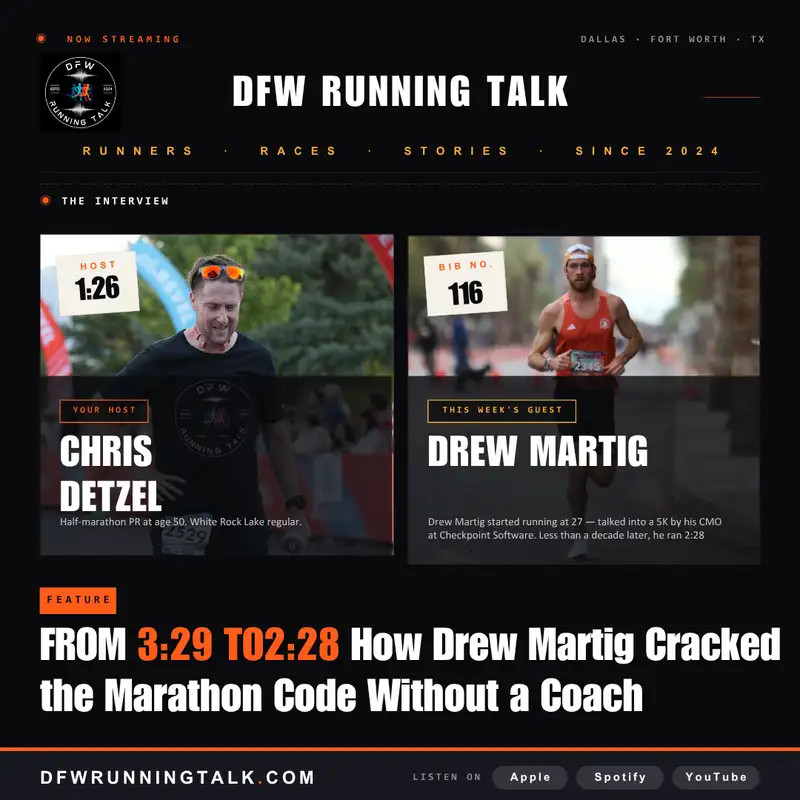
All right, welcome to another DFW Running Talk. I'm Chris Detzel and today's special guest is Drew Marteg. Did I say that right? Oh good. Drew, how's it going?
Drew Martig (00:07)
Yes you did.
It's going alright. Yeah. How are you?
Chris Detzel (00:12)
Doing well. So, you know, some of you heard our podcast that we did, probably most of you, around kind of my journey and I was on his podcast and we just talked about a bunch of different things. And so I promised that he could come on this podcast as well. So we kind of did this collaboration and we're going to learn about a little bit about your journey, Drew, and we'll just kind of dive in. So let's talk a little bit about you, how you got into running and what you do as.
Do you start running in high school? What does that look like?
Drew Martig (00:41)
Yeah, so no, I didn't start running in high school. I didn't run at an early age at all. I played like team sports growing up, but my dad was a professional athlete and I guess it skips a generation because my brother is also was a stud athlete with team sports. I never caught that bug. I never really performed where I was on like the freshman football team and I was like,
Chris Detzel (00:44)
Okay.
really?
Drew Martig (01:08)
hurt, didn't really play. It just kind of fell out of team sports pretty early. So that was my early sports career. Really short lived, really just like baseball and know, baseball and basketball and stuff as a young kid. And then I didn't really revisit any sort of athletics until ⁓ I started running when I was about 27. Our CMO, I was at Checkpoint Software.
Chris Detzel (01:28)
Okay.
Yep.
Drew Martig (01:31)
which is
another cybersecurity company. I was on the marketing team and our chief marketing officer, he comes into the office, he just throws it out there to the group. He's like, who wants to run a 5K with me? And it was in like a month. And me, like eager beaver trying to impress my boss. I was like, sure, I'll do a 5K. I didn't really run more than maybe like a mile at some point.
I wasn't really good at it, didn't know anything about it. And that was my first real running experience was I tried running. I tried training for it, which essentially was me going to a track once a week and running so hard that my lungs were just burning and I was coughing and it was horrible. I had no idea what I was doing.
Chris Detzel (02:15)
So it's always kind of cool when your CMO asks you to do something. So it's hard to turn down, I'm sure. It's funny because a lot of times at some of these events that we have at work or whatever, I'm the one kind of trying to get people to run different things. And so that's pretty cool that your CMO did that. By the way, I think I forgot to mention, we both work at the same company, Taneum. We mentioned this at the last podcast and
You know, we're both interested in running. We've been doing it for a little bit. And so I wanted to make sure we got through the journey as well. So, all right, you got into a 5K and then did you think, okay, I need to, I want to do this again or what?
Drew Martig (02:55)
yeah, I mean, leading up to that, I kind of was like falling out of my old lifestyle, which from when I told you I quit sports at an early age, I quickly got into a life of sin and debauchery or whatever you'd call it, as most teenagers do. So it was I wasn't a healthy till till like my mid 20s. And then like when I was probably 25, I started like corporate jobs. I realized like I just can't.
Chris Detzel (03:04)
Yeah.
Until you're a 27?
Drew Martig (03:20)
I can't drink every day. you know, I stopped smoking pot at that point and I was like, I gotta do something about my health because I just physically didn't feel very good. ⁓ and it's hard to perform. You're at work. You need to be smart. You need to be on top of it. And you, you know, it's hard to think. so yeah, I, I kind of like moved away from that, moved into working out, going to the gym, lifting weights, stuff like that. And so running was like an easy jump to what's the next thing that's going to make me more healthy.
Chris Detzel (03:30)
Yeah.
Drew Martig (03:48)
And I'm really happy I did because now it's like, it's my life.
Chris Detzel (03:53)
You mentioned that your dad was a professional athlete. What was he professional athlete in? What was the...
Drew Martig (03:58)
Baseball and football. So he yeah, my my dad. He went to if you're from anyone from the Bay Area, Bellarmine is a a Jesuit all boys prep school in San Jose. And so my my dad went there and played baseball and football and then he went to Santa Clara, which is like across the street, essentially, which is another Jesuit University popular for sports.
Chris Detzel (04:00)
Okay.
Drew Martig (04:23)
And they had a football team back then. So he was quarterback and free safety of the football team. And, and he played baseball as well. And then he was, he did some minor league ball for the A's in Modesto. And then he got cut from a preseason squad on the Seahawks. Then he decided to go into corporate life after that.
Chris Detzel (04:42)
It's kind of cool. mean, nice little story for him, you know?
Drew Martig (04:43)
It was cool to like,
cool to grow up with that, you know, and like one positive thing was my dad was always, he was just always really motivated to get his kids into sports. So that was positive because I always, I just always was doing something and whether I liked it or not, I think that's a good thing. I kind of encourage the same for my kids. So yeah.
Chris Detzel (04:53)
Yeah.
Attitude. Yeah,
I mean, I push active activity of some sort. Hey, if you don't like athletics, bands, like my son's in band and things like that. He's like so hardcore. So it's hard for him to get in trouble. I do kind of push. If he's over here and we're doing a 5K, he's going to do a 5K. Like this weekend, we got a 5K coming up. I just signed him up. He's going to do it one way or another. You can walk, run. I don't care. But you're going to do it. He's 15.
All right, so you did this 5K and you've been working out a little bit, you know, what kind of set off kind of the, hey, I want to do more of this.
Drew Martig (05:27)
That's great.
Yeah, and then I shortly after that I don't know why but I signed up for a marathon at some point after that CIM ⁓ in
Chris Detzel (05:42)
Wait,
wait, You signed up for a marathon just after the five kit. You're like.
Drew Martig (05:43)
Yeah, I did.
I well, I did the 5K and I think I did like a 10K after that with some family members. I was like, oh, that wasn't too bad. So I few months later I did like a 10K and and then after that I like wanted to train for a marathon. And so it took me some time to get around to the marathon. I don't want to do math on years, but you know, it was it was maybe like a year after that. And I ran CIM.
Chris Detzel (05:50)
Okay.
Yeah, it was a couple of years.
Drew Martig (06:10)
for the first time and for that I got a coach. so I went from just, yeah, I was just hurt all the time and I was like, I couldn't figure out how to be consistent with running. So I ended up signing up for a coach that I found online. She was great. She was also a nutritionist. So she helped me with a lot of nutritional stuff too. Yeah, kinda was my gateway into running.
Chris Detzel (06:14)
you did, okay.
How'd you do?
Yeah, I mean, how'd you do on that first marathon?
Drew Martig (06:33)
I ran a 329 at CIM.
Chris Detzel (06:37)
Okay, I mean,
for our first marathon that didn't do hardly any running besides training for it more than one time. That's pretty good.
Drew Martig (06:43)
Yeah, yeah,
I mean, if I remember correctly, I didn't really string together like too many really solid weeks. It was just kind of up and down, kind of learning how my body responded to stuff. Again, lots of niggles and stuff. I think because I don't have the background of running that lot of people do, like from an early age, my body's probably less resilient naturally than a lot of runners. And so that's something I work really hard on these days.
I've been able to be fairly consistent over the last couple years because of that.
Chris Detzel (07:11)
So you run that marathon, you actually find somebody to help train you, which is pretty smart. A lot of people don't do that. Not in the very beginning. You weren't ever a runner. So what was next? How did you think, OK, well, I did a 329. Did you get into a community at all? I mean, were you just running all the miles by yourself?
Drew Martig (07:32)
I've trained almost exclusively by myself for, yeah, it's been like, I'm 34. So it's been like seven or so years, seven or eight years since I started this whole thing. And I probably, yeah, at that point, I think my coach was the main person I leaned on and just trial and error, learned it by myself. Yeah.
Chris Detzel (07:45)
Yeah.
It's kind of gross.
I mean, one hell of a marathon for your first and not really doing it with anybody else. So what happened then? Were you happy with it? Do you remember?
Drew Martig (08:03)
I mean, the cool thing about being a beginner in running is it's really easy to see those gains. as I'm sure you're aware, it's like, when you start, just doing the most basic of things, you just see really solid growth in your potential and your times and everything. So every time I raced after, after that 5k, every single time I would race, I would get better, like, you know, noticeably better, measurably better.
So after that first marathon, from that into then COVID happened the following year. And so I signed up for CIM again. And I wanted to do better. And I was like, OK, maybe I could do a Boston qualifier, which I think was like 252 or something like that, if I remember correctly. Or 254 or something. Yeah.
Chris Detzel (08:52)
Usually it's by fives, isn't it? It's like 255, two, three.
Drew Martig (08:52)
I quickly started like
Maybe
I'm remembering my time, but I think because of the cutoffs, you know? So maybe it 2.5, yeah, it might have been 2.55 or maybe it was sub 3 and I think I ran like 2.56 the following year. And I did that through COVID. I was training by myself, obviously. We weren't allowed to do much during that first year. And CIM was canceled, so I had my...
Chris Detzel (08:59)
Yeah, okay, got it.
Drew Martig (09:23)
my cousin's husband who's a good friend of mine. was like, dude, just ride the bike next to me, give me fuel. was on our, we had a creek trail that was, you could go for like 20 miles on it. So I just went like in out and back on the creek trail and I ran, yeah, I just did my own thing, but yeah.
Chris Detzel (09:35)
They just did a virtual.
Drew Martig (09:39)
Yeah, it was that that was fun. I mean, if you can, if I feel like if you can do that, it's I trained for it. And like just with CIM being canceled, if you can do that on your own, that's like it's a solid thing for a lot of people to do, I think just kind of build some resilience and. Yeah.
Chris Detzel (09:52)
Yeah.
Yeah,
I don't disagree. I think that, you you probably build a lot of resilience once you're, once you do a marathon like that yourself. Did you, so it didn't count. Do you remember what you ran at all or not really?
Drew Martig (10:05)
I think it was like 256. Yeah, so I broke that three hours. No, because, gosh, I don't even know. I don't think I ran another marathon for a while after that. I've only run four real marathons. ⁓ I kind of just like, just put all my eggs in one basket, which is not super great. I want to race more and it's kind of...
Chris Detzel (10:08)
But did you submit it to CIM or? Okay.
Good.
Drew Martig (10:29)
been a goal of mine to race more, but a lot of times life gets in the way. You know, we're really busy. I got a family and so focusing on one big goal for me ends up being fun. And then if I can fit in a few things along the way to get me there, then I do.
Chris Detzel (10:34)
Yeah.
Do you ever do any half marathons? Did you kind of race any of those or?
Drew Martig (10:45)
Yeah, yeah. Yeah, and like along that same path, like after that, I think I ran half marathon in like 75, I think, after some training there. And then I jumped into Santa Rosa marathon after that. timeline, I don't even know what we're talking here, but like along the course of these years.
Chris Detzel (10:57)
Okay.
Drew Martig (11:08)
Santa Rosa Marathon, I ran 241. I kind of blew up and had a like a rough last few miles, but I still squeezed out a 241. And then, yeah.
Chris Detzel (11:19)
for the marathon. So that was your, were you excited about
like hitting these? Like, because I mean, you're going from a 329 to, you know, 256, which 256 is pretty amazing when you think about it, you know, it's a huge jump. And then going to 241 or whatever you said, like, that's really a big jump. That's huge. I mean, you're seeing huge gains. And you said you're running just a few marathons here and there, you know.
Drew Martig (11:43)
Yeah, yeah, and this was a lot of those were probably off of like higher mileage for me at that those points was like 50 miles a week. So it wasn't that was high for me. I 50 60. And yeah, even now I don't I don't run like super high mileage compared to a lot of people who who I'm around just again, like busy. I think that like life stress really, really impacts me.
Chris Detzel (11:54)
Yeah.
Drew Martig (12:07)
So I do a lot and I just try and keep it manageable and make sure that I'm progressing toward each goal in measurable ways, I guess.
Chris Detzel (12:15)
One of the things that I was thinking about today, and it's a little story, just because it just, what you said kind of hits is life and work. so last year I started, so I do half marathons. I think I've told you this and everybody else knows this, but I really wanted to get really fast last year. And the way I knew to do it was to run more miles. And you know, it was just, you don't necessarily have to run harder miles. I'm not saying you shouldn't, but I just ran.
probably 20 or 30 % more, maybe a little bit more than that at times. And, you know, I went from running 900 miles from the year before to about 1600 miles. So it's a big, almost double, not exactly double, but I did know that when I could do it, if I just went slow and things. so I did that like all of last year from basically December, 2024, all through 2025 till September when I had my race and my PR to race. And then,
You know, my job at the time wasn't all that difficult, you know, as a matter of fact, it was a lot less stressful. And, you know, uh, so I just did a lot of running and podcasting. And so that was really kind of, you know, so. But I find that this year has been a lot harder because the job is a lot more demanding. Don't get me wrong. I love the job, but it's just a lot more demanding. There's a lot more to do. And so that takes up my mind space. You know, my son had a big.
you know, band thing that he's big time into. So I've been going to his stuff, you know, and then trying to keep up with the podcast, keep up with the running. I'm like, man, you know, and you have a family of how many kids do you have?
Drew Martig (13:48)
We're expecting our third in two months.
Chris Detzel (13:51)
Yeah, so I mean, you know, you have a demanding job and you're expecting a third kid and you have two younger kids. so that's just life, man. We're not. I'm certainly not even close to being an elite athlete. And, you know, so this year is a lot harder. You know, it's like, man, like every 138 last week in a half marathon and, you know, several weeks before I a 141 and I'm like, yeah, how am I going to back to that 125 mark, you know?
So was just last year. But it's just life. old age helps too. Anyways, I digress a little, but I think it's important.
Drew Martig (14:23)
And no, that's a good point.
Yeah, it's a good point. like, I think we're all like, all runners are kind of creatures of habit. We all, our brains kind of focus on the same things and it's very time oriented, goal oriented. A lot of those things can be like a goals can be kind of a soft goal, but most of the time I feel like runners really focus on seemingly arbitrary numbers. well, from a workout where you're trying to hit certain paces and you
really hyper-focus on what those paces are versus how you're feeling to like, I'm going into a marathon. need to have these need to be my splits. I need to run a negative split. need to do X, Y, Z. something that has really helped me a lot has been focusing more on the effort and being consistent. We talked about this last time we spoke. I think that the consistency of aerobically focusing on aerobic development,
since I started running later and just building on that every single year, every day, I'm just like, what can I do today? ⁓ for many years, I, I stopped taking days off completely and I would, I would run every day. And sometimes if I needed a day off, I would just go, you know, I'd go run 10 minute miles for three miles. And that was, that was my movement. And a lot of times I ended up feeling a lot better doing something versus doing nothing. And I won't feel flat the next day.
Chris Detzel (15:39)
Yeah.
Drew Martig (15:43)
So like really, really focusing on how do I be consistent and how do I get less focused on what those numbers are, these kind of arbitrary things we get in our head and we obsess over and just focusing on like long-term, where do I want to be three, four years from now? And what are the little steps every single day that are going to get me there? I think that's done me a huge
Yeah, a huge service, ⁓ both mentally and just like in my performance, I'd say.
Chris Detzel (16:16)
I like that. I like that a lot. think, you know, look, if you want to do this long term, you don't want to just continue to wear yourself down, wear yourself out. You know, we do this for our fitness. I mean, for the most part, like, you know, I don't think either one of us at this point are going to go pro, you know. So, I mean, you're a lot closer than I am. So I do want to talk about this final marathon that you ran about a year ago, a little less than a year ago, right? I think you ran like a three
or 228. Is that right or?
Drew Martig (16:44)
Yeah,
228 in Berlin. It was 2024. So I think that was that was about a year and a half ago because I had some injury issues. Yeah.
Chris Detzel (16:50)
You're gonna have to go.
Let's talk about that because you ⁓ you were just getting better and better at the three marathons that you ran. I mean, extreme better like going from a 329 all the way down to four or 220. Sorry, 256 down to 240 now to 228. What did you do differently? What was the mindset? What kind of what's your training look like? All that kind of stuff.
Drew Martig (17:15)
the funny thing. I'd say the consistency was the biggest factor in getting me to that, kind of two 40, range. And after that, the biggest factor was I decided to coach myself. I kind of had hit a point where I was, I was obsessed with running and learning about the physiology of it and training methodology and listening to podcasts and just, just kind of like, just
Subjectively hearing what everyone's thinking, how people approach training and incorporating things that I felt like would work for me. the way I train is really focused on certain systems and weaknesses that I have. So if I have a weakness, I just really lean into it for a while, figure out how to work that system and build that up and then kind of pivot. so I periodize things.
⁓ based on what my goal is and then kind of what my weaknesses are leading into that goal, getting those better and then getting really specific as I get closer to the goal. like a lot of, for me, it's been a lot of like power and speed oriented training to kind of raise my ceiling and then aerobic development throughout those periods of just trying to stack as many miles as I can while also being able to sustain.
Chris Detzel (18:17)
Thank
Drew Martig (18:26)
harder workouts to make sure that I'm able to raise that ceiling. So that's kind of like my higher level, that's kind of my higher level strategy of how I approach training. Yeah.
Chris Detzel (18:30)
Do you ever do any cost training? Yeah, it's a very high level. Can
you talk about the amount of miles you started to run? Did that go up at all during that block?
Drew Martig (18:42)
Yeah, I also moved to Flagstaff. So I ran that 240 after living in Flagstaff for probably like six months or something like that. Actually, no, only a few months because we moved in June and the marathon was in late August. So for the 241, yeah. Yeah. And I was targeting like a 236 for that. And
Chris Detzel (18:57)
That's for the 240 or for the 240? Okay.
Okay, there it goes.
Drew Martig (19:06)
So yeah, like living in at altitude two is something really cool. Cause like you, you see like really measurable improvements in like blood markers after a period of time. So it's about three weeks. You get your blood tested. I got my blood tested when I moved to Flagstaff and then got tested about like a month later and you can see your, your red blood cell count, your ferritin and gosh, there's another, I forget what it's called.
But you can see those rise. So all those the oxygen transport system in your body improves significantly when you spend more than about three weeks at altitude. And three weeks is kind of that pivot mark. So anyone thinking about altitude training, ⁓ don't go for a week because you basically are going suffering and hurting a lot and then leaving before you get any real benefit from it. But go for go for like a month. It's solid. Yeah.
Chris Detzel (19:46)
Yeah.
That's hard.
So you didn't... Alright, so I thought we were talking about the 228. So, alright, that's... For the 240, you did that. Let's go ahead.
Drew Martig (19:59)
So.
So yeah, I moved to Flagstaff and then after that marathon, I was being coached by a friend of mine, John Ranieri. He's a professional runner here in Flagstaff. Still good friends with John, run with him every once in a while. yeah, he's... My goal with having a coach was like, here's someone who's done what I want to do. John, think he was like 2'12 marathon or maybe slightly faster than that, maybe 2'10.
Chris Detzel (20:25)
Okay.
Drew Martig (20:27)
Really great athlete, you know, just it's cool getting to talk to someone and getting advice from someone who's done things that you want to do and telling you how to get there. I think for me, the biggest challenge was my lifestyle. In having a coach, I felt like I was constantly trying to fit things in and make it work. And there's this ideal plan of what everyone has in their head about what their training should be.
Chris Detzel (20:34)
Yeah.
Drew Martig (20:52)
And I would argue that never ever in any circumstance is there a perfect build up to any race. think shit happens all the time, no matter who you are. If you're pro, same deal based on what I've seen. So like my biggest challenge was I'm trying to fit in all of these plans and structure into my life and it just wasn't working out. It was causing me more stress than I could deal with. And so I...
Chris Detzel (20:58)
Yeah.
Yeah, of course.
Yeah. And you never let your coach down,
you know, so.
Drew Martig (21:18)
Exactly.
And it also like, but John also was great with with teaching me the value of running to feel and really understanding how I feel in workouts, adjusting based on conditions, which is something in Flagstaff. When you come from California, you don't have to adjust based on conditions because conditions are always exactly the same. It's either slightly chilly or slightly warm. so so, yeah, that that was a big benefit. But I
Chris Detzel (21:39)
Yeah.
Drew Martig (21:45)
I think me doing my own thing gave me the flexibility to be super consistent, create my own structure. I knew what my weaknesses are. I didn't have to run it by someone or get their opinion. I just would do it. I think the only downside is I potentially am not squeezing the most out of myself at any time because I think people are people. Pushing yourself to do something is a lot different from being health accountable to someone else.
There's definitely drawbacks and positives, but for me the positives were definitely outweighing the drawbacks.
Chris Detzel (22:15)
Yeah, for sure. So you started coaching yourself for Berlin, is that right?
Drew Martig (22:20)
Yeah, yeah, I don't I don't know how many years I think it was either a year.
I don't recall. It might have been a year, might have been two years, till Berlin. But I started coaching myself, basically changed the way I approach training, which was kind that high level of what I described. And I think I saw really big gains. And you asked me about mileage. My mileage during marathon blocks is at most I've hit about 90 miles ⁓ at most. So that's not a lot.
Chris Detzel (22:44)
Okay.
Stop
right there.
Drew Martig (22:48)
considering
people in Flagstaff run a lot more than that. yeah.
Chris Detzel (22:51)
Yeah, but.
Yeah, but you I don't think you should compare yourself to people in Flagstaff. mean, know, 90 miles in general is probably good. I understand that, you know, if you ran 110 miles, 100 miles on a consistent, somewhat consistent basis, maybe you'd have got a little faster, but you know, you obviously saw some progress, right?
Drew Martig (23:11)
Yeah, and I would say my sweet spot is like, feel really good around 70 usually. And this year with, I've had a little bit of a injury issue I've been dealing with. So I've added in some cross training via indoor cycling. And so this year I'm going to really try and get my overall training hours up by incorporating the cross training.
and keeping my mileage at something I know is really manageable where I can get like two to three solid workouts in a week, know that I'm not really raising my injury risk to a level that's super risky, and ⁓ fit in some extra hours beat across training. So that's my strategy right now.
Chris Detzel (23:49)
So I'm going to go back again to Berlin because I'm interested in hearing about the race. Is that OK? Yeah, all right. So you train yourself. You're running 70 and 90 being the of the max, which is good. I mean, it sounds like it's more than you've done in any other block, I guess. Is that right? Or did you kind of do that? OK. So let me.
Drew Martig (23:54)
Okay. Of course. Yeah.
Yeah, yeah, that was the most I
think I think for Berlin I probably over like 12 weeks I probably averaged 80 average.
Chris Detzel (24:16)
Okay, so
it's pretty good about and you know when you get to race day, how are you feeling right before the race? Like were you like man I'm ready I'm gonna kill it. What was your goal? What were you thinking?
Drew Martig (24:27)
I actually had a little bit of a niggle. like in my my hip flexor had been bothering me for a while and then in the taper it started bothering me again, which most people, most runners have figured that out. Taper tantrums, your body starts freaking out ⁓ with the change in mileage. but but yeah, it was so I was nervous going into it. It's a long trip. And so my wife and I, went and we hold up in a in an apartment in a
Chris Detzel (24:40)
seems like it.
Drew Martig (24:50)
lovely little town, Potsdam. Anyone visiting Berlin, was really nice. And we hung out there for a few days and acclimated. It was great. Basically by the day before the race, I felt like I had adjusted to the time. So that's a huge, anyone going overseas, I highly recommend that. Yeah.
Chris Detzel (24:52)
Yeah.
two or three days before.
Drew Martig (25:07)
Yeah, yeah, and minimum three days, I'd say three to four days and then run the race and and
Chris Detzel (25:10)
Okay, yeah.
My wife did it. I mean, I
went with her, but yeah. I remember. ⁓ I'd have to ask her. mean, we've done that once. And she's done Chicago a couple of times, New York, and Boston several times. So I just go for the fun. That's how I know about all these races. Plus hanging out with people like that. Anyways, go ahead.
Drew Martig (25:17)
nice, she did what year?
Okay.
It's loads of ⁓
Yeah, but you asked how I was feeling, so not super great, but aerobically I knew I was pretty fit, and so my goal was to run 227. I had done some workouts up here at altitude. did a 13-mile tempo on Lake Mary Road, which is famous spot in Flagstaff that I run often. It's kind of rolling hills.
fluctuates between probably 6900 feet maybe like 7200 feet or something like that and and No, that's the elevation yeah, it's around 7000
Chris Detzel (26:03)
Okay, or is that where it starts? What's the?
⁓ god, it's
pretty high, but yeah.
Drew Martig (26:13)
Yeah, and so I think I averaged, I averaged like 539 for those, or no, 543, sorry, 543 for those like 13 miles. so the altitude conversion, I gained like 15 to 20 seconds on my marathon time going down to sea level. And some folks up here, they...
Chris Detzel (26:19)
Okay.
Well.
Drew Martig (26:34)
get less, it might be like 10 seconds. Some pros, it's only like five seconds. I think as you get faster, the gap might narrow a little bit. But for me, it's roughly 15 to 18 seconds. given that time on that tempo, was like, okay, I feel like 5.35 is a really solid mark for me to go to. ⁓ But the race Berlin, it's so big. There's like
Chris Detzel (26:55)
Okay.
Drew Martig (27:00)
So many people at the beginning, it was freezing and I was like, I didn't bring a good jacket. So I was like freezing my ass off and people are like pooping in the bushes and you're in this group of, you know, you're in this group of like 50,000 people. I'm right in the front. And then it started and everyone, it narrowed, came like this with those cattle corrals. And I like got pinned at the beginning and I was like, oh geez, I'm gonna get trampled.
Chris Detzel (27:19)
Yeah.
Drew Martig (27:26)
And so I managed to squeeze out, jumped over the little fence and then I snaked out. But I ⁓ probably averaged for the first mile or two, I averaged like a six minute pace because I was just like stuck in a group of people. Yeah, so that was kind of frustrating, through the race, I negative split, which was great by like a minute. yeah, so I felt really good for most of the race. Ran most of it relatively alone.
Chris Detzel (27:37)
You to figure out how to get out of it. Yeah.
Drew Martig (27:53)
There was some grouping, yeah, like I was pretty steady. People were surging and stuff, and I like to just run my own race and do my own thing. So I was mostly alone, especially toward the end. But it's nice to, you know, it's nice to like pick off some people and be like, all right, I'm gonna pass you, buddy. And then just sneak past them if you can. Yeah.
Chris Detzel (28:07)
Yeah, of course. We all do that. like if I can just,
you know, especially if you're struggling a little bit, did you ever, like one of the things I hear athletes like yourself that are really fast and kind of strategically thinking kind of during the race, you know, the first maybe half is at some certain speed, but not at your best, right? Knowing that you're going to really start picking it up depending on how you feel at mile.
It could be 16, could be 20 or anything like that. Was there anything like that that you kind of thought of? Or did you just run it kind of even? What was the?
Drew Martig (28:40)
I actually was with a friend, Jay, who I had met through previous race. He's a runner in Santa Cruz. His PB was 226 and I wanted to run 227. We started together. After a little while, was like, do your own thing. Don't worry about me. He kind of took off. He was in front of me for a lot of the race and we finished, I think, maybe 30 seconds apart. He was about 30 seconds in front of me.
Chris Detzel (28:50)
Okay.
Drew Martig (29:05)
My strategy was pretty good that I generally like to aim for a negative split or at worst, even split. I'm kind of conservative when it comes to the way I approach these things just because you put in so much time. Like I said, I put all my eggs in one basket usually. So don't want to just go all out and try and race when they're... I'm looking for like...
Chris Detzel (29:22)
Yeah.
Drew Martig (29:29)
200th place at a world marathon major. So racing doesn't do you any favors, right?
Chris Detzel (29:32)
Yeah, I mean, you're not. No, you're
just trying to get the best time you can. You know, it's not you're you know, you're not going to it.
Drew Martig (29:37)
Yeah, so like,
yeah, no, like, I'm a big believer, like, I'm a big believer in, the idea that if you know that you're, you're in a certain level of fitness, like getting to that level of fitness can be the goal, and not necessarily achieving the time because there's so many factors that go into that time, like, like, you know, you're trying to work from, from what
Previously was a good time for you and now all of a sudden that's changed and you're adapting and Sorry, what's up, baby? If I taught him just walked in can I'm good. It ⁓ can I help you in a little bit? I'm busy. I need you to go downstairs, Is mom here? Yeah, go downstairs. Talk to mom. Okay, please don't come back
Chris Detzel (29:58)
Yeah.
Drew Martig (30:20)
Please, I'll come downstairs soon. Please go talk to mom. Please. Thank you. We can we snip that out. I don't know where I was. I'm sorry. It's hard when when she's a she's staring at me right there and I'm in middle of a thought process. So.
Chris Detzel (30:24)
Love it.
Hasta luego.
You're talking about
your kind of, you know, how I was thinking I was, you I'm trying to get back to that 125, 26 and, you know, the thought process there and just you're big believer in just kind of your fitness and, you know, do the best you can for your fitness.
Drew Martig (30:48)
your fitness level.
yeah, so sorry for the dad break that had to happen just now. ⁓ So yeah, like the main thing I was getting at is your ability to perform is different from like the level of fitness that you're in. if you should, you should. I shouldn't tell people how to feel, but I think it would be beneficial for most folks to really just focus on getting
Chris Detzel (30:53)
Hey, don't worry. Who cares? I'll edit it out.
Drew Martig (31:13)
to that point where you're like, all right, I'm teeing up a potential opportunity to run a time that I can be really proud of. whatever happens based on that, you know that it's all about the process. It's all about the buildup. And we don't do this because like if there was no training, you know, no training time before a race, we wouldn't do it because that's what we live for. So, yeah. So for me, it's like going into a race, you know that you're in a certain level of fitness, just expressing that fitness in the right way.
Chris Detzel (31:25)
Yeah.
The Chair.
Drew Martig (31:40)
is the main goal. so I think being content with that is a really good goal for people to have.
Chris Detzel (31:45)
kind of like that. Something I mentioned that right now my fitness at a half marathon is, depends on the half marathon, but this last weekend was a 138. It was hilly and all these other things and that's where my fitness is. I was happy with it. wasn't mad. I knew going in that I just wanted to do under a 140. And so I accomplished it and I felt like that was kind of a hard.
goal, you know, especially with the hills and things, know, but I think, I think that's right. You know, I like how you, you said that. mean, at the end of the day, there's another race tomorrow, you know, and do the best you can on that race. And I know for you, you know, you're doing a marathon. not like tomorrow you can do another one because you seem to do marathons every couple of years for whatever reason. So, well, you know, you get a lot of stuff going on and marathon training is tough. Yeah.
Drew Martig (32:28)
Yeah, sadly. I would I'd love to do more. Yeah, I'd
love to do more. It's tough. There are people who like string together a marathon every three months or something. That's great. I I've also like coached people who that's their approach. think it is easy to get stuck in a cycle of, you know, you kind of get your identity absorbed into this. I'm a marathoner. I'm just
focusing on marathons all the time. I think you miss the opportunity to get better ⁓ in a lot of ways by doing that. So that's something I like to revisit other skills in the meantime.
Chris Detzel (32:57)
Yeah.
See?
You mentioned you're a coach, running coach and stuff. How did you get into that and when did get into that?
Drew Martig (33:09)
A few years ago, I guess I've been coaching since since like I ran under three hours. I kind of realized, hey, maybe I'm not terrible at this. took I took a course. don't recall who did it, but I took a course that was like a week long course. That was really interesting, kind of pretty basic thinking back to it. But it was it was helpful, just like just a base level understanding of how to
Chris Detzel (33:31)
Yeah.
Drew Martig (33:36)
how to work with people, what do you focus on when you talk to people who trying to get better? How do you coach them through certain problems? And then the basics of physiologically how to structure training plans and stuff. I've been coaching people for probably four years now, and I've had anywhere from eight to 10 athletes down to right now I have.
two folks that I've been working with for several years and both of them are friends of mine and they're both doing great. And it's like, you know, I'm not advertising or anything from a coaching perspective. It's just word of mouth and people I enjoy talking to and people who are really, I think being coachable is really important. Cause I think I like to try and be really coachable personally.
Chris Detzel (34:21)
Yeah.
Drew Martig (34:23)
And I think I try and reflect that in the way that I coach other folks too.
Chris Detzel (34:28)
Do you have like a website or anything or like what is your coaching company called or do you not even have? Is it just? It just. That's right.
Drew Martig (34:35)
I don't even have, I don't have a name. I don't have a website. I started YouTube. So my YouTube channel
was a way for me to, kind of start getting out different, you know, certain levels of advice, things that I've benefited from through my training and also like documenting what I'm doing just, just so that people can see and I'm transparent. And, and yeah, so growing that channel, I think is the main.
go for me now. I'm jumping back into it currently after taking a little break because of injury. But I think that's a great resource and I'm a huge YouTube person as I'm sure you are too.
Chris Detzel (34:58)
Focus.
Yeah, you know, find that, and I think I mentioned this too, I do use YouTube a lot, but I find it hard to find the subscribers, you know, and so I just do the, the audio is where I focus in on Spotify, Apple, and you know, also the newsletter. And so, I mean, I advertise YouTube and I push stuff to YouTube, but it's just not my main channel, you know, and I've looked at your YouTube and it's interesting. It's like, the content looks good, but you know, a lot of yours is...
10 or 15 minutes kind of stuff, you know, and I think that is interesting to people because they can spend just 15, 20 minutes on there rather than my hour long videos like this. So nobody wants to really watch an hour long podcast, but they'll probably listen to a 15 minute kind of quick hit. So I thought about some of that too, and how the titles and things that you're doing, but yeah, you're doing a really good job. I'm pretty impressed.
Drew Martig (35:57)
Thanks, Chris. I think YouTube is just, it's so accessible and information is more accessible than it's ever been. And I think that's a lot of the reason why people like you and I have any sort of audience, even if it's small. For me, it's small. Your community is a lot bigger than me speaking to my YouTube channel. But the reason we have that audience is because the sport is now growing because
Chris Detzel (36:12)
Yeah, that's right.
It's crazy.
Drew Martig (36:23)
information
so accessible. Health is important to people, especially young people. And being competitive is easier than it's ever been at any age. And I think that's a really awesome thing. And it's one of the things that I've personally benefited from.
Chris Detzel (36:36)
I think it's interesting because just watching one, DFW running community grow and you have now kind of these sets of different people that, know, I kind of break it down. I think I mentioned this before to groups. So, you know, you have some really fast people that are really grouping together and those are pretty much the fast people that all run together and that's in there to know, or at least somewhat known within Dallas anyways. And then, you know, you get your
kind of middle of the pack groups, you know, that people want to run with people that, you know, are doing similar things than they are. And I've seen DFW explode as my point from running community. And then, you know, where you're at too, Flagstaff is, I mean, the elite of the elite. And you made some points as the reason they're going there is, you know, the altitude, right? It's a beautiful place, I'm sure all that kind of stuff and great places to run. But also the altitude helps you, you know, when you go down to
you like you said, just normal flat land, you know, you really can take advantage of some of that stuff, you know, and so I assume that's, you see a lot of people in Utah, you know, doing the same stuff, it's kind of similar to flat stuff, I assume, so.
Drew Martig (37:44)
Yeah, Utah, depending on where you're at in Utah. know a lot of like a lot of people train in Provo, which is about 4,000, 4,500 feet, I think, which some friends of mine would call medium altitude. think, I think in a it's it's a little bit of a pejorative. Yeah, in the running community. But I think that that that that level of that I think Flagstaff is is
Chris Detzel (37:49)
Yeah.
Yeah.
Well, compared to 7,000, fair enough.
I'm sure the running community can be snobby.
Drew Martig (38:12)
an amazing altitude to train at based on everything I know from from, you know, but people who are professional training at the professional level, coaching at the professional level. Like Park City is a similar altitude. think it's like 6500 or something. That's a really awesome altitude just because it kind of it maximizes totally. It maximizes your ability to get performance gains while also still being able to
Chris Detzel (38:14)
Yeah.
and beautiful but it's super expensive.
Drew Martig (38:37)
recover at a rate that's manageable. think if you go higher, if you go, a lot of people will go up to like, I run up to maybe 10,000 feet here on some roads. And that's, that's pretty, pretty tough. You can't really, you can't really do hard workouts up that high. Um, and like truly run fast and be able to recover well. Um, where 7,000, you can still run really hard and train really hard and sleep at 7,000 and your body.
Chris Detzel (38:48)
Okay.
Yeah.
Drew Martig (39:05)
gets a lot of benefit from it. Whereas if you go down to like 4,000, I think that it's too close to C level to see the same level of gains that you would get at a higher ounce dude. In my unprofessional opinion. Sorry.
Chris Detzel (39:16)
What do you think about like?
Well, you've been doing it
for a while and you've been around for a bit. like in Dallas, it just gets really hot. So, you know, it could start out at 80 degrees in the morning over the summertime, you know, and then with 80 % humidity. so I feel like. Exactly. So we get some of that. Yeah, yeah, yeah. I mean, so I mean, you just have to take advantage of what you have, but.
Drew Martig (39:34)
They call that poor man's actually. It's heat and humidity. It's brutal.
Chris Detzel (39:47)
I do think that there is, heat training does help, especially October, November. It comes around and it's nice and cool. I mean, you can fly. When I go to Utah and do those downhill half marathons, man, I'm flying. I feel like, damn, how did I get so fast? I know the hills help, but.
Drew Martig (40:03)
How do you deal with the summers in Dallas? I've heard horror
stories about the heat and dampness.
Chris Detzel (40:08)
Yeah, you just don't in general. So here's what I did last year, which was a little different than most years is you run in the morning, so you get most your miles in the morning. And then what I did was I did some two days on Wednesday. So Wednesday morning I would do Hill work and you get up and you start at six or five thirty five thirty six in the morning. So you have to because when the sun comes out, it's just brutal, you know, because it's going to get to 100 to 105 degrees, which in Arizona it does too. But I don't.
It's a little different. Like it's a lot cooler in the mornings, you know, in Arizona. And then even in the evenings, it doesn't get cooler in the evenings. Not really. Get down to 90. So, you know, and then I would, I would do like 5k hard workouts on Wednesday nights. So, you know, like we have this 5k, we have this group that gets together and they host these 5ks every Wednesday night from May all the way until August.
And so I went to like seven or eight of those and really did a lot of work doing that. So, you you just run in some heat, you know, except that was 7 PM, but so you just run in the mornings mostly and you just die. I mean, you don't have shirt on ever because it gets all soaked in everything else and it just is brutal, but you got to try to get through it. So.
Drew Martig (41:05)
Are you done working?
I do kind of love a good sweat though.
Chris Detzel (41:26)
don't worry, man. If you ever come out here, you'll get plenty of sweats, especially over the summer. Did I miss anything? You know, as we kind of shut this down, but did I, if there's anything that you can kind of think of that we missed or didn't talk about or that you would want to say?
Drew Martig (41:41)
⁓ no, think like, do you, how do you approach training? You know, ⁓ the, the kind of how to of, of day in and day out training really fascinates me. So, I'm kind of curious when, when you talk to folks on your podcast, are there any things that everyone's doing in terms of certain types of workouts or like, things they're leaning into to get better?
Chris Detzel (42:03)
Yeah, so I kind of told you what I did and it did help me. More Miles was, I would say like, the more Miles is kind of, when you start talking to these athletes doing kind of the level, the 220, the 230s, those kinds of things and trying to get better. I know this one guy, he now hit 40, he just hit a 228, which he's done that several times, but at 40, it's still pretty impressive that he's still doing it. But one of the things he,
was very interesting to me is so he's running 100 to 110 miles a week, you know, during a training block, not during off time, but, and the way he kind of talked to me a little bit about it and that was very, one is to get that many miles, you gotta do two a days. And then two, because he has a couple of kids and he has a full-time job and all these things. So it's not like he doesn't have the same kind of things that all of us do, but, you know, but one of the things he said that was interesting was,
He goes, know, Chris, whenever, I, like if I have a 20-miler, is one example, but maybe not all the time, but if I have a 20-mile, I might not do 20 miles at one time. I might do a 10-miler in the morning and a 10-miler later in the afternoon, like at one or two o'clock. This way I can go and eat and everything else, and then I can maybe run a little faster during that second 10-miler so that, you know, because he, it was all about the recovery to him.
I never really thought about it like that. I just thought it was, I'm trying to run 110 miles and I'm trying to get it in. And I think that was part of it. But that other part was kind of that recovery of he's still getting in 20 miles in that long run, but he's doing it at a separate time. And that worked for him. And I never heard it that way. And something that he's read, he's very much of an engineer guy, and just is deep into all these things. But it was a fun podcast and very well received.
seem to really like it, get a lot of downloads and things. But the point is like, you know, I learned a lot from these guys, you know, and, you know, I think at the end of the day, there's no shortcuts, it's all about training. You have to do the work to get that much better. You know, if you want to see gains, you have to continue to do the work, you know, and that's what's consistent is the miles, the work, the consistency, the blocks that they focus in on. It's I mean,
And a lot of these people do it within communities. There's these two guys, these two women, and this group's called the Sloths. They did CIM last December. And so they all train together. And specifically, it was three, these three folks. One was these two guys, Aaron and Eric, and then this one woman, Jennifer. And they all run, their goals were to hit low 230s.
They trained together all the time. They were just nutty, they were crazy, they had fun. But they were hardcore training. And then one of the things that they did was during the race, they decided, well, Jennifer was generally faster than them, right? And so she was 234-ish and these guys have never run that fast until CIM. And they found themselves all running together. This guy, Aaron, he brought this...
Speaker and if you listen to podcast, it's his name is Aaron Pearson. He tells a story It's kind of fun, but he brings a speaker puts it in his pocket and he he's like guys I gotta get I gotta get the speaker he picks up the speaker and he's gonna start playing the music and it falls right and then He falls out of his hands and then he stops and goes around and gets it. No, no And so he gets it and comes back and mind you they're still running this really fast like these they all three run to 234 Is you know somewhere around there?
And so he turns on the music and people are jamming, the people with them and everything else. so it's one, I know the question was, you know, what have you learned or whatever, but it's definitely the hard work, the effort, the, the, the, but you also have to have fun with it. These guys had fun. And I mean, you know, I just, I just wish I was there having fun with them. You know, I was a little jealous. I was like, damn, that sounds awesome. You know? And so that to me, some of that, that's what running is about is
Yes, I know you like to do it alone and things like that because of circumstances, family and stuff, but for me it's about the community. I'm all about hanging out with people, doing things together, being goofy, I don't know, all that kind of stuff. That's what makes this work. At my age, yes it's about the training, that's how you get to know people, but then race day, man, you get to have fun and do the best you can. Hey, you might even get to run with two of your friends. I don't know.
Drew Martig (46:23)
Yeah, that's it. Well, yeah, and I'll correct that. Actually, I love running with other people. I think it's more out of necessity that I end up training alone. But nothing beats having some support in workouts. I think getting the most out of yourself is if you see all the professional runners in the world, all the best, most elite, highest, highest level athletes, they're all training and training groups. And that's for a reason. ⁓ So
Chris Detzel (46:23)
So. ⁓
100%. Yeah.
Drew Martig (46:50)
I try and meet up with people as much as I can for runs. It's just, you know, doing a job like we have, I think it's tough when you're like, all right, I have meetings from 830 until 530 every day. And then I've got kids that need me before then and after then. So most of mine, like, especially in the summers in Flagstaff, mean, nothing beats it because the sun's up at like 430. And so I can get up, yeah, I get up like 430 in the summer.
Chris Detzel (47:14)
yeah, that's right.
Drew Martig (47:17)
And just it's everyone in Arizona's early risers, which is another huge benefit of living here, because down in Phoenix they have to be because the same as it's the same as Dallas. It's like when it's hundred twelve degrees during the day, you got to you got to get up. Yeah. So but it's great because I can get up super early. go I have the closest like forest trails to my house or less than a mile. So I'm in in the woods and less than a mile.
Chris Detzel (47:28)
Yeah, it's hot as fire there.
That's fun.
Drew Martig (47:47)
⁓ do my out and back, get back. I've got a gym in my house now, which saves me a ton of time. So I've kind of like optimized everything in my little bubble in my work from home bubble and, ⁓ and just getting, yeah, like he said, like getting, getting in the training and being consistent is huge. Cause if you, you just like stack up all those weeks, years on end, your, your ability to aerobically get, get better is so much better, but also your resilience to injury is
Chris Detzel (47:54)
That's awesome.
Yeah.
Drew Martig (48:13)
is so much better if you're in the gym, you're not slacking on your gym work and making sure your body's strong as well. I think that's something that a lot of people miss out on, especially like even at an elite level, so many people, they just don't do the gym stuff because they're like, well, I'm a runner, I need to focus on running. And I think it's okay to have that kind of, you have your gym on the side in terms of priorities, but two days a week, know, that's all most people, it's two days a week for 30 minutes.
Chris Detzel (48:34)
Yeah.
Drew Martig (48:39)
and they can prevent probably 80 % of injuries that they would get if they incorporate that. So I think that's huge.
Chris Detzel (48:44)
I love that you
said that. And I think that we as runners know this, but you know, it's, let's put it in perspective. We're doing all this running, hundred, I don't know, so, you know, especially the elites, 110 miles a week, you know, and so now to go into the gym, although highly important and they should, and they, like you said, 80 % of injuries. I mean, that's pretty high, you know, but yeah.
Drew Martig (49:07)
That's a me number, by the way, not a
book's number. But yeah, that's my assumption based on... Yeah.
Chris Detzel (49:13)
That's Drew's number. He's chat GPT'd it. ⁓ So
this one not so long ago that I had on, she's very young and she ran like her first marathon at 303 or two or something really fast for her first marathon. But her plans came from chat GPT. Like every one of them. That's how she ran. And she, I mean she's focused, right? You know, so she did all the runs. But I'm just saying like that's how she did it. That's where's her coach.
So I said, well, I guess that shit works.
Drew Martig (49:41)
Let me play, let me play devil's advocate.
I actually love that you brought that up because, ⁓ so in a world where like AI is taking over everyone also just with how buzzy AI is, feel like people use AI just to use AI in some cases, like getting a coach or using AI. They'll, they'll kind of tend to go for the AI cause it's easy, but not only does it make mistakes, you don't, you don't have the personal one-to-one relationship that you have when you have a coach or like even just a mentor, you know, like I,
Chris Detzel (50:07)
Hope so.
Drew Martig (50:09)
I talk to friends on the phone where like we're both training, talk about our training, what's going well, what's not like, just that exchange, even your community, right? Like just meeting up and talking, training with your buddies. I think that you.
Chris Detzel (50:17)
Yeah.
100%. I'm not telling you should do that. I'm just telling you she did that.
Drew Martig (50:23)
Yeah. No, I know
I'm playing devil's advocate for like the broader for the broader world. I think I think that like there's there's apps like Runa, right? ⁓ There's there's a lot of things I've read about about Runa taking over a lot of the coaching market. And it makes sense to a certain degree. And there's there's certain people I think it's really good for. But when you it's the same reason.
Chris Detzel (50:29)
Yeah, yeah.
Yeah, that's right.
Drew Martig (50:47)
Like if you go on Google and you say 5K running plans and you download the first one that pops up, if you're trained, if you've worked on, like if you have all these running skills, if mentally decision-making, you know how to make the right decisions on a day-to-day basis to stay healthy, to get the most out of yourself, you know what systems you're working, then I think those plans can make sense. But it really, it really, really...
is beneficial, I think, to just have a personal relationship with someone. And like I said, it doesn't even have to be a paid coach. It's like even just a mentor, someone who's done things that you haven't done, I think is a huge benefit. Yeah. So I'd encourage people to do that if they're, if they're just leaning on chat, GPT, right? Yeah.
Chris Detzel (51:14)
Yeah.
I mean, that's why we run with people, you know? Yeah. I
mean, she did say, you know, she started, she met, look, I don't think she knew a lot of people, you know, and then she started to meet people and then running kind of close to what she's done and, you know, and so, and she found it better, you know, but certainly, you know, you can get a plan and maybe run some of the plan and be okay, but you're not, I don't think you'll ever get better unless you start kind of, you know,
understanding what running is all about. If you're new to running, to me, the best thing you can do is get into a community of runners that have been doing it. Because it's not, you think it's, let me put on some shoes and go. Yeah, I mean, sort of. Because then what you do is you start running too fast all the time or too slow all the time or whatever. You'll just, I think, I agree. So ⁓ what's next for you? What's the?
Drew Martig (52:12)
Yeah.
Chris Detzel (52:15)
What's kind of the future hold for you?
Drew Martig (52:18)
⁓ I mean
in the, in the near term, I'm coming back from injury. I, ⁓ I got surgery in September and, still kind of working back from that. I had a hernia repair surgery. So, just trying to get strong. like I mentioned before, I kind of periodize things in a way where I'll have blocks of trying to get fast, basically getting comfortable running faster speeds.
Chris Detzel (52:39)
Yeah.
Drew Martig (52:41)
So there's a fun race in Flagstaff July 4th. It's in downtown Mile. I like trying to get fit for that. It's a ⁓ all-out mile on the road, a hilly road ⁓ in downtown Flagstaff at 7,000 feet. So it's pretty painful. yeah, it's only a mile. Exactly. Just keep telling yourself that the whole time you're dying.
Chris Detzel (52:47)
Cool.
sounds fun.
Delicious only a mile.
Exactly. You're almost done and you're done. It's basically a sprint.
Drew Martig (53:07)
I have a little bit of a rust buster race coming up in a week and a half that I'm excited about down in Phoenix. Pat's Run, which it's Pat Tillman's foundation. I think it's a great foundation to support. I love that. And it's a great like local Arizona race that's really big down in Tempe. So hopefully I can average, you know, 520s or something like a little four mile tempo and just feel good and bust the rust.
Chris Detzel (53:33)
Yeah.
Drew Martig (53:33)
That's my near term goal. And then I'll try and get faster the summer and run Chicago marathon in the fall.
Chris Detzel (53:35)
Good.
Great man. Well, I'll be following you and you know, we do work together. We don't ever really cross paths at work, but I think we will more often now just because we have something in common, you know.
Drew Martig (53:40)
Yeah.
For sure. Yeah. Corporate life. Yep. Corporate runners.
Chris Detzel (53:52)
corporate life. Well, Drew, thanks so much for coming on.
And, you know, thanks everyone for tuning in to another DFW Running Talk. Go to dfwrunningtalk.substat.com to go to our newsletter and make sure you subscribe if you have it. But until next time, thanks everyone. And Drew, thanks again.
Drew Martig (54:09)
Yeah,
thanks. ⁓ and.