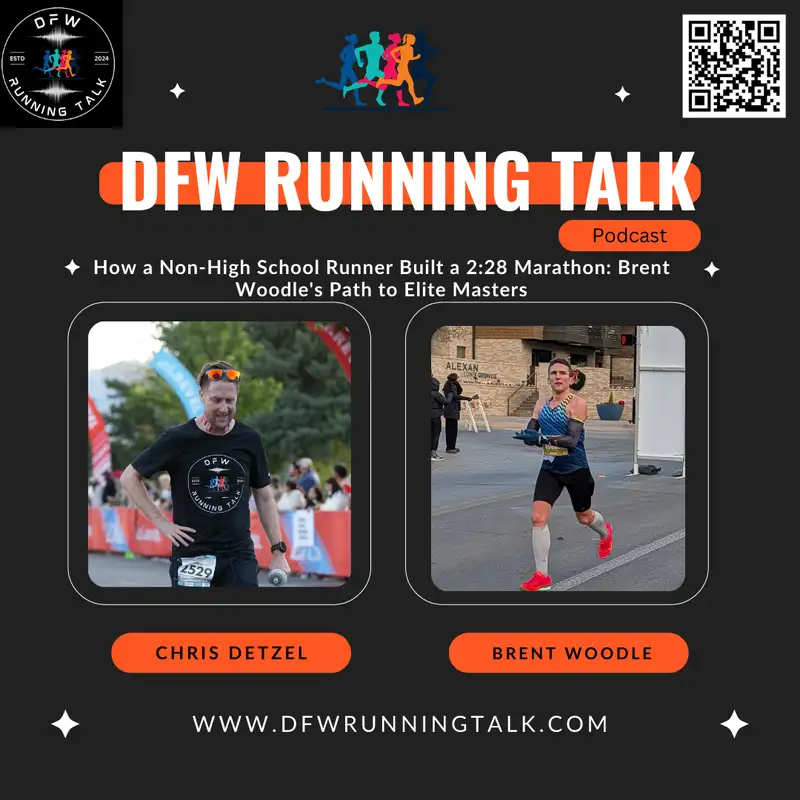
How a Non-High School Runner Built a 2:28 Marathon in Indianapolis: Brent Woodle's Path to Elite Masters
DFW Running Talk: Brent Woodle
===
[00:00:00] Welcome to DFW Running Talk. I'm Chris Detzel, so let's get started.
Chris Detzel: Alright, welcome to another DFW Running Talk. I'm Chris Detzel and today special guest and third time on Brent Whittle. Brent, how are you? I'm doing good, Chris. Thanks for having me on. How are you doing? Doing well. This is not your first time on, but it's your first time solo, that's cool.
Brent Woodle: Yeah. Yeah. I, the last time we talked, I think it was before the Houston Marathon, so probably a year ago, and a lot's happened since then, obviously. Yeah. We chatted with Javier I think last time, and he is not in Dallas anymore, so that's unfortunate.
Chris Detzel: I know. That's a bummer deal. Actually, the last time we spoke was on that.
There's four or five other people on from the Boston, or was it Boston? I don't know. Was it five people? That's right, yeah. Free.
Brent Woodle: Free Boston. Free London,
Chris Detzel: yeah. Yeah. So that's the last time. But yes, Javier was me, you and Javier, and it was a great conversation. You've done some interesting things over the last.
Several months and we're gonna get into that and did some [00:01:00] amazing things and so definitely get into that. One thing we haven't really talked about much was your background, not too deep. So before we talk about all these amazing things that you've done and. Before I say anymore, Brent is one of the fastest known master runners in all of DFW that I know of.
I'm not sure that there's anybody else faster from a 40 plus, and so that will just tell you what we might talk about. Later. Brent, tell us a little bit about when you got into running and why you got into running. How did it even start? Sure. So
Brent Woodle: I have I guess a relatively unique background for a competitive runner.
I didn't run when I was in high school or college. I think I did some half marathons. If I look back probably like in the 1 47, 1 50 range in college, just as hobby running to stay fit. And then after college started working and just wasn't into it. And then when I was 24, 25, I decided to move to Dallas.
I'm originally from [00:02:00] Omaha and I Makes sense. Started a job. Still have that same job. So I was like 16 years ago.
Chris Detzel: That's impressive.
Brent Woodle: Yeah. Thanks. And I didn't have any friends, I knew I always wanted to run a marathon eventually, just as like a bucket list item because I like to do challenging things and that seemed like a challenging thing, but I knew I would have to join a club and find running friends to do that.
So when I was new to Dallas and finding friends I. Basically joined all the different running clubs. There was like a run on social run, a Thursday night, social run up in Plano. And then DRCI, I think I did a few runs with 'em and ultimately a white rock running co-op. And over time, that collapsed down to just the two running clubs, TNSR and White Rock Running co-op.
And I made a lot of friends and ultimately ran a lot of races and trained with those groups quite a bit. Since then, it's been less of a group activity for me. I still mostly am friends with runners, but the running part [00:03:00] I've continued on, separately from the social aspect of it.
Chris Detzel: Did you do anything like in high school or college, like any other sports or anything or?
Brent Woodle: No, without going too much into it, I was into things that weren't very athletic at that time in my life. Okay. Like I definitely. So I'm a programmer, I'm a software engineer. Yeah. I grew up on my computer like every minute of the day. I was on my computer. I was into drinking a lot. And I don't consider that to be like I'm not a reformed alcoholic or anything.
But that was definitely what dominated my social life in my early twenties. And obviously that's changed, I think. I think that's a lot of, I didn't do a lot of drinking,
Chris Detzel: but a lot of people do.
Brent Woodle: Yeah, for sure. And I abnormal, I still drink more than most runners do. I would say it's just that running is probably more important now.
Chris Detzel: Yeah. And you got family too, so you can't party as much, I'm sure. Exactly. Yeah, a little different. And all right, you got into running and then like, how did you get 'cause you're pretty hardcore now, so how did you get so [00:04:00] just interested in becoming really good at it.
What kind of I guess the question is what made you realize you were pretty good at this? You started running and some people look, I think I'm decent at it, but I'm not a Brent Whittle. You know what I mean? Now that I know you, no, you're extremely serious. But how did that happen? Because you weren't that serious at first. You in it, that's kind of stuff.
Brent Woodle: Yeah, it's fair. So when I talked about running a half marathon in college and running like one forties, one fifties, that was just for fitness. When I got into it later, it really became a competitive outlet.
And this may sound silly, but before running video games was a competitive outlet. Like I, I played video games as competitively as I could. Definitely not the direction I wanted to take my life. So running, what's your favorite video game?
Chris Detzel: What was your favorite?
Brent Woodle: I played a lot of Warcraft. Three ultimately, world of Warcraft.
I rated, I played
Chris Detzel: World of Warcraft so long for so long, dude I think I played for 15 years and I got so obsessed and I had to stop because. It doesn't bode well for relationships.
Brent Woodle: Yeah, exactly. I actually had a lot of close friends in World of [00:05:00] Warcraft. We would travel together. Like when I lived in Nebraska, I would, I traveled to Austin a couple of times to meet everyone that's, and that was a lot of fun.
But none of those relationships really lasted after the gaming ended yeah. Didn't the game's
Chris Detzel: still there, by the way? A lot of stuff to it. That was such a Yeah, for sure. So anyways, that's funny because I play, we could talk about that all day and I guess we're here to start talk about running. All right.
You get outta that and got into more competitive running so it sounds like you get pretty competitive in whatever you might do.
Brent Woodle: Exactly. Yeah. It, for me, it's just I want to be good at the things I do. This applies to my career as well. Like I try to be really good at my career and. Running has really scratched that itch because when you start out, like for me, I would do all the monthly DRC races.
Yeah. Those are relatively cheap. They're still going on. I recommend that people do them or play no running clubs, monthly races, and you start to look at where you rank on the age group results. And so as I started to get. Better age group placements. I wanted to race more and try to place better, and then eventually [00:06:00] I got to the point at some of these races where I could potentially compete for the podium overall, and that was just hugely motivating to me.
Chris Detzel: Yeah. So yeah. I love that. Did you, like, when you're in some of these running clubs, did you ever have somebody that you ran with and that you always, like maybe you became good friends with, but you still wanted to beat him and they wanted to beat you, kind of stuff? Did that ever happen or?
Brent Woodle: I wouldn't, I try not to have that type of relationship with the people I run with.
Like just, I just find it, it takes the fun out of the social aspect of running, which is really important as well. But, there are people, Kevin Alloy is one, I would say, who I would run with quite a bit, and he would always push me. We would push each other on the typical WROC Saturday.
Where you go down Swiss and then come back up at, when we were coming back up Swiss, we would always be like six flat or sub six and then pushing it in the last few miles. So that's always been fun. And then there are all, people have come and gone from the local running community who run.[00:07:00]
Times that are close to yours and you're always looking at their race results and saying okay, how would I do in a race against him? Is he running the Dallas Marathon? Things like that. How many times have you run the Dallas Marathon? It's a good question. I don't know exactly. I think probably seven times.
Okay. Somewhere between six and eight times.
Chris Detzel: Yeah, it's, and did you ever do any of your quickest times on that? I just outta curiosity 'cause it's coming up. That's the only reason.
Brent Woodle: Yeah, I wanna be careful in how I say this. For a very long time I focused on the Dallas Marathon as my goal race. Like I wanted to win it and I never did win it.
I've never won a marathon, partly because I've had some poor performances there. Like it's a hard course and if you're trying to run. A PR time, it will just eat you up. And then partly because there are people who are like levels above me in the sport and occasionally those people run the race like Kolby, Mayman, I'm sure I'm mispronouncing his last name, but Kolby, everyone knows who Kolby is.
The year that he ran it and won it, like [00:08:00] I'm not in a race with him. Really? Yeah. Yeah. And it was yeah, it was always a little bit disappointing to me the years that I didn't run it, and I would see a time that was slower than what I could have run. Just feel like I'm sure it didn't work out.
Chris Detzel: Let's you've run it quite a bit of times and do you plan on ever running it again?
I know it's not a goal race, per se.
Brent Woodle: Yeah. So I will actually be running the Dallas Marathon next weekend. Oh, you'll, yeah. Okay. Like you said, it won't be a goal race. I'm gonna run it as, as fast as I can. I thought I would stay in shape after Indy more than I actually have, but we'll see. I still would hope to win the Masters at Dallas.
That's awesome.
Chris Detzel: All right, so you got into the community a little bit and I know that you're a big part for a long time of WRC and mentioned that you don't really run with groups too much anymore. Why is that? Is that just family and things like that work?
Brent Woodle: Yeah. It really boils down to trying to optimize my schedule.
We might talk about this a little bit later, but I'm trying to [00:09:00] get in as much volume as I can. You have time constraints with family and work. I've got a 4-year-old and a 6-year-old. That makes sense and. It's just easier for me to run from home most of the time. Like I, I could potentially drive to someplace to meet people to run, or I could run for 30 more minutes if I run from home.
So usually I just choose to run from home.
Chris Detzel: This year, so 2025, my hope is to get this podcast out before the end of the year. But is you've run India. I know, and we'll talk heavily about that race here in a minute. But what are some of the things that you did because you did some races before, like some halves and things like that to prepare for India.
Is that right?
Brent Woodle: Yeah. Not as much in this cycle as previous cycles. One of the things about training for fall races in Dallas is that it's really difficult to run good workouts or races before your goal race. Like two of my fastest races have been Chicago and Berlin. Both of those are early fall races, and this time around it was [00:10:00] Indy, which is maybe mid-fall race.
But in all of those it's just really difficult to get like fitness checks in, let's say. So this time around, I did run a half marathon. It was one of those in Irving, I think it was the, oh man, I'm gonna get the race name wrong. It's okay. I wanna say Toyota Music Factory, but I feel like that was the other one.
But anyways I ran a one 13 I was, I think, second place in that race. I was five minutes behind the winner damn, five minutes. It was a solo effort, start to finish. It was a relatively warm day. I paced it very well. It was even split with a kick at the end. So I ran a one 13 half leading into a 2 28 marathon.
A lot of runners will look at that and say, okay that's a weird split for me. It was more of a check of where I was with my fitness at that time. Yeah, particularly. With that weather, I knew that I was going from a place where I was out of shape, and so every [00:11:00] week I was getting, substantially better.
So I, I knew based on that one 13, that I was on a path to be close to PR shape, which is 2 28. And ultimately it, it ended up working out.
Chris Detzel: So let's dive into that. When you're trained for a marathon like Indie, 'cause you came in you did indie this year and did really well, but what does a, like a typical training day look like for you?
What do you, when you start. Kind of thinking about, Hey, I've gotta run indie. I picked that marathon. Walk me through what that looks like to, to you from the beginning to now or to race day.
Brent Woodle: Yeah, good question. So for me, the advice I would give to most people who really want to try to run a marathon very well is you want to be really consistent and get a lot of runs in.
And by that I mean like the number of sessions you get in. I would try to optimize for that. More so than even like total volume or like your medium long run length. Or your long run length. So wait,
Chris Detzel: so quick question around that. Do you think it's just the number of runs [00:12:00] rather than the volume of runs in the beginning?
Is that what you're saying? Or,
Brent Woodle: I think both matter, but the number of sessions is probably more important. Interesting. First, for a runner like me, like I, I'm definitely more endurance focused. Like slow fish. Yeah. A marathon.
Chris Detzel: Like really I've never thought about that. I just think five days a week, two days off kind of thing is that's what I do, i'm only doing half marathons, but still but you're saying like maybe twice a day, depending on, and you wanna get long stuff in, but. That's interesting.
Brent Woodle: Yeah. Yeah. And I, part of this philosophy is decoding the gurus. If you look at people who are successful you'll notice pretty quickly that doubles are a big part of it.
And a pretty common debate on running forums is, is it better to run a 10 miler or. Two, five milers and those are different workouts for sure. And I definitely fall in the side of two five milers. And the main reason is because you're less likely to get injured, you're gonna generate less fatigue.
So you can, interesting. I don't think the choice is [00:13:00] between seven days where you're running seven 10 milers, or seven days where you're running two five milers. It's running those two five milers lets you do more in the other days or run harder on the other days. And so it all adds up to, more training stimulus.
Chris Detzel: I like that
Brent Woodle: man.
Chris Detzel: But I appreciate you explaining that. I've never really thought about it like that at all. I just what most running groups or people do is. You run five or six days a week, especially for a marathon. The, from what you're doing, I know you do two a days and I've known that for a while, but I didn't understand that thinking behind that.
So it's quite interesting.
Brent Woodle: Yeah. So you don't get the opportunity to go back and be a beginner anymore.
Chris Detzel: Yeah.
Brent Woodle: I have some friends who are like not really big in the running community and the advice that I give them is, yeah, try to do two 30 minute runs a day if you can. And a big reason why I think that's something worth trying for newer runners is because I think it reduces the risk of injury, which is, that's always a concern for runners and for newer [00:14:00] runners, it's way more of a concern than for someone who's been running for 10 years.
Chris Detzel: You yeah, it's so interesting. Like I feel like I've just learned something that is I never thought, I never thought about it that way. And it makes me wanna think, maybe go try some of that. If you're doing a 10 miler one day, just do five in the morning, five in the evening and something that you've mentioned before.
Running slower at times and how important that is. What does that look like, during those, and then how much speed work do you do per week? If you were to,
Brent Woodle: yeah. Let me step back a little bit to the training day question because I feel like this is a really nuanced answer for me.
And I also want be clear that I train in a particular way because this is what I found works best for me. And it's not the way that I think everyone should train. Different people will have different needs for me right now, I start off every day with a walk basically. And it's time that I would otherwise be sitting on the couch.
Like I, I've gotta have my coffee go to the bathroom and everything. So if I'm in training, what I try to do is, wake up, [00:15:00] get my coffee, and then immediately just go outside and walk. For 20 or 30 minutes, and that ends up being pretty brisk. So whether you count that as running volume or not, I don't count it as a run on Strava, for instance.
I do think that helps get you warmed up. And I do think that there's a very light aerobic stimulus there. Then afterwards I do my primary run of the day, which will either be a workout or about an hour easy run, like maybe seven or eight miles. Used to be, that would be a 10 mile run, maybe even a 12 mile run.
But with the family schedule being what it is, I find it, it's easier to do 20, 30 minute walk, hour run, and then get on with the day. And then later in the day, either lunchtime or after work, I'll get in. A very easy run where like it's purely zone one. Like I, I start the treadmill at 5.5 miles per hour and I ramp up from there, but I never get my heart rate above one 10 in the evening.
Okay. Yeah, it's alright. [00:16:00] But to your last question, the morning run is more intense. So either it's a workout or if it's not a workout, it's zone two. So like the upper end of what your easy pace might
Chris Detzel: be. That makes sense. And then when be, so that morning or some of those mornings are your speed workouts, is that right?
Or there any specific kind of speed stuff that you do? Sure.
Brent Woodle: Yeah. So like most training programs, I try to break it out into meso cycles where there's a different focus for the workouts during different times of the training block. Although I find myself, and this goes back to what works for me, not necessarily advice I would give to other people.
I get a lot more out of tempo runs, and I don't get as much out of like maximal effort, like VO two max work. I don't wanna say like I shouldn't do VO two max work because certainly I should, but. The training to fatigue or the stimulus to fatigue ratio on that type of work [00:17:00] doesn't work out very well for me.
So I mostly try to run like tempo intervals. If you read Jack Daniels' book, he calls them cruise intervals, but just somewhere around like threshold pace and short reps with one minute between.
Chris Detzel: And then how do you think about, especially during your training cycle and runs and things like that.
How do you kinda look at nutrition and just on the run specifically? I mean on the training stuff?
Brent Woodle: Yeah, so this has been a hot topic in the running community lately. There's a lot of evidence that if you feel more during your workouts, you'll recover more and you'll be able to get in more training volume.
I think the way that I schedule my week with, I'm usually doing 13 runs or 14 runs a week, so I'm rarely running really. Like long runs to where the fuel would benefit me. So I don't feel as much during my runs. I will on, let's say like a 20 mile workout, I will bring a lot of calories on that and I'll [00:18:00] bring like somewhere between 70 to a hundred grams per hour of carbohydrate.
But for the most part, I run my morning run completely fasted. So I've really breakfast after I've been awake for three hours. Yeah. I always eat breakfast and then I go run. Oh yeah, I, yeah, I've always gotten dizzy if I eat and then run, really? I feel terrible. Yeah. Even on my doubles, I have to make sure that I don't eat anything for about three hours before my run or I just, I don't feel good.
I
Chris Detzel: get dizzy if I don't eat. So it's interesting that, because I'll wake up a couple hours before a run anyways, and then eat like an hour and a half, an hour before. Any run really. Whether it's race or any run. That's just my thing that I do. So I think it's interesting that you don't do that at all.
Some people can do that,
Brent Woodle: yeah. And it's a challenge for races yeah. I'm really big into race fueling, and we can talk about that if you want, but like I, I do, I maximize my race fueling and so [00:19:00] when I do race, I have to wake up at four in the morning. Yeah.
Just so that I can eat ahead of time.
Chris Detzel: So let's talk about that. We'll get back to training a little bit, I think, but is race day fueling? Since you don't eat much during your workout, so you don't really practice it. But yet you do something completely different on race day.
Brent Woodle: I practice it a few times, it's not a weekly thing, but Okay.
I'll get in two or three workouts every cycle where I would consider it like a race simulation. Okay. It's different of course, because you have breaks during training, which help to digest. I think one of the bigger issues with fueling during a race is that you don't really have that break. And so if you're over the edge it can be harder to digest.
But yeah, so I always, this has been a big focus for me, even. I'll say before the cycling community started making it really popular to like ramp up to that a hundred grams per hour level. I've always been pretty able to get down a lot of gels [00:20:00] without too many issues, and I've always thought that it helped my performance.
So it's always been a part of my, my, my game plan on race day, but now with the products that are out there, like the Martin one 60 gels and the three 20 drink, I found it, it's actually really easy to get in a lot of calories. And I end up bringing, for most marathons I'll bring four gels, 4 1 60 gels.
Okay? And so that's 640 calories. And then I start the race with a bottle of three 20 now. That sucks. I don't like carrying a bottle for the first three miles of a race. I try to get rid of it as fast as I can, but I also think you don't wanna drink that bottle of three 20 a half hour before the race, because then you're gonna have to pee at the starting line.
Yeah. And you really wanna get those calories in. So that's usually how I approach most races is start with a bottle and then have a bunch of gels done.
Chris Detzel: You mentioned you eat breakfast. Go ahead. What, before you get to Indy for breakfast, you mentioned that you get [00:21:00] up, really early and you eat a full breakfast, or what is that?
Brent Woodle: Not quite a full breakfast, I would say. Like the first thing I do is eat a bagel with jelly. For the most part, that's my go-to. It might be oatmeal with sugar, otherwise, but pretty much pure carb, like I, I'm not eating a full breakfast with like proteins and fats as well. Yeah. And then I'll also drink like a Gatorade.
I usually buy a Gatorade the night before.
Chris Detzel: Okay. And I try not, I drink a lot less before a race. Right before a race. 'cause I have to peel up, when you get older you'll see, I know you're now 40, but I'm 50 and it gets worse from that standpoint. So you really gotta think about stuff you eat mostly.
But. The stuff you drink, because there's been times, I'll tell you a little story and maybe you have something as you think about it, is one time I was running Houston half marathon, I went to the bathroom and everything else, and it's chilly that day and it's, when it's cold, sometimes you set to pee more.
Literally right before the race star, I started having to pee really bad. And you know how, those lines are really long and you're not gonna be [00:22:00] able to get into the line. And so I started and I saw, and after the starting line, I saw a bathroom. I was like, screw it, man. I'm just gotta go, man.
I got a PR that day, which was weird. I only take 10 or 15 seconds, but still, you gotta watch that stuff.
Yeah.
But I believe you man. What all so what'd you do then with Indy? You mentioned you were, you did something, I dunno if different, but how did that. Look, and then let's talk about the race at Indy.
Brent Woodle: Yeah, so the main difference is just as I aged into the 40-year-old master's division, my times qualified me for the elite master's division. I wouldn't qualify as an elite in the open field, and so the benefit of that is you get bottles on the course. It was the first time I've ever had bottles on the course, so it was nice because I didn't have to carry a bottle and four gels for the whole race.
I was able to. I basically had half bottles of three 20 at three different points along the course, [00:23:00] and they each had a one 60 gel attached to it. So I started the race with only one gel in my pocket, and I still got in I didn't add it up, but somewhere around 900 calories. Wow.
Chris Detzel: And did that work well for, obviously it worked well for you, so it's a tough question.
Was it different? Was it like, oh man, I wish I had this all the time, or,
Brent Woodle: I wish I had it all the time. For sure. Yeah. I, I guess some people aren't as bothered by carrying things. I try to carry as little as I can when I'm running. But yeah, it makes a huge difference the last few miles at Indy.
I think could have gone a different way for me because I was experiencing difficulty around mile 18 or 20, but I was consistent with the nutrition. I surprisingly, I would say, had a little bit of a resurgence where I started to feel really good again late in the race. Now.
Chris Detzel: Let's back, let's go way back because we're getting already in the end of the race, but let's go back to the beginning.
So we've talked about nutrition, and maybe we'll get back to that, at the end of the race. But let's talk a little bit about. When you started the race, 'cause you already [00:24:00] mentioned that you did a 2 28, so we know your time and that was to me, it's your fastest time at, it's a 40-year-old anyways, so but let's talk about the race, when you first started.
How do you approach it? Do you, how do you go out really fast? Do you see somebody you know and just hang, what did that look like for you and how do you approach those things?
Brent Woodle: Yeah that's a really good question. I think goal setting is probably the most important part of race prep for any marathoner.
I don't have any secrets for that. The trap that I always fall into, and I think you'll find most competitive runners fall into this, is that we think we're faster than we are. You just, you get so motivated. Yeah. Leading up to the race that you're like, yeah, maybe that workout indicates A two 30, but it felt easy.
I could go faster. And the last couple of marathons that I've run. Like at Peak Fitness, I've convinced myself that, I'm probably in 2 25, 2 26 shape. And that might have been true particularly like on a [00:25:00] course like Chicago briefly mentioned the Lincoln Marathon in May of 2024, I was on pace for 2 26 through mile 20, and I felt very good for most of that race.
But then. I lost those two minutes and I ran a 2 28, whereas if I had gone into that race thinking that I am in 2 28, shit. I would've run a 2 26 or a 2 27 because I would've been able to close faster. So it's always a mental battle. So true. Going into Indy, I was really confident that I was in 2 28 shape, but I didn't think I could run any faster than that, like maybe 2 27 high.
And that's just based on one workout that I ran where, so pulling back the curtain, 2 28 pace is five 40 pace per mile. I had a key workout, I think it was four by 5K, where I ran 5 35 pace, a negative, split it and felt great. Like it wasn't in perfect conditions. It was a bit of a hilly route. And so [00:26:00] I thought, yeah I can probably run about this pace for a marathon which is like 2 27, 2 28.
So I wanted to reduce the risk of blowing up, and I wanted to give myself the opportunity to. Negative split if I felt good. And so I intentionally used heart rate effort based training in the first half to not go too fast. Okay.
Chris Detzel: Interesting.
Brent Woodle: Yeah. So if I look at Strava I do believe that, until the last two miles, my first two miles would've been the slowest.
They were above five 40 and then. I got tucked in with a group, and when you're in a group, you let the group dictate the pace. And so by mile 10 I think I had gone down to where I was on like 2 27 pace and ultimately I stayed around 2 27 pace until mile 23, where I lost it. I ran 2 28, 26 in the [00:27:00] end.
Okay. So I was right there and. The last three miles were like 5 45. I lost it in those last three miles. I felt good. I felt fast. I felt like I was pushing myself, but I also wasn't looking at my watch. There's no way I could have run faster in those last three miles, but just didn't have it that day.
When
Chris Detzel: sometimes when you look at your watch like that, knowing already that you're running as fast as you can and it feels fast, if you look down at your watch and it's 5 45, and you were thinking you were hitting. 5 35 or five 40, you could probably really psych yourself up, in a negative way.
I think so. It's probably good that you didn't
Brent Woodle: Yeah, for sure. I know a lot of the times when I look at the splits in the middle like around half marathon, most marathoners will feel good, but you'll look at your PAC and go, oh God, I'm going way too fast. Yeah. Gonna have to pay for this later.
Chris Detzel: Yeah. And then maybe you will, maybe you won't. Marathon's a long ways. You've been doing it for a long time and, but you're happy with that time, right? I think you told me you were pretty happy with it [00:28:00] when I text you.
Brent Woodle: Yeah, I am. I am. So the background of why I'm happy with it, like I ultimately, I would like to pr so I would like to run faster.
Sure. But I had a really awful spring. We talked about this a little bit the last time I was on the podcast. I really. Psyched myself up for Houston in January of this year, January, 2025. Yeah, I trained really hard and then I got burned out before the race happened. So the last three weeks before the race, I was pretty burned out and on top of that I got What do you mean?
What do you mean you were burned out? I'm just tired of running in three weeks. Yeah. I don't know how to describe this, but it's when I'm in marathon training it's all consuming. And so every second of the day that's not focused on family or work is focused on, what can I do to make myself a faster runner?
I typically enjoy it. I don't find that to be a miserable yeah. State of existence, but it can just become too much. If you're doing that too often. You will burn out. And like right now, after [00:29:00] my indie race, I'm going through a down period where I'm not really focused on running and that's a necessary mental break.
And I feel like that absolutely.
Chris Detzel: It's a necessary, it's very necessary. Completely agree. Especially as intense as you are and a lot of us, so I like that. Anyways, go ahead.
Brent Woodle: Yeah. In the spring, I'd focused on Houston for so long, burned out, and then I got really sick before the race. Like I don't wanna overplay this, but I was very ill.
I had night sweats and shivers like the night and two nights before the race, so I don't know if it was a good idea. I ran the race, I ran a time that, most 40 year olds would be extremely happy with, and I was very unhappy because. I had trained so hard and I got a result that the way I looked at it was I didn't have to train this hard to get this result.
So like why did I do all the training? And then I went on a vacation shortly after that. So it was like a no running vacation and. I ran a few more marathons in the spring because [00:30:00] I had them scheduled and it was just I don't know I felt myself getting more out of shape, but I was still going through the motions.
So I ended up just having a good mental break after the spring. Good through the summer. And then by the time I started training for indie, in the mid-summer, I was very motivated again. And so I had a really good training block, but the problem is that I was too out of shape. When I started.
Like I mentioned, I ran a one 13 half leading up to the 2 28 marathon. That's because I was like one 13 half was probably the fitness that I was in. Five weeks out from the marathon, but I was still just continuing to get back into shape.
Chris Detzel: What would've in shape meant to you for, what time?
I guess for a half Were you thinking that you'd have been in really good shape? I'd be looking
Brent Woodle: for one 10 to one 11, like one 10 would tell me that I'm in PR shape for sure. Got it. One 11 is still really good though. I think I've only run [00:31:00] 1 10, 1 11 like two different times.
Chris Detzel: A fast one.
13 is a normal thing for you, I guess if you're not in eight, right?
Brent Woodle: I would say I've consistently been around that time for most of my career. And then hopefully you peak and you run faster than that.
Chris Detzel: What's as you I know you're doing Dallas Marathon and I don't know if this will be out in time, for that, but so no real goals there as it just go out.
You're gonna run hard, obviously, but hopefully you're not gonna be disappointed if you don't hit, 2 26 or something, yeah, no, I,
Brent Woodle: i'm not putting a lot of stock into any time goal. Okay. I think I'll be around a 2 33, 2 34. The most important thing to me is that I run smartly so that it's not a miserable experience in the last KI want to enjoy it and for me, part of the enjoyment of a marathon is running really hard at the end.
Yeah. So I'll try to pace myself based on effort. And then if you look at my Strava, I do show my heart rate, it's [00:32:00] available, and every race you'll just see, it's just a ramp up. So for me, that'll be like 1 45 at the start of the race, and then like 1 65 to one 70 at the end, which is. My heart rate almost never goes that high.
Chris Detzel: That means you're booking it, pushing it really hard.
Brent Woodle: Yeah. Yeah.
Chris Detzel: What, as we back up and just look at the over overview of running, what do you see as Hey, I wish I would've known this thing about, running and marathons and half marathons.
Is there something that you would've wish you would've known earlier? Lessons learned as you kinda look back, it's dang, I wish I would've. You know
Brent Woodle: that, that's a good question. Thank you. And it makes me think because there's a number of different things that I wish that I had known.
So I was a big advocate of Jack Daniels' training, Daniel's running Formula, and the key takeaway from that book in my mind is that you have to run at these specific [00:33:00] paces to train these specific systems like. You run at t Pace to train your aerobic threshold and you run at I Pace to improve your VO two max.
And so he has this chart laid out of your goal times for these various paces. And throughout most of my running career, I was unable to hit those paces and feel good, like it was always a struggle for me to. To hit the paces that I wanted to during his training programs. And these days you may have heard of like double threshold or the Norwegian singles training.
I think as a community we've learned that running a little bit easier threshold paces, so like a little bit slower than Daniels'. Daniel's as tea paces or as I. Call it myself. Usually it's seven out of 10 effort. I think that's been a game changer for me. So I'm able to get in like a high volume of total training and a high volume of running at threshold by running, a little [00:34:00] bit easier pace on my threshold runs.
And I feel like if I had been able to do that earlier on in my career. I would've been hurt less, I would've gotten more volume in, and I wouldn't have been as burned out when it came to races. That was always a really common thing for me. I'd show up to the race and I'd just be so tired that I couldn't run fast.
Chris Detzel: You'd be tired to the race. You gotta take time off, man, before the race. Yeah. I like that. That's, you seem I've worked with a lot of developers over my career. Some of you guys are extremely fast and focus in on specific. I feel like developers are the best runners, and I don't know why, but maybe it's just because you're so analytical, you're focused in on kind of the data a little bit, more than a lot of people in the, I feel like you're very analytical and very focused in on some of these things that, you've talked about.
One of the things you mentioned earlier that is that you ran. In a community. And I always bring this up on my podcast 'cause I see the big value of community. I do this [00:35:00] for work. And I love the running community. That's why I do this podcast. One of the many reasons.
But can you talk a little bit about what community has meant to you over the years? Of doing this? I know you mentioned you did it in the beginning and, but even now as you think about it.
Brent Woodle: Yeah. So early on when I was, I started running because I was looking for friends in a new city.
But I stayed in the running community because all of the people I met and became close with. We're very good people. Some of the people who I look up to the most in life, someone like Rick Simonson he doesn't live in Dallas anymore, but he was a big part of our running community for a bit.
And there are many others, but I haven't met a lot of bad people who are runners. And I do believe in that philosophy of you are the average of the five people you spend the most time with. I think people like Javier I spend a lot of time with him, and I think he is rubbed off on me in a positive way and yeah. Yeah. I look up to a lot of runners. I think all the runners who I've met have all been really good people, and so it's a community I wanna be involved in. Beyond that, just how it [00:36:00] might impact me in a positive way. We've always done fun things as a group. Back in the early days of the White Rock running co-op, there would always be group race plans.
Now that still happens with other running groups. Yeah. Like I know Pegasus does a lot of that. The slots are going to CIM. It's harder for me to do that now because my travel is more booked around family.
Chris Detzel: Yeah.
Brent Woodle: But as I get older and my kids don't wanna spend as much time with me, I'll be. Trying to find more group running trips.
Those have always been the best vacations that I've had. Yeah. And
Chris Detzel: I'll say, my wife and I, because she's a big runner in the community and we always do running trips we've booked I don't know, a year, two years ago we went to the Alps, and it was this trail running trip to where you'd go run in the different mountains in the Swiss and the French Alps.
For five days straight, and then one time we did this running trip, which was in Colorado, and it was 120 miles and a and six days with 20,000 feet of gain from one city to another, up and down these mountains. One day was [00:37:00] 25 miles. The next day it was 13 miles up the mountains straight up, that took you an hour and an hour just to go up a, a mile or two, and it's geez, what?
We wanna do those kinds of things. We, we run marathon, or I don't run marathons, but half marathons and things like that with the community within Dallas Fort Worth, but we also go out and do a lot of other things, trips and stuff like that. When I go to Boston now because of this podcast, like last year.
I just got it started, and I get to interview people or talk to people and I get to get more. And now a lot of people know who I am. And so it's, for me, it's more fun to go to Boston and see all these people that I know and run the day before with them for three miles, two miles, whatever they're doing, hang out, whatever.
I love it, man. And I continue to embrace that running community to do some cool shit. You know what I mean? Like I just. And I agree with you, man, and that's my hope for like WRC now is how do we get back to that? Yeah. Like, how do we get back to, going on trips, hanging out, doing that kind of stuff.
It it's changed a little bit over the last few [00:38:00] years, but, that's really what, to me, community is about. I, I didn't mean to hijack that piece, but community is, that's how you build relationships, man. Love your trip to the Alps sounds like heaven on Earth. To
Brent Woodle: me.
Chris Detzel: It was awesome. It was awesome. Just there was, it was funny 'cause I'll tell you a little bit about it. So it was five days, five nights or whatever in the Alps. And so we had a guide and four or five other, six other people went, but I didn't know these people. It didn't matter. They were same.
Level ish as us. You're in the woods anyways. And so it's nothing like the road, it's not like you're racing on the road or anything. It's not even a race. But, so every day you're in the ops, maybe it's seven to 10 miles, something like that. But then the last day was this race, and I accidentally signed up for some bullshit of 50 K.
And I don't know why I did that, but I was like, I'm not doing a 50 k after all of that, and but I should have signed up for a 20 k or whatever it was. And I just didn't do it. I couldn't, but I regret, that's the only thing I regret about that is that I signed up for the wrong race and I wasn't gonna do a 50 K because just too much.
Like I don't run that much anyways, for [00:39:00] that kind of fitness. So anyway, the point was, it was the coolest trip I ever took or. Maybe not the coolest, but a super cool trip that we took, together as a family. But you could do that with friends, Yeah. It's
Brent Woodle: yeah. So one, one of the first running trips I went on with the White Rock running co-op was in December of 2013, 12 years ago.
And we went to CIM, so we all ran CIM in Sacramento and we booked a limo to Sonoma for, it was like two hours. It was after the race. We were all cramped and it was not a SUV up in the scene, it was a car. So we were all struggling to get in, but it was like an hour and a half right up to Sonoma. We had an Airbnb downtown that was a house that had been split into three separate two bedroom units.
Yeah. And we bought out all three of those units as a group and one of the best weeks of my life, honestly. See,
Chris Detzel: that's what running brings, man. Your best life. I'll tell you one other story 'cause I think it's cool is not so long [00:40:00] ago, probably two years ago, I went to Utah to run the Rebel race. I did the downhill half marathon pr that one, that time.
But the point was I get there and I bring a friend, like from Boston, 'cause we worked together, and I said, Michael, you have to run this half marathon with me. He's never run a half marathon, I don't think. And I was pushing him to work out and he was ready for that half. And so got him excited and then.
Funny enough, I saw all these people from Dallas, from DRC that ran it as well, but they were doing the marathon and so they ran an Airbnb, we hung out with them, ate, did some things, so Michael and I, that's the guy that from Boston that I worked with, we did it. I ped and he, I don't know if he PRD or not, but he did really well.
He was very happy with this time. He had to leave and so we had to book it back to the hotel. But then that night I went, we went to park Cities, Utah, which is. I dunno if you've been to park cities, but this very beautiful mountain ish, amazing, super rich, where the super rich are, but it's so beautiful.
So we went with the DRC folks and just ate dinner up in this kind of on, on [00:41:00] top of this mountain. The view was a beautiful and amazing, and it's little things like that you remember. And I think that, and you do it with friends. That's, we should have a whole podcast just about hanging out with friends during runs.
That's just fun like that. Yeah. What do you, what's next for you? Whatcha you thinking about? I know Dallas, but that's not really your main, but as you think about it, are you doing Boston? What's kinda look like?
Brent Woodle: Yeah. So as a runner, you've gotta plan your marathons a year in advance.
So 2026 is mostly planned. I'm not shocked. There was a period of time I've been married to my wife coming up on 10 years and dated for a while Before that, there was a period of time where all of our trips were running trips, and so she voiced the opinion, her opinions that, maybe we should do some vacations that aren't related to running.
So we've avoided running trips for the past few years.
Chris Detzel: Yep.
Brent Woodle: So just as an example I did Boston and Indie this year, and both of those races I went to alone and I flew back the day of the race, which [00:42:00] is fine. I'm there for the race, but we are going back to our roots next year. We're going to Paris for the Paris Marathon.
Yeah. She's not running it. She has run other marathons in the past, but I don't think she's interested these days. But we have. Her best friend, there's a couple who are runners who are already planning on going to Paris and running the marathon, so we're joining them. I'll run the marathon, I'll start training.
I'm gonna stay down from now through my birthday, like on January 12th, and then I'll have 13 weeks to train for Paris. And then after that I'm signed up for Chicago, which is where I have my pr. And so go back to it
Chris Detzel: then.
Brent Woodle: Yeah, it, I'm not gonna set too lofty of goals. I'll be 41, but I think that both of these races will give me the opportunity, if everything goes right to run a pr I still think that's a possibility.
Chris Detzel: Yeah. I think so. I know you're, do you feel like from an age standpoint, do you feel your body kinda. Slowing [00:43:00] down or, not, what does that look like for you right now?
Brent Woodle: Last year spring of 2024, age 39, I felt like I was the fastest I had ever been. Like I didn't get a pr, but I still felt like I was in the best shape of my life.
This year, I won't say I don't feel as fast, but I also don't feel like. I don't feel old. I don't feel like I'm slowing down. Point I would make, is that I do work a lot harder in terms of both training, volume and discipline outside of training. Like I watched my diet. I don't drink during training.
I really do. I try to do everything right during training and when I was younger I didn't have to do everything right. That's true. We'll see, assuming that I can do everything right and not burn out for 13 weeks, then I still think that I have the ability to get in my best shape.
Chris Detzel: 13 weeks.
Is that a normal training cycle for you?
Brent Woodle: Yeah, it is. Sometimes even as low as 10 weeks, but I like to do somewhere between 10 to 12. [00:44:00] Was actually longer. Indy was 15, but I had a break in the middle. I had a one week break in the middle.
Chris Detzel: So as we go through this lull, I know you're doing a marathon here in a week or so, but.
Do you are, do you like just chow down and drink a lot, just from here till January or not, what's that look like? Because, I was gonna ask him to go out for a beer or something, so
Brent Woodle: I will drink that. That's one thing. I had 15 weeks of no, no booze with indie.
The last thing I want is to take two weeks off, sorry, two months off. Between races, which is kinda what I'm doing, and get really outta shape because then I'll have the same issue in that it'll be a
Chris Detzel: tough 15 weeks or 13 weeks. Yeah.
Brent Woodle: Yeah. I, and I won't be able to hit a new ceiling if I give up all the gains that I've had.
So I, I don't know. I. I'm just trying to be balanced, yeah. Not completely ignore my friends.
Chris Detzel: Yeah. And your wife and stuff. So as you start, all right, so we've covered a lot of ground and I appreciate you coming on. Is there anything that, you were like, man, he should have brought this [00:45:00] up and we didn't really talk about this thing.
Is there anything that you can think of that we should have talked about?
Brent Woodle: The last, a couple of times we've talked, I've thought, man I wish we would have talked more about training. Yeah. Because that's a topic that I love to talk about and I think I have maybe a unique view on it, but honestly we covered all of the training aspects.
Chris Detzel: Is there specific, yeah. Is there specifics that we didn't cover that you wanted to be more, that you wanna talk more about or not really? Or did we just cover it pretty heavily?
Brent Woodle: No, I think that we covered the stuff that I think is important. It's a habit. You need to, the more frequently you can run, the better.
You wanna try to optimize recovery. We didn't talk about sleep. That's always been, like, I've always slept eight hours a night and that's just huge for me. I think that's
Chris Detzel: one of the most important things is rest.
Brent Woodle: Yeah, and I know people who run high volume and who get by on six hours of sleep, and I just can't imagine it.
If I have six hours of [00:46:00] sleep I really can't function especially too many times,
Yeah. I think it goes back to. I mentioned one of the first things, I've had the same job for 16 years. It's now a work from home job. It's never been overly stressful. And so having that real work life balance taken care of at work, having a very stable family life, I guess just a consistent routine for basically the entire time I've been running has been perhaps the most important thing.
If I were to change jobs right now, I would. Probably take some time off of running and that, that would make it really difficult to even think about getting back into shape.
Chris Detzel: It's hard. I just, I've just had to do that five months ago and now that I'm ramping up with the job, it actually is getting busier because I'm building this thing, within the company.
It's true like you have to reestablish yourself at a job and wherever you go, right? You've had 16 whatever years of. Same, not the same job, but the same company. You've [00:47:00] already built that up. They know you, they know how good you know your stuff already. When you go to a new company, man, it starts all over.
Yeah, maybe you make more money, but that doesn't mean that you don't have to start all over. You know what I mean? So it's tough. Yeah. It's not easy, it's
Brent Woodle: if you're ever gonna put in the extra work to impress people or just get more done. Yeah it's when you're new.
Chris Detzel: Well, Brett, this has been really good. I really appreciate you coming on and telling us your story. And I think the training piece is huge because, obviously you've seen some gains and you're, one thing that I've learned about you is you're very consistent in all aspects of your life.
Whether it's work or running kids, I mean everything. So it's pretty impressive. I love it.
Brent Woodle: Thanks Chris. This is actually, this has been a fantastic conversation. I'm really happy you invited me on.
Chris Detzel: Cool. Thanks everyone for coming on to another DFW Running Talk. I'm Chris Tetzel, and don't forget to rate and review us and go to DFW running talk.substack.com and subscribe to our newsletter.
We also have a YouTube channel, YouTube at, or I mean you can find it. Brent, thanks again for coming on. [00:48:00] Really appreciate it. Yeah.
Creators and Guests