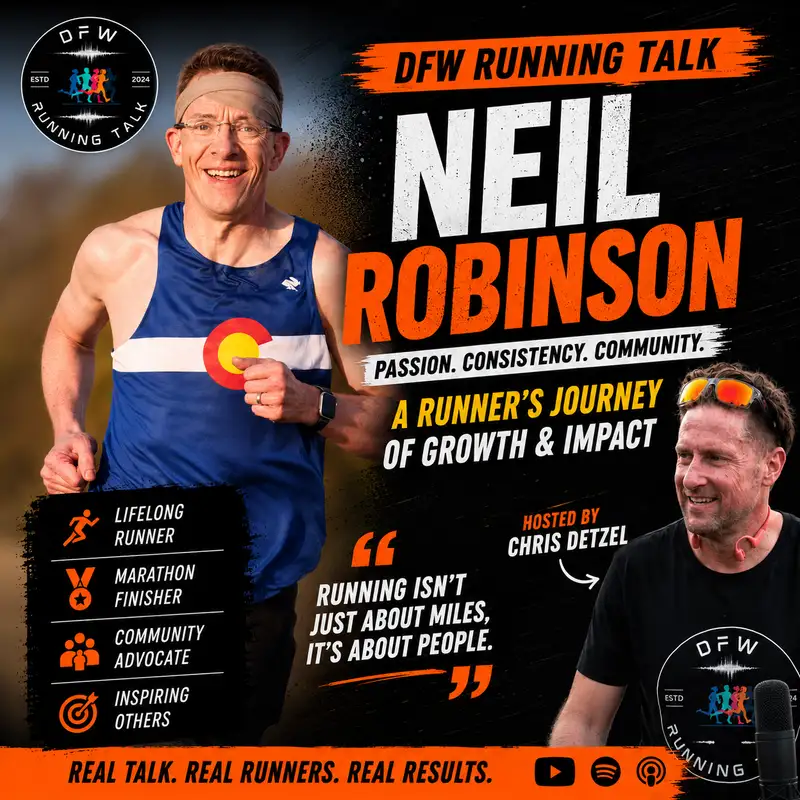
DFW Running Talk: Neil Robinson
===
Chris Detzel: [00:00:00] Hey, DFW runners. It's Chris Detzel here with a quick update. So for almost two years, I've been putting out episodes almost every single week nonstop. So I'm gonna take a little summer breather for the first time. So DFW Running Talk is going on a short break starting mid-June through the end of July.
We'll be back in August, and I'll have fresh episodes, new guests, and more of the stories from our running community that hopefully you've come to love. ~You are still listening, so that's good. Look, we all need quick breaks, and honestly, two years of weekly episodes while building this thing alongside everything else has been a grind, but I'm very proud of it.~
~So I want to come back in August recharged and ready to bring you the best content yet. So I may also put on, uh, the newsletter on pause, so don't be surprised if your inbox is a little quieter. But in the meantime, uh, the backlog isn't going anywhere. I've had a hundred and fifteen-plus episodes, too, so revisit them on Apple, Spotify, YouTube, wherever you listen.~
~Uh,~ the Facebook group is kinda buzzing, so that's good. Instagram, I always post there, so if you haven't followed us on Instagram or Facebook, please do. I'll be out White Rock running. ~Uh,~ come say hi. Thanks everyone for two years of listening, sharing, and showing up. See you in August. Keep it up.
Welcome to DFW Running Talk. I'm Chris Detzel, so let's get started.
All right, welcome to another DFW Running Talk. I'm Chris Detzel, and today's special guest is Neil Robinson. Neil, how's it going?
Neil Robinson: I'm doing well. How are you, Chris?
Chris Detzel: Appreciate you getting on, [00:01:00] and this is your first podcast, right?
Neil Robinson: Absolutely.
Chris Detzel: The first time I met you was at a, I think it was at a White Rock Running Co-op run on a- That's
Neil Robinson: uncertain
Chris Detzel: Saturday. Maybe it was Saturday. I don't remember.
Neil Robinson: Almost certainly a Saturday, 'cause that's usually the only day I can get down.
Chris Detzel: Yeah, you know what? I- w- that's right because I was running and I ran with you the first time, and I was asking you a bunch of questions, kinda like what we'll do today. But I was like, "When'd you start running?"
"Are you new to White Rock Running Co-op?" And you're like, "Yeah, I live in Plano," and all these things. But since then I've got to know you a little bit, and one, you're a fan of the podcast, so I appreciate it. So-
Neil Robinson: I get a lot out of it. I really enjoy listening. You do a great job, and the people that you- Sure
have on are fascinating. I learn a lot from them.
Chris Detzel: Me too. That's why we have them on, but I think a lot of people can learn a lot from you. And so yeah, I appreciate you being a fan but also appreciate you getting on. And today what we'll do is tell a little bit about your story. Before we do get into that, did you run in high school or, were you into sports?
Things like, tell me a little bit about... Let's start back. [00:02:00] Yeah. You and I are about the same age, but we don't have to go back that far for long.
Neil Robinson: Yeah. No, it's fine. I grew up in the Denver suburbs, and so I was probably more into individual winter sports than anything. Yeah. I ice skated for a while when I was a kid.
I, I was probably skiing was the thing I was best at, but nothing really competitive. I was-- I did, soccer one year and was terrible. I was the worst guy on my high school tennis team for two years. Okay. They just didn't cut anybody, so I never really seriously an athletic person. I played-- I enjoyed playing racquetball when I was in college- Yeah.
Love racquetball ... and did a little bit of that when I was in graduate school. I guess I tried when I was-- I went to graduate school in Chicago, and I was-- the marathon is such a big deal there, and I thought I have time as a graduate student. I should try and do running." And I looking back on it, it was so stupid.
I just found, this is like the late '90s, so somewhere on the internet found the Hal Higdon, you know- Yeah. Love Higdon ... and I just went straight in, no base, no foundation, terrible tennis shoes that were probably, years of use. And [00:03:00] so the inevitable happened, which is I ran until I got injured.
Like I just- Yeah ... kept adding a mile on the weekends, and I think I got up to 13 or 14 miles, and I was out, on the lake and, on the trail that runs along the lake, and just my knee gave out onto me and I had to walk all the way back to my apartment. And I waited a few weeks and, tried to let it heal up, and then went r-right back out again and got myself injured again.
And I thought that's good." Interesting. "That, I've learned my lesson. I don't need to be a runner." That's fine for me." And so that was it for quite a while.
Chris Detzel: So graduate school, where'd you go?
Neil Robinson: The University of Chicago. It was in the English- Okay ... department up there. Yeah. So
Chris Detzel: you went to Chicago.
When'd you move to Dallas?
Neil Robinson: We moved here in 2002. Okay. My wife is from here. She went to Lake Highlands High School in Richardson, and her- Yeah ... her folks are still in that neck of the woods, and we moved here to be close to her family and when we were ready to start ours. And, she'd moved up to Chicago to be with me for, seven or eight years, and my turn to reciprocate.
So we-- so moved down to Dallas in 2002 and then up to Plano in 2003, just a few months after our son was born, and we've been here ever since.
Chris Detzel: How many kids do you have? [00:04:00] I'm
Neil Robinson: just curious. Two. I have a son who's 22. He just fin- just about to finish his first year teaching at Plano East Senior High School.
He teaches- Nice ... social studies, and then my daughter is a sophomore at Trinity University just finishing up her second year there.
Chris Detzel: So when did you get into running? When... you kinda did that at, in graduate school, you kinda quit. What, when did you start again?
Neil Robinson: I think, so in 2014, I just turned 40, and the kids were, like, 11 and 8, and so we stopped.
We had enough... they were independent enough that we didn't have to play man-to-man defense in the evening. They- Yeah ... and so I started having a little bit of time, and I started feeling more and more out of shape since I was 40, and I thought, "I gotta do something." Yeah. And I was like, "I know that running is something that I can do I can fit it in."
So I would just go out three nights a week, half an hour. At first just kinda run, walk. And, but I kept in the back of my head I will get injured if I do something more serious. Like what I learned from my Chicago experience. So- By three weeks,
Chris Detzel: you kept doing the same thing?
Neil Robinson: So I just I just religiously would go out [00:05:00] three nights a week for half an hour, kinda run, walk, and I kept that up until about 2018, was probably about the time when I finally was, like, running most of the time. That I was going out, but still only three days a week, and I just kept that up.
And I hated it. I didn't enjoy it, but it was convenient, and I was feeling in better shape, and so I j- and it was... I just kept it up. And I think the... When things really switched for me was when the pandemic happened.
Chris Detzel: Before we get to that- Yeah ... what do you think about... Because I, I think that as I've been running for a long time as well, and funny enough, it was about when I was 37-ish, I got a divorce, and I was- Yep
overweight. It f- it feels like that 40 mark seems for men s- specifically, like some women, it s- seems for us, a lot of those guys, start getting into running around that age. For whatever reason, they're like, "I don't have any more kids," or at least the kids are grown, like 15, 10, whatever, like you said.
They can kinda get along theirselves, and that's just when the... I don't know if you've seen that yourself, but I've seen that a lot. I was-
Neil Robinson: Yeah, definitely. [00:06:00] And there's something about that suddenly was when I just put on 10 pounds without even trying. Yeah. I don't know, something about the metabolism slowing down, and it was like, oh, I gotta nip this in the bud.
My-- I don't know whether you need this or not, but my dad d- died of a heart attack, like, when he was 55 years old. He had his first- Wow ... he had quadruple bypass surgery when he was 38, so I think there was something in the back of my head that was like- 100% ... let's make sure that, I address this before it becomes a serious issue.
Chris Detzel: Was he overweight or just didn't work out
Neil Robinson: or? He was-- it was everything. He smoked, he was overweight, high, high cholesterol, high blood pressure- Yeah ... didn't exercise. He did quit smoking after he had the quadruple bypass surgery and but yeah, he d- he just wasn't as active as he would've liked to have been,
Chris Detzel: yeah. And hey, whatever it takes to motivate us, I certainly-- All right. So you got into running a little bit from 2014 to '18, a little, and then COVID happened. So what happened after that?
Neil Robinson: Yeah, I was... we-- I work for SMU, have worked there for about 12 years, and we were home for only about three months, but March through June, and I [00:07:00] was just feeling so-- like, after a couple weeks, I was just feeling so tired in the afternoons and just didn't have any energy.
And I thought maybe I should switch my runs to the morning, and maybe that'll make me feel better. So I started running every weekday in the mornings. Again, just half an hour and then it was like, oh, that made a huge difference in my mental health. It made a big difference in my energy level. And so that was kinda the time when I started to feel like maybe I really like this, maybe it's really valuable to me and s- and started to get into it.
Not that I really picked up the mileage that much. Yeah ... I was probably running, 400, 500 miles a year in that period of time. That didn't really change, but it definitely changed my attitude about things.
Chris Detzel: That's-- It took you five years to do it.
Neil Robinson: Yeah seven years probably befo- before-- of running before I finally would, would've thought of myself as a runner.
Chris Detzel: Did you do any 5Ks or anything? Just
Neil Robinson: to kinda- No. I think my first 5K, SMU did a, They've, they have A 5K they've done several years. The first year was in 2021, and they did it as a virtual event, like April of 2021. So I [00:08:00] just ran in Plano, you just had to send in your Strava thing.
That's how I found you. That's how I got on Strava, was I needed to prove, what my time was. Yeah. And so I just sent it in, and it was, I took some notes. 24:34, so like just under eight minute- Pretty good ... per mile pace, and I was-- I finished second place in the masters division. The guy who was the athletic director at the time, Rick Hart, he was the first place guy.
And so I was like, "Oh, that was surprising. I totally didn't expect that." But that was the first time I'd done a race. And then in-- The first time I did a real in-person race was the next April, and again, it was the SMU race on campus, and I think I was like 23:50 or something, so maybe, gained like 30, 40 seconds or something like that.
But- Yeah ... but that was when I first-- Maybe 2022 was when I really started to think about, as a result of those two races, maybe I should start doing a little bit more. Started, running more on Saturdays, adding a little bit of mileage to it, and started to think about maybe trying a longer distance.
Chris Detzel: Did you run with anybody, or was it still by yourself?
Neil Robinson: No, still by myself. I really didn't start running with [00:09:00] anybody until October of 2024 was when I start-- was the first time I ran with White Rock Running Co-op.
Chris Detzel: Did you get smarter about the shoes and gear and things?
Neil Robinson: I did go to the shoe store, get outfitted with, something.
I was pretty bad pronator when I first started, so put me in some brick shoes that were stabilizing and started to work on improving my form a little bit. Still had a lot to learn about picking up the cadence and stuff, but at least knew to change out the shoes every 350, 400 miles to try and prevent the injuries from happening, yeah.
I feel
Chris Detzel: like that's probably the number one thing that people, they might not know at first, or- ... these shoes, and they'll just use the same shoes over and wonder why their feet or ankles or Achilles or calves start hurting all the time. That's right. That's right.
You know- Yeah
Shoes, yeah. That's an easy fix.
Neil Robinson: And have you replaced them anytime recently?
Chris Detzel: Exactly. That's pretty simple. There's a lot of other factors I could go into, I guess- Absolutely ... but all right, so before WRC, but [00:10:00] you said you were kinda getting into it, wanted to do a little bit longer and ran longer on the weekends.
Did you start training for half or something like
Neil Robinson: that? Yeah, I think, I guess maybe by Febru- I worked my way up January, maybe February 2022, I was maybe-- That was pr- I think the first time I'd run 10 miles since, back in Chicago. And I think in August was probably the first time I ran a half marathon length.
And I thought, "Okay I'll pull out the Hal- go back to Hal Higdon and pull up the schedule and- Yeah ... and see if maybe I could do a half marathon." And I looked at where I was in the schedule, and I was like, "Oh, I could probably try and do a full marathon." The smart thing to do, of course, would've been to do the half marathon, but I thought, "Well-" always do that.
I'll be smart." So I thought I will-- I'll si- I'll try to train for the Dallas Marathon in December of 2022, and I'll see how it goes, and if it, if I can't keep up with it, I can always drop down and do the half marathon." That, that was my thinking. And so the training went pretty well.
I did-- In November, I did my only 20-mile run, which was, like, a nine, [00:11:00] 9:15 pace kind of thing, and so that kind of gave me a good guardrail. I thought I could maybe try and go out and break four hours the first time," was the goal.
Chris Detzel: Sure.
Neil Robinson: And and I had a miserable day when the race hit, so
Chris Detzel: What happened?
Neil Robinson: It was a, that was a warm year. 2022 was a warm year, and- Is that- ... the first half went pr-
Chris Detzel: No, I didn't. Mine,
Neil Robinson: no What'd you say? I
Chris Detzel: was thinking that's when I ran it, but no, I ran mine in 2018 or '19 or something.
Neil Robinson: Oh yeah. So first half went pretty well, like 153 so like- Yeah ... 835 pace.
But my leg started to feel tired like 10, 11 miles in, which hadn't happened on any of the long runs. And then mile 17, I started having what turned out to be, like, IT band pain. Yeah. But I'd never had that before on my right leg, and so I had no idea what was happening to me. And I tried, walking some and then, kinda alternating between walking and running.
And then I think after mile 22, it was just so painful that I basically just walked the last four miles. I saw a friend of mine from work along Swiss, stopped and talked with her for five minutes. And, I just felt so silly. It turned out to be a beautiful day, and [00:12:00] I was just walking the rest of the way in.
So I d- I finished in four hours and 53 minutes. But it the, it was just a miserable day, and I said that's it. I never need to do another marathon again."
Chris Detzel: It probably-- The last four miles probably took you 20 minutes a mile or something,
Neil Robinson: exactly right.
Chris Detzel: I remember that I did this marathon one time.
It was my last marathon officially. It was, I think it was Dallas. And so I was running it, and it was 70 degrees at the start, so it was hot. But I was running, the 320-- with the 320 group. And so I was pacing the 320 group, I think. And I was like, "You know what? I'm just going for it."
And so I ran, 140, 141 for some. I started feeling it at 13, 14, yeah. And probably mile 20, I was like, I started walking and-
...
Chris Detzel: Then I would go a little bit, but mile 23, I was dying. Literally- Yeah ... I'm just trying to get through it. So I start walking, and I remember my wife going, "Come on, Chris."
He passes me 'cause I was way ahead of her. Then I wasn't. I was [00:13:00] like, "Ah, just leave me alone." She said, "Okay, whatever" and leaves. So 'cause I was not in a good... And then somebody slapped me on my ass, and they're like-- I was like, "Oh," I don't know. I thought I was dying, literally. "Go Chris," that kind of thing.
Yeah. And then I remember one of those miles was 20 minutes. I was like- Yeah ... "Holy cow," "I'm never gonna get done." I'm gonna... It's gonna take me 40 more minutes if I do- ... two more like this. So I had two more. So I jogged it in, got maybe an 11-minute mile, the last two.
Neil Robinson: Oh, that's
Chris Detzel: strong.
So basically, I ran that last half marathon two hours and 19 minutes. Yeah. So the first one was 1:41, the next one was 2:20 or 2:19. So I still did under four, but it was 3:59.
Neil Robinson: Yeah. Yeah, my, my first one it was 1:53 for the first half, and then three hours for the second half.
Chris Detzel: Oh, God. Yeah.
Neil Robinson: That's
Chris Detzel: even worse.
Neil Robinson: But I saw my wife and daughter had come out to... They were at Boy Scout Hill, so maybe right around the 14-mile mark, and they had signs, and I was so happy to see them. And then I was... I, they went to the finish line [00:14:00] to, to see me, and I had to keep calling them on the cell phone being like it's gonna be- Lucky them
a little longer. It's gonna be a little longer before I finally get there." But they were nice enough to wait for me,
Chris Detzel: oh, man. What a story. It brought back my story. Yeah,
Neil Robinson: yeah. It's
Chris Detzel: terrible, actually. I haven't done a marathon since Well- ... officially. I've done
Neil Robinson: plenty- you don't need to. You don't
Chris Detzel: need to.
You're, you're- I'm cured. I don't know, but for you, the journey keeps going, so let's keep going. Let's-- So all right, you said, "Oh, I'm done," "That took way too long."
Neil Robinson: Yeah, so then I said I'll, I'll-- maybe I'll just do half-marathons." Maybe that's, 'cause I was just trying things, so that was more my speed.
So 2023 through 2024, it was all halves. So I did Too Hot to Handle. I did the, in, in June. I did the Tour de Fleur in September. I did the Dallas Half in December of 2023, which was a beautiful day. That's one of my very favorite memories of racing. It was, like, a c-cold day.
Chris Detzel: Yeah.
Neil Robinson: It was, like, just gorgeous and, like- Yeah
I think that-- I took it eas- I was a little slow at the beginning 'cause it was so crowded, I was b- in the back of the first [00:15:00] corral. Yeah. And but then, on the downhill on the second half, I was just able to kill it, and so I think I finished in 1:39 change. I, that was just a great day.
And then I did the Irving Half Marathon in March of 2024, and then and then I did the Tour de Fleur again in September of 2024, which was a bad day, again, hot and humid. But- ... a really important day for me because I was trying to run the 1:40 group, and Javier Trio was, was- ... one of the pacers in that group.
And then I, couldn't hold on in the conditions, and I was I got dropped about halfway through the race, and I was having one of those sort of dark night of the soul, why am I doing this, kind of things. And then was like, wait a minute, you're out at the lake.
You got a body to do th-that can still be out here. You're gonna go poke around the arboretum with your wife after the race and have a good time seeing all the, Snoopy, Yeah ... stuff that they had. And then, so I kinda picked it up again, and then the 1:50 group came by, and [00:16:00] Julia Lenot was, was- Yep
Pacing with that group. And so after the race, and I held on with them till about the spillway and then did the last mile on my own. And then after the race, I reached out to Javier and to Julia on- Strava, and, just to thank them for pacing and appreciated them. And Julie was really kind and wrote me back-- both of them, Javier said, "Just so you know, it was a tough day for us pacing, too," which was nice to hear.
And then Julie wrote, and she's "You really should come run-- like running by yourself, if you're not running with people, you really should start running with people." Love that. And she was nice enough-- So that was in September, and then mid-October, I hadn't done anything about it, and she wrote me back again and said, "Are you gonna come out?
You really need to come out and run with us." And I said I got-- I have plans this week, but I'll come next week." And I made a commitment to her, so I said like October 26th or whatever, 2024, I said, "I'll come out." 'Cause, yeah, I live in Plano, as we mentioned earlier, so Saturdays are really the only day that I can get down and run with a group.
And Julie wasn't-- [00:17:00] I think she was out of town that weekend, but she, posted on the Facebook group and said, "Neil's running 20 miles," 'cause I was trying to work my way back up to do the Dallas Full in- Okay ... in December of 2024, and so I had a 20-miler that weekend. She said, "Neil's running 20," and she got me connected with Mark Rich- Yeah
and Cheyenne Meyer and Chet MacArthur. And and so we did-- That was my first run with WRRC, and it's really interesting 'cause those are people-- all three of those people are people that I run with very frequently now. Yeah. And Julie was really critical in, in making that happen for me, so that, that's-- The whole WRRC thing has just been transformative for my running.
Chris Detzel: So we'll talk about that in a minute because I do think that community piece is extremely, is important. I always talk about community. All right. So I love that. I love that piece. Gives me some ideas. Julie just knows to kinda do that and push, and that's how she kinda has grown that group, over time.
And I think that th- that means a lot for somebody to kinda come out and actually
Neil Robinson: reach out to- Yeah it- You
Chris Detzel: reached out to her, but then she [00:18:00] said, "Ah."
Neil Robinson: Yeah I did the kind of, introverting, l- little comment on Strava kinda thing. Yeah.
And, but it was really intimidating for me, like the idea of going and meeting a new group of people, especially like running, I felt are they all gonna be faster than me? Are they gonna be kind? Are they gonna be- Yeah. I didn't know what to expect, and I was-- I just remember driving down, even maybe the-- even through the fourth or fifth time that I would drive down, I would still feel nervous, in my stomach on the drive down, worried about it.
I don't know why. I guess it's just, my personality type or whatever. But her, saying, "We really would like you to come. It-- You really should do this." And, obviously she's an accomplished runner. I could see, she's the kind of person- Yeah ... who could pace a race. It's it was really encouraging and kind.
Chris Detzel: Yeah. Yeah. It's an interesting thought or it- interesting that you said that, because sometimes, when you're in a group for a long time, you don't think about some of the new people in the group. And I do think it's important for folks that have been around to welcome others, 'cause it's not always easy, right? If you see me around going, saying hello to everybody, and-
Neil Robinson: I think that's
Chris Detzel: so nice that you do that ... easy to miss somebody. Yeah, but sometimes I'd miss somebody or something like that, and I'm like, "Oh, shoot, I should've [00:19:00] said..." So I'm glad she did that, and I'm glad that you stuck with it, and that's pretty cool.
I really love that story. It's a great lesson for all of us, to be honest.
Neil Robinson: Yeah.
Chris Detzel: What-- So you decided you're gonna go for another marathon. What made you decide that when you had such a bad race last time?
Neil Robinson: I think the, having had some success with the half-marathons and feeling like maybe there was some unfinished business there, and maybe, it was a opportunity to do, to do something a little bit better and try again.
I don't know. It was-- not that I had a-- didn't have a particularly good second marathon either. But, I had-- Part of that was I di- I hadn't ne- I still had not really built that strong aerobic base that you need- Sure ... to be effective. I didn't know anything about nutrition, But I guess in October of 2024, in addition to being when I first started with WRRC, since I was listening or, on the Facebook group, Andy Wheatcroft had posted that he had been on that Extra Miles podcast- talking about his running journey. And so I listened to that, and he did such a good job of talking about the [00:20:00] importance of, slow running and really building the aerobic base, and I on the weekend did a deep dive into some-- And I was like, "What does he mean by Zone 2 running?
I don't really understand." I wanna know what he
Chris Detzel: means too, because that guy's sitting there sprinting on every single run, it seems like.
Neil Robinson: You do what he says, not what he does.
Chris Detzel: Yeah,
Neil Robinson: exactly.
Chris Detzel: Yeah.
Neil Robinson: I'm one of those things.
Chris Detzel: No,
Neil Robinson: He's c- he's a good one for always complaining about what the pace is, you know-
even when he's the one out in front pushing it,
Chris Detzel: yeah, that's right.
Neil Robinson: Yeah. But when I went down the rabbit hole, internet rabbit hole to learn more about this, it was like, it explained so much about the struggles that I was having, where it was like- ... long runs would just zonk me. I would feel so tired at the end of a, long run on Saturday, and it was y- I just didn't have the base.
I wasn't focused on slow running. Yeah. So I kinda just threw out the Hal Higdon plan, and just from October 24 to February of 2025, just focused on getting that Zone 2 running to be much more efficient, and it moved from where, an easy run for me was, like, at a 9:50 pace- Yeah
which felt glacially slow and so [00:21:00] frustrating to run at that pace. But by February, that same level of effort was, like, 8:55, and then I just... once I'd built that base, then I could go a lot better. So the Dallas Marathon in 2024, again, another hot day. I've run four marathons, every d- every time has been hot.
I got, haven't gotten lucky with the weather yet. But another hot day, and I just There was a whole parking snafu, and I, didn't start until the fourth corral or whatever. But I think I finished in 4:09 or something like that. So definitely an improv- That's pretty awesome
def- you know, again, I was shuffling. The last six miles were more at, 10:45, 11:30 kind of pace. So I blew myself up real good by not, not being disciplined, not n- not having the proper nutrition. But still, that was positive progress.
Chris Detzel: Yeah, it's positive. And, you mentioned that you just didn't have the nutrition down.
So you mentioned that you started running then all the way till February, just very low-key, just Zone 2. Yeah.
Neil Robinson: I didn't g- and I didn't go back to WRRC because I was just trying to run my pace, just trying to go, super slow, and I knew that I w- you know, wouldn't really be running with people.
But [00:22:00] in February of '25, I felt like I could, go back. And so I, I went and did a 15-mile run, and I was with Anil DG, and Mark Rich was there again, and Andy Wheatcroft, and Nick Polito, and Matt Babcock, and Karen Nyholm. And we, ran as a group, and that was like... And talking with Anil was really interesting, 'cause, he's run so ma- I think he's run, what, 35, 40 marathons in different states, and he's had some real interesting challenges with, gastrointestinal issues.
And he was able to talk to me about, nutrition and all the stuff he'd learned, and talk to me about how marathons are as much eating contests as they are running contests. And I just, I remember that was a really influential conversation for me, learning a lot more about nutrition, how, to start eating a lot more gels and all that kind of stuff during a run to try and be ready.
So that was
Chris Detzel: important.
Neil Robinson: That
Chris Detzel: wasn't all that long ago, man. To be honest, that was only a little over a year ago.
Neil Robinson: Yeah, that's right. And after-- And now that I think about it, after that run, at the taco joint afterwards, I saw Javier and [00:23:00] was talking with, sitting next to him and talking with him, and at that...
And he was the one who turned me on to the Pete Pfitzinger books. Yeah. And Advanced Marathoning and Faster Road Racing, so I got used copies of those, and those were really helpful for just understanding the mechanics a lot more about what different run types are supposed to be doing, what- Yeah ... why you don't wanna overrun your tempo runs, why, running the very fastest you can is not the right move.
You want, really wanna focus on, on your intervals, how can you pick a pace that you can actually, do all of the intervals at? Yeah. That was really helpful. And then, really just the importance of really upping the miles. I think in 20- Let's see. I have my notes here.
In 2023, I ran 950 miles. In 2024, like 1,450, and then 2025, 1,960 miles. The- Man, good job ... the, between the nutrition advice from Anil and the running advice from Javier in terms of the Fitzinger plans and picking up the mileage, that's really when I started to, have really started to see the big results in the last years.
Chris Detzel: And you've heard me say this too, is [00:24:00] one of our winners of the marath- the Dallas Marathon a f- a few times, two or three times. He said, "Chris there's no secret about marathon running." He goes, "It's the miles. You have to run the miles." And he mentioned that, not to keep beating this dead horse, but, elite athletes if they are running under 110 miles a week, they're anonym- an anomaly.
Yeah. And so the point is like more miles will help you. You're-- I think you're, you hit the nail on the head too, partly when you said, "Hey, when I was... You weren't running enough, basically. But you didn't have enough fitness.
Neil Robinson: That's right.
Chris Detzel: So you have to get those miles, and you gotta get that zone two kind of stuff.
I really like how you did that,
Neil Robinson: and once you do that, once you start taking your easier runs easy, it's more fun, right? Yeah. Like when you're out, when you're out, especially when you're out with the group runs on Saturdays you're shooting the breeze, catching up on people's lives, hearing about the stories about, whatever, how they got running what movies people went and saw.
Whatever to pass the time, it's really enjoyable. Yeah. And even, solo runs, it's just nice when you don't come [00:25:00] back at the end, just totally, totally fatigued and, you know- Exhausted ... it's just nice. You feel good. You-- it adds to your energy level, and then it makes it easier to do more miles, so it's a- Yeah ... virtuous circle that way.
Chris Detzel: That's why you do it too with the community. It's rare that people wanna run 20 miles by themselves or- ... speed work by themselves or whatever. It's hard sometimes.
Absolutely. And
Neil Robinson: some people
Chris Detzel: saying, "Oh, I-- that's my zen." And I'm like fair enough, but that's why-- why do you why do you think we have all these big-ass groups everywhere? But rarely do people wanna run 20-plus miles by themselves.
Neil Robinson: Right.
Chris Detzel: Human nature. And I hope I get this clip because, I just don't think it's true.
Most people don't. Like it's not easy doing that. I'm not saying sometimes, we definitely have to run by ourselves. That's just part of it. What are your- Yeah, definitely
Neil Robinson: I was just gonna say there's some-- I still run by myself most m- you know- Yeah ... weekdays. I, take the dogs out for the first three miles and then do it by myself.
And one thing I noticed you need that time to focus on your mechanics, to focus on keeping your cadence where it needs to be. L- if I'm [00:26:00] talking with people I'm not always paying attention and making sure I keep my form where it needs to be. So th- there's some balance to be had between these things.
But yeah, you're totally right. It's a lot more fun, a lot easier to get out and do it with other people. What
Chris Detzel: does your wife think about doing, you doing all this running? What's going through her mind? What does she tell you?
Neil Robinson: She's so supportive. That's been really helpful.
She she goes to the gym Monday, Wednesday, Friday, does a bunch of, resistance training and strength building kind of stuff, balance work. Yeah. And those are the days I'm out running. We walk together Tuesday, Thursdays with the dogs. Yeah, she's been super supportive.
It's nice that she's willing to listen to me drone on about, various running-related things. But, we're just invested in one another's, whatever the other person's interested in, we're interested in. So I appreciate all the support she's given me.
Chris Detzel: That's really helpful, isn't it?
I have a wife who's-
Neil Robinson: It's huge ...
Chris Detzel: obviously the same way because she's way more of a runner slash t- She does all kinds of stuff. She's,
Neil Robinson: no, she's a super weightlifter, yeah?
Chris Detzel: Yeah, exactly. And so I'm like, "Yeah, whatever you wanna do." And I've always been supportive and, she's obviously been very supportive, and I think it's like [00:27:00] having a spouse or s- significant other that, is supportive of what you do is important.
Neil Robinson: Yeah. Like my kids are, just, they'll-- I'll post about, some big run I had, a race or whatever, and just, those words of encouragement, it's- Yeah ... it means everything. It's so nice.
Chris Detzel: 100%. And look it's really about our health, and that's, at our age, as we definitely- Absolutely
wanna get faster and better. There's, that's always a plus and what we go for. But-
Neil Robinson: Totally ...
Chris Detzel: at the end of the day when you really look at it, it's just I don't wanna be overweight. I don't-- I wanna feel good, I wanna feel healthy. That's right.
Neil Robinson: That's right. And that's
Chris Detzel: really why I do it.
Neil Robinson: Yeah, we're trying to stave off death as long as we can, right?
So enjoy. Exactly. And then be able to enjoy as much of what life has to offer for us, if it's, travel or getting to see our kids grow up- Of course ... or our grandkids or whatever. Again, I think back to like my dad, never got to meet my kids and, like I don't wanna miss the opp-- or opportunity to meet grandkids if my kids are lucky enough to have them or, to have the experience, get to spend...
My wife's my favorite person in the whole wide world. To spit what all-- whatever adventures are ahead, I wanna be able to enjoy as many of those as [00:28:00] possible. And so the- Love that ... time spent running definitely helps make that happen.
Chris Detzel: I love that. I'm gonna send that clip to her. You have to get her to listen to this.
So when you started running with WRC, you mentioned Javier kinda helped with the- Yeah ... with the plan and things like that, and what was next then? Because I will say this- I did the- Go ahead.
Neil Robinson: No, go ahead, Chris.
Chris Detzel: I was gonna say, when I met you, you weren't slow. You're pretty fast. You and I- I guess when I saw you, I kinda ran with you, but then we did this race over at Plano Running,
Neil Robinson: Yeah, Plano Pacers, yeah
Chris Detzel: Plano Pacers, that's right. And- Yeah,
Neil Robinson: we, those must have... I think that was, like, probably May and June of 2025. Yeah.
Chris Detzel: And you kicked my butt.
Neil Robinson: No I think I- you were my rabbit for those races. I appreciate you ... I think I
Chris Detzel: beat you for about one of them. I think I beat you- Yes ... for one or two of them.
Neil Robinson: You beat me one- No ... and I think we, I think it was one and one, yeah.
Chris Detzel: And then, but then July 4th came, and we ran that one-mile thing. You remember that?
Neil Robinson: Oh, the 1776 thing that Matt Campbell put on. Yeah. Yeah, that was fun.
Chris Detzel: It was a lot of fun. And so I was beating e- not everybody, but I was beating you until the last 200.
Neil Robinson: No, you... see, I'm not good with pace [00:29:00] control so good because you, you set the mark, so I just hung off of you, hung off of you- But then you just passed me- ... and then at the end I had just a little bit left. So yeah but one of the things I love about you is that when I, when you pa- or when I pass you by, you are, like, sa- you like encouraging words.
You- Oh, I
Chris Detzel: mean, I-
Neil Robinson: You're a competitive person, but it's always- Yeah ... about, you're such a supportive person in encouraging other people. I love that.
Chris Detzel: Of course, man. Look, I, yeah, I wanna beat you, but you know what? Who cares? You beat me, so what? I wanna beat you next time. And then if I- Yeah
don't, then I'll try again. You know what I mean? I was trying to beat Nick and- Oh,
Neil Robinson: at Oklahoma City?
Chris Detzel: At Oklahoma City, and I was beating him all the way until 10 or 11 or something.
Neil Robinson: Yeah. Yeah.
Chris Detzel: But- that's good ... he passes me, and it was 'cause we were uphills. I just I'm terrible at uphills.
Neil Robinson: The back half of that course is tough.
Chris Detzel: And yeah. And of course the next three miles I'm just gonna flutter a little bit, and then last two miles I start coming on, and catching him. I can see him, but then he does, too. He's- Yeah ... "Dang it, I'm not gonna catch him."
Yeah. So he beat me by 20 or 30 [00:30:00] seconds, but I digress. But yeah, so you caught my eye in a big way, especially one was at that Plano Pacers, I think it was a 10-miler or something. I don't remember exactly what it was, but it was a 10K. I think
Neil Robinson: it was just a couple of 5Ks 'cause it was in the summer.
Oh, okay. It was hot, so it was kinda hot. 5K, that's
Chris Detzel: right. And, and then you beat me at the the mile, and so I was like, "You caught my eye." So that's... I started watching you then. I was like, "Damn, that guy."
Neil Robinson: We're basically the same age, so we're d-
Chris Detzel: Yeah ...
Neil Robinson: I think we traded third place in the, in our age group there at those two Plano Pacers races.
Okay. Yeah. You got it the first time, and I think I got it the second time,
Chris Detzel: one time I got first there just because the, Did
Neil Robinson: you? ...
Chris Detzel: two Latinos didn't show up, so I was like, it was Paco and JR. They're like-
Neil Robinson: Paco is, that guy is a machine. He's-
Chris Detzel: Anytime they show up, they're-
Neil Robinson: Yeah, that's- ...
Chris Detzel: gonna win.
Neil Robinson: That's right. Absolutely.
Chris Detzel: So all right. So I digress a little bit. But you started really getting into it. I think you were really getting into it 'bout after, starting in February probably, right? 'Cause you're starting to change things. That's right. You get into a running group, and you really start training, doing some things.
Talk about kind of that cycle [00:31:00] of training from, I don't know if it's February, March, or, summer-
Neil Robinson: Yeah. I really started- ... but just from when you got into it ... I guess I started running that Fitzinger schedule that Javier turned me onto in February. I did the Tal Morrison half in the DRC's Tal Morrison half in April, and that was another, nice cold day, and I had a really good time there.
And then, What'd you run in
Chris Detzel: the half there?
Neil Robinson: What'd
Chris Detzel: you run? What was your-
Neil Robinson: Like 1:38:50. And I f- I-- That was the first place masters, and I finished fifth place male. And that was a really that was a really strange experience just because, at all the races I'd done before that were big races, there were, you know- Yeah
dozens of people ahead. So just to be out in front of, it was really weird. But that was a, that was also a day when, you know, it-- Flagpole Hill's like the middle of that course, and then when I came back, I saw Chet and Mark, they were just out doing their Saturday run, and, high-five as we went by.
So it was, nice to be out- Okay ... and feel part of the community that way. And yeah, and then May probably was when I really started seriously going to White Rock almost every Saturday that I can- Yeah ... unless [00:32:00] I'm, traveling or the wea-- lightning or something like that, there's some reason not to.
And then- That was really started working on the training block to do-- I was originally gonna try and do the Niagara Falls Marathon with my best friend from high school, who's a big runner. Yeah. And he's run Boston a couple times, and we were gonna do that, but had a scheduling conflict, and so we ended up doing the Tucson Marathon which was the same day as Dallas in December of 2025.
And in, maybe Ap- August or something like that, I was out for a run and ran-- Oh, I guess it was right after Labor Day early September. I ran with Adam Watson for the first time. And he was running also the Fitzinger schedule, and he was training for Dallas. And so we basically ran the exact same training plan the whole rest of the fall, and that was huge.
Getting through some of those-- the Fitzinger-- The Fitzinger's got four long runs where you do marathon tempo pace for eight miles, 10 miles, 12 miles, and 14 miles with, stuff on either side of it, and those are hard runs. And- So you [00:33:00] did those
Chris Detzel: four times
Neil Robinson: within that
Chris Detzel: block?
Neil Robinson: Yeah. And so getting to run with Adam was huge during that training block, and that was really a ton of fun. That's fast. So but-- Yeah, and got up to, running, I think, 50 miles for the first time in that. And then I had a little bit of a break in the middle there where I was having some foot pain, turned out to be nerve pain, 'cause I have a-- Andy got me turned on to Alan Sherman, the podiatrist- who's an accomplished runner himself. And what he des- what he said is that when my right foot lands-- my left foot lands, it's totally solid. When my right foot lands, it's just a little bit askew, and then I twist my foot to get it, back centered. And that little twisting action, just microscopic, but with all the increased mileage that I was doing, it was pinching- it was revealing a problem. So that's why I was having this pinched nerve. So he said, "You can run on it. It's just pain. It's-- You're not gonna make it any worse." But he got me fitted for orthotics. And I-- but I took three and a half weeks off while I was trying to while I was waiting 'cause I didn't know, I didn't know if I was gonna do any damage to it.
But other than that training block went super [00:34:00] well, and then I went out and did the Tucson Marathon in December. Record high day in Tucson, unfortunately. Yeah. So a theme for me. But the real problem that day was just that I had not trained properly for the-- It's a downhill race, like they- Yeah
adjusted the course so that it's 150 feet downhill so it doesn't run into- ... the Boston penalty. So it's uphill for the first mile, but then downhill the whole rest of the way, and I just hadn't done enough hill training. So like cardiovascular-wise, like I don't even think my heart rate got over 150, so for me that's like- Really?
zone three solid the whole way. But mile 18, 19, like my legs just started to seize up on me, and the last couple miles was just a slog. I did manage to get in just under 3:30, so that was, huge progress. But I, had felt like I was hoping to, maybe m- be more like a 3:20 pace, but I just hadn't done the proper training for the, for that downhill course.
I don't know how you do the, that Revel course that you do- Yeah, that's hard ... that's what is it, like 3,500 downhill in for a half marathon? Plus- I don't know how you do [00:35:00] that. That-- 'cause that's like twice as much downhill and half as much distance. No, I know,
Chris Detzel: but you did the marathon. So if you do a-- doing a marathon is way different than even with 1,400 feet of down, which is a lot.
I'm not saying it's not hard, but it's not... You can manage a half marathon. If you've run a half marathon, and then you have another marathon of downhill like you did, 'cause you head up and then down, that to me is just... The marathon thing downhill is very difficult. You know- Yeah ... a lot of people, if you don't tr- you can train for it properly, but like in Dallas, it's very hard to train for that, number one.
Neil Robinson: Yeah.
Chris Detzel: And, and-
Neil Robinson: Yeah, unless you're just gonna go run Flagpole Hill repeats or, which I've done with Mark a couple times, or they-- We've got a-
Chris Detzel: It's
Neil Robinson: helpful ... Windhaven Hill up in Plano that I, I've, I run that sometimes to try and get more of that in, but-
Chris Detzel: Plano. That really has no hills.
Neil Robinson: There's one right on-- It's right on the edge of Arbor Hills-
Chris Detzel: Okay ...
Neil Robinson: Park. So there, there's one g- good steep descent of half a mile that you can run up and down- Okay ... and it's pretty good.
Chris Detzel: I you have to show me that one day, because I know Leah lived out there for a little while, and it was pancake flat in Plano.
Neil Robinson: [00:36:00] Yeah. Yeah, it's right on the border with the colony,
Chris Detzel: oh, okay. Oh, okay, that's, that makes more sense. Look, 3:30 is really good. I know you said... So you know, that's way better than you've ever run.
Neil Robinson: Yeah. No, that was like, what? Like 40 minute, 40 minute improvement off of my personal best, so it was huge.
But like I thought I was gonna do better than my friend Larry. Like he was coming off of an injury and hadn't been able to train very well, and then like I finished the race, grabbed a water, turned around, and he was there, right there grabbing a water. And I was like, "Oh man, I thought I was gonna beat you by 10 minutes."
And instead he was like right there.
Chris Detzel: Did you beat him though?
Neil Robinson: Oh, but bare- just barely, yeah.
Chris Detzel: There you go.
Neil Robinson: Yeah.
Chris Detzel: It's a little competitive, I like it. Yeah. You've got a lot faster already, so I love it. And, the rest of this story, obviously I know how it pans out, but let's talk, let's keep going because it's pretty fun.
Neil Robinson: Yeah, I think after that, I d- the big thing was, to, to train for Oklahoma City in April. You did
Chris Detzel: a half, so why don't we go to
Neil Robinson: that one? Yeah. And I did the Cowtown Half as part of that build, and so that was a great experience. I-- that was my first time running-- I'd run out in Fort Worth with a friend of mine a few times, [00:37:00] but that was my first time to run Cowtown.
It's such a well-organized race.
Chris Detzel: Yeah, it's
Neil Robinson: brilliant. I heard you talking with Nick about how you thought the crowd there was maybe the strongest that you'd ever seen. It was a little bit of a warm day, but- Yeah ... man, for the half, it was just great. I was-- Braden Kiefer was pacing the 305 full, so I ran with him, and he was a great, pace leader.
And when you're-- like, when you come down into the stockyards at the six-mile mark, and you get that little bit of a descent, and the people on the other side just- Yeah ... screaming. Yep. It was, like, just a great day. The-- I felt that's as close as I've ever felt to being a celebrity. It was so much fun.
Yeah. And then getting to go up-- when you're doing the, that Blue Mile hill up at the ninth mile, and you get to see- Yeah ... the first responders and the service people who've given their lives, that was really meaningful and, Definitely that's important ... and took my mind off of the difficulty of working my way up the hill.
And then- Yeah ... we did the split afterwards and let Braden go do the hard part, and we turned around and went downhill and- Yeah ... just killed it. So I think I finished at one, just under 1:31. So-- and that was third [00:38:00] place in- you can see you did 1:30
Chris Detzel: left ... in our age group, you
Neil Robinson: did 1:30, so let's just- Yeah, 1:30:56, yeah.
Chris Detzel: Perfect. It's still under 1:31. It's still in the 1:30s.
Neil Robinson: Yeah.
Chris Detzel: That's extremely impressive. I was just like, "Holy cow, Neil hit a 1:30 something," and- But isn't
Neil Robinson: that-- That's one of the things I love is, like- About, that I love about being part of the running community here is, like, how much joy you get from other people's success.
The, so the day I, the day I did Tucson was the, was, Dallas and it was a n- cold day, and I got on and saw Adam had a killer time. Yeah. And so many people had great times. Or like, when the day of the Houston Marathon, when like Chet, had a, an incredible time.
Erasmus- Oh, he did ... had a huge personal best. Yeah. I get so much of a charge of other people's successes when they have a big, whether it's a great workout or... And just the encouraging words I love the way that the Jennifer Popes of the world will just, send encouraging messages, or the Matt Campbells of the world, or, Antonio Fort Cruz, some of these really great racers that we have.
They'll post little things on Strava or if you see them afterwards- Yeah ... just nice. And it just, it's so [00:39:00] nice, and then you get to kinda draft off of their successes when you see them- Yeah ... accomplishing these amazing things that I'll never get to accomplish as a runner. But I know those people and I, you know- Yeah,
Chris Detzel: exactly
Neil Robinson: have had a short conversation with them or, I got to run with Megan Smith a couple weeks before- Sure ... maybe a week before she did the Banana Slug Backyard. Yeah. And that's somebody I could never run with, right? She's just- Actually ... an elite athlete who can do incredible things.
Yeah. But it just happened that was the day when she didn't have to do a whole lot of mileage and, there was a lightning storm and we got to go out, and then you just kinda get to draft off of these incredible accomplishments that people have. So it has brought so much joy to my life, just meeting these people and getting to cheer on their successes.
I- that's one of the hu- that's another reason to, get involved with the running community, is just because it brings joy to your life, all, all these connections and moments.
Chris Detzel: I love that you said that. That's part of the journey, right? Is, the people you meet, the friends you build relationships with.
Part of the reason I started this podcast was I can't talk to everybody, it's really difficult to talk [00:40:00] to those that you hear are doing amazing things. And what Dallas, what we don't have in Dallas, we do now, but was somebody talking to these really good runners and other runners with stories and just journeys that we have a great running community here in DFW.
Absolutely. And let's talk... And, you think about the running groups. I don't know, there's 50 of them. And so me being able to tap into all of those, if possible, which is, impossible because I could have three a week-
Neil Robinson: Right.
Chris Detzel: That's right ... I still don't have enough time to, to interview everybody.
So when people give me, "Chris, you should interview I was like, "Yeah I've got three already." But I mean- I'm all,
Neil Robinson: All the more flattered that then you wanted to take time to talk to me. I appreciate that.
Chris Detzel: Of course. No, you have a great story. It's not that I don't wanna talk to others.
I
Neil Robinson: do. No y- but you have limited time.
Chris Detzel: Yeah, limited time, but, it's been great. And so you do Cow Town, which is one of my favorite races, just- It was great ... not necessarily-- It's not my favorite race is to run it. I like running it because of the crowds and the, as-- they do a very good job.
But it's always one of my worst [00:41:00]
Neil Robinson: It's tough. Yeah- It's hard ... yeah, it is hard. And and it was a warm day that day. Like I r- I went out afterwards, after we were done with the half, I went out and to, see a few people that I know who were doing the full and, you know- Sure
cheer on Mark and Kieran and some other people that I saw out there, and I saw Don out there cheering on people as well and, it was a tough day at the office, that's for sure.
Chris Detzel: 100%. And so then not so long after, you decided to do Oklahoma. What-- how did that come about? How were you feeling the day of, and you know-
Neil Robinson: Yeah, I just, I thought, I had picked that race just because it was convenient, it's only what, three-hour drive away- Yeah
And, any-- I knew that I was gonna try and do like my big marathon for the fall that I'll probably travel for, I was-- I went-- I-- like I entered the lottery for New York City, and that didn't go through, like everybody else. So I I'm signed up to do CIM in December, so I kinda-- that's the hope that I could-- that might be the race where I might be able to actually qualify for Boston.
So I was just looking for-- to try and do something in the spring, and Oklahoma City worked well with the training cycle, and it was [00:42:00] convenient. So I knew it was gonna be, potentially tough. Not as hilly as Dallas, still a little bit of undulating hills kind of thing. And who knows what the weather was gonna bring.
Oh, it was hot. And it was, again, a little bit of- It was hot ... a little bit of a warm day and... But again great group. I got to-- My wife came up with me, got to have lunch with Craig the day before- Yeah ... and then, got to see- I love it ... a ton of people, you and Nick and Greg, and there were several other people there at the-- Taren, and at the start of the race, and it was-- it's really meaningful, isn't it?
Since it's a m- since it's a fundraiser for the memorial. Yeah. And you get to go to the memorial and the museum, which are so well done the day before.
Chris Detzel: Yeah.
Neil Robinson: And then, think about the people who aren't able to do what we can do, right? That their lives were taken from them way too soon.
All those babies that were in the daycare centers- yeah ... or the two women who were pregnant with unborn infants and then, to be there and to see the way that city really rallies around r- the Run to Remember kind of theme. Yeah. And they all come out and there's, gospel music at one place and jazz music at another place, and the [00:43:00] people are out in the neighborhoods, and I was really impressed with it.
I thought it was a really- Yeah ... really good race and similar to Cowtown and that feel of just, the whole community coming out and really showing up in a big way for their city. And I thought it was so meaningful, and the 168 seconds of silence before the race- that was kind of- It's staggering how long that is
Chris Detzel: longer than you think, yeah. Yeah. It is. It is. I love that you sum that up. That was really good, and I think that it was really cool for us to-- It was my first time to run it, yeah. I've known about it for a long time, but I've never really- Thought about it but I agree, it was-
Neil Robinson: Even when we went the afternoon before, they had the 5K and 10K on the Saturday morning, and there were, on the chair, the chairs that they have at the memorial that, one for each victim, there were people who had put their medals or their bibs on the chairs because they were the kid or the grandkids or whatever of people who had lost their lives in the bombing.
And so it's- Wow ... it was just a very moving experience, and it's, the memorial's so well done. So it's a tough race to [00:44:00] go-- I don't know that, it's the kinda thing one wants to go do all the time, but I would highly recommend people in Dallas-Fort Worth area at least go do Oklahoma City Half at least once, 'cause it, I just found it to be super meaningful.
Well,
Chris Detzel: so you actually did the marathon, so let's talk
Neil Robinson: about the- I did the full ... marathon. Yeah. I went out thinking I was, I had kinda done the calculations and I for our age group, the Boston qualifying time is 3:20. Yeah. And so I was, thinking that I probably needed to be under 3:15, maybe- Yeah
Maybe closer to 3:14. So I went out, it's a little downhill for the first nine miles, so I went out at probably a 7.10 pace, maybe a, I probably- our first- ... overcooked it a little bit ... mile,
Chris Detzel: I don't know, our first two miles was, like, a 7.01 or something, so I don't know.
Neil Robinson: Yeah, but for the first nine, I was- Oh, okay
kinda doing-- But then- Got it ... you start out going straight downhill and all the in, and all- Yeah ... the adrenaline. 100%. So yeah, I was d- I was definitely overcooked, in the first two miles. '
Chris Detzel: Cause I was
Neil Robinson: like, "I think we can go a little
Chris Detzel: faster" ... but
Neil Robinson: kind kinda scaled it back a little bit.
But then, my maybe miles 9 through 14, a lit- it's a little bit more uphill, so kinda slowed down to maybe more a [00:45:00] 9.20 or a 7.20, 7.30 kind of a pace, and then got a second wind maybe about the halfway mark and was starting to feel like maybe I might be able to make something happen.
But then you get to miles 19 and 20, the sun came out. There's no shade- Yeah ... anywhere on the course. And it's a-- there's 19 and 20 are downhill, and I just couldn't get any speed going, it was still like 7:30, 7:45, and I was like, "Oh, okay, so it's really just gonna be like a hold on for dear life, through the end."
So like miles 22 to 24, which is what? 11 or 10 to 12 of the half, is that uphill section. We were, getting a little bit of a headwind, and so that was a little bit... I think my slowest mile was like 8:20, so you know, again- Yeah ... huge improvement in fitness over where I'd been, and then kinda tried to make up some ground on the last two.
But it was definitely like holding on, at the edge of, what I could do and really, you know-- I felt like I was really proud of, I felt like I pushed my body as much as I could- ... during the whole time. So I [00:46:00] finished 3:16:24, so that's like a 7:30 pace overall. So a BQ time- Pretty well
with, like three and a half minute cushion, so it won't get me to Boston in in '27, huge progress for me and I think sets me up for- But we
Chris Detzel: don't know that it won't. We're pretty sure it won't.
Neil Robinson: No. Pretty sure.
Chris Detzel: But, let's-
Neil Robinson: Yeah ...
Chris Detzel: there's still a slight chance.
Neil Robinson: I'll enter the drawing.
There's no doubt about that. I'll give it a try. But I'm gonna-- I'll make them reject me. But I think I got, I think another six months of a build and even more predictable temperatures in Sacramento in December, and I think I, Yeah ... unless I get injured, I think I got a good shot,
Chris Detzel: dude, you've come a long way. Just, how does it feel to be-- think about it. You're-- Are you 51? I'm 51, so I don't know if
Neil Robinson: you're- Oh I'm 50, How old am I? I'm 52. I'll be 53- Okay ... this year.
Chris Detzel: So you're 52 years old, and you're just killing it. You just keep getting better and better.
Neil Robinson: I have the benefit of never have-- I started late, and and s-so-- But I'm definitely in the best shape of my life, and I, I-- So that is-- that's the [00:47:00] biggest benefit of the whole thing, is just- Yeah ... feeling good, feeling like I have the energy, feeling like I am still getting better and enjoying that.
So I don't know. I saw- I love it ... I saw this guy af-when I finished the Oklahoma City Marathon. Had purple hair and, he was a little younger than we are. He, and he was like, the marathons don't get any easier. We just get tougher." And I was like- Yeah ... "Yeah, that sounds about right."
They all feel really tough, you know- ... at the end, but, huge, huge-- It's 'cause we're making huge progress.
Chris Detzel: Yeah, I think, one is I really like how you're talking about how you're holding on and if you look at some of these races I've been kinda doing this at the end of these races lately, 'cause in warm or whatever, and warm's not that- I don't love it, but i- it's like in your mind I feel like you have to push yourself to make su- j- hey, look, just keep the pace.
Keep the pace. Don't, don't slow down too much. Don't go faster. Just don't, and if you can, the last two miles feel it. Th- those are the times that you really have to get through your own mind to say, "Hey, I can do this. I freaking did 20 something miles," or however many miles.
And so- [00:48:00] And that's when it gets tough, is those last three, four, five miles. And I do think that it does become, for the most part, a mind game. I'm not saying that there's not real-life things that happen that you're just gonna die or whatever, but you're-
Neil Robinson: No, I think there's definitely something to that.
I think one-- for me, one of the benefits of having had that, foot pain that I had in the Tucson build was, like, I would've thought of my o- self before that as a pain-averse runner. If it got tough, I was just like I don't wanna make things worse," right? I just wanna... And when Dr.
Sherman was like you can run on it. It's just pain." Yeah. You're not gonna break anything. And it was like, okay, so the-- during the rest of that build there was a lot of discomfort, p- particularly on days when I was doing speed work or, on the long run days or whatever. And it was like, but I knew it was just pain.
It was just something- Yeah ... or discomfort, that I would-- could get through. And so then, like on a day in Oklahoma City where it's oh, I can suffer a little bit, I can- Yeah ... push through this a little bit and you got-- you can't do everything. As you said, there are limits to what your body can do, but you can k- you get a better sense of how much you can put up [00:49:00] with and there's some kind of accomplishment in that, right?
You gotta be smart. You don't wanna hurt yourself long term, yeah. But you can be uncomfortable, and there's something to that. There's something to be learned from that.
Chris Detzel: Yeah, I love that. Is there anything that we missed that, we should've talked about or that you were like, "I wish we'd have said this," or that maybe it's a tip or trick or, for kind of the folks out there?
Neil Robinson: I've-- I think, yeah I made some notes. I wanted to talk about how much fun it is to root on the success of others, which we talked about, and just how kind the people in our community are. Like, we were talking on the run this weekend just about how if you're an unfriendly runner, I guess you don't show up to the, to these group runs, yeah. So if you're the kind of-- you know, one piece of advice I'd have for people is if you're the kind of person like me who's intimidated by group runs- Yeah ... at the start and brings up that sort of nervousness in the pit in the s- of the stomach these people are all friendly.
The unfriendly ones are staying at home, so- Yeah ... they're just out by themselves. And so everybody is so kind and so nice and it's not that it makes it easy to go out, but-
Chris Detzel: Yeah.
Neil Robinson: It's still
Chris Detzel: hard ... and
Neil Robinson: then, and then the other thing I'd say is that's been so much fun about it is just, like, how much fun it is when you're [00:50:00] traveling to run in different cities.
Just in the last few years as we've done family vacations whether it's-- I got to run a bunch in Des Moines 'cause my son was going to Drake University in Iowa, which is a great place to run. There's-- it's really pretty there. There's all kinds of rivers that come together, and they have a great park system there.
Or I've gotten to run in a couple places in Italy or Paris or New York City or San Antonio or Jasper in Alberta, Canada. Like- You just see a different, different-- weird statues or weird- Yeah ... graffiti or, just interesting... It's just an interesting way to explore different places in the wor- wherever you happen to be traveling- Yeah
for business or f- or for pleasure, and that has been a real joy. So I think that was the only other thing I think I had wanted to mention.
Chris Detzel: Okay. We'll be finished here shortly, but one time... Running has taken Leah and I a lot of different places, and it's taken me all around the world, running, really.
Neil Robinson: Yeah.
Chris Detzel: And so one time I went to Belfast and ran and decided, hey, there was a race on Saturday. I get there late Friday night, so you know, the time difference, everything else. Yeah. And [00:51:00] it was a trail run, and I decided, you know what? I'm gonna run it. So I get there. I take an Uber to the trail run or a cab, which it was really out there, probably like 30 or 40 miles.
So it was hard to get a cab back 'cause- Yeah ... it was like in the country somewhere. Anyways, and I ran it and I got first place. So- Oh, awesome It was crazy. I got first place on this trail run in the half marathon. That's cool. The point is I, that I think that running does that. It brings people together.
It brings you-- It could bring you, take you in lots of different places around the US, the world. And it's- It
Neil Robinson: can introduce you-- In your case, it can introduce you to an incredible woman who, who's your wife.
Chris Detzel: Yeah. And it introduced me to Leah, so- Yeah ... if it wasn't for running, I would've never met her.
Thank God I ran.
Neil Robinson: Yeah.
Chris Detzel: But no,
Neil Robinson: it's really good. No I'm so grateful, just... I find, people are willing to be vulnerable in conversation. People are willing to be open about, struggles they're going through, difficult moments. I-- We're all-- People have vastly varying ability levels, right?
Yeah. Some people are super fast, some people are not as fast. [00:52:00] But I think we all are going through a, hitting a lot of the same emotional moments as runners. Yeah. And so I think we can all relate to when, you're having-- You do have those dark night of the soul time, kind of moments. You do have those moments of exultation, the moments of pain, and so we all can kind of bond together over those things.
And so I feel like it's an opportunity to feel a little more human and to be in, and to be in conversation with people who are struggling with the same things that humans struggle with and experiencing some of the same joys that humans feel. So it's definitely made my life more full.
I'm grateful for that.
Chris Detzel: Man, it's been great. I really enjoyed our conversation, and congratulations on s- such a fast marathon and half. Thanks
Neil Robinson: so much.
Chris Detzel: You've accomplished a lot just in this one year.
Neil Robinson: It was so nice to finish up, finish the walk and run into you and Leah at the valet stand and- Yeah
and get to introduce you to Lori and just, decompress for a little bit. So appreciate what you do for our community, appreciate the conversations that you bring, and again, it's a great way to get to hear from people that I wouldn't get to hear from otherwise. So I really appreciate it, and thanks.
It's very flattering to have the opportunity to talk with you.
Chris Detzel: Thanks everyone for tuning in to another DFW [00:53:00] Running Talk. I'm Chris Detzel. Please subscribe to dfwrunningtalk.substack.com, our newsletter. Until next time, Neal, thanks so much for coming.
Neil Robinson: Thanks, Chris.