DFW Running Talk: Steven Fahy
===
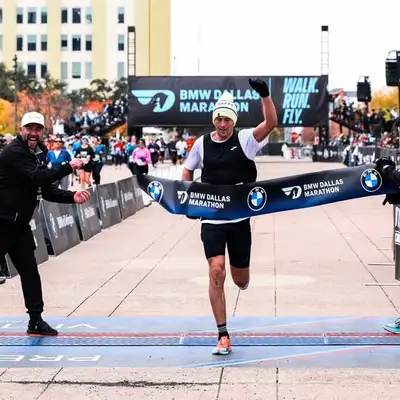
Chris Detzel: [00:00:00] All right. Welcome to another DFW Running Talk. I'm Chris Detzel, and today our special guest is Steven Fahe. Steven, how are you? Good, Chris. Thanks a lot for having me. How are you? I'm good. And special because you won. The Dallas Marathon this last weekend, and it was your first marathon. Wow.
Steven Fahy: Yep.
Yeah, that was the debut, just jumping in there, seeing what I had on the day. So went well for me, but yeah, not a bad first one to get into the books for sure.
Chris Detzel: How did that we'll talk a little bit about your. Past and what you've done, how did that feel though?
Like you won the marathon, did that anything special? You've won races before. We'll talk about those things, but never a marathon or that long or anything like that. How did that feel?
Steven Fahy: Yeah, it was cool. No, I know, I've been racing for a long time, but that was something different than I think I've ever really experienced before.
And I think, like I said, in all the the newspaper interviews that went out to print on a Monday morning, like it was just really special kind of getting to be around so many of the training partners that I've had this summer too. I think the really cool thing about it [00:01:00] being Dallas Marathon, that was my debut and being able to win that one is just the amount of people that I lined up with and got to see after the race that were a part of the build this summer and fall and, whether they're running the half or the full or just out spectating today, like it was cool to just have a big support system and just a bunch of people to share it with and I think it made it really fun to, kinda win on the routes that we're running every day and everything.
And yeah, I didn't think it was gonna feel that sentimental, but it really did. So it was pretty cool.
Chris Detzel: Yeah, that's pretty awesome. Do you run with the sloths or other groups? Who do you run with mostly?
Steven Fahy: Yeah, I mostly run with the sloths and definitely a lot of overlap with train Pegasus. Yeah, it's, I've done a lot of my training, I would say since about July with like Matt Campbell, David Salyer, Troy Castle, Mick, like a group of runners.
Mimi is always out there, and Jennifer Pope. Yeah, all the regulars I feel like in that kind of Dallas area. So slots definitely are, I would say the majority of the people. But pretty much just anybody who's showing up to Germany Park on Tuesday mornings or out at East Dallas, middle ground on Sundays.
I've probably shared at least a few miles with it the last couple months. Yeah. [00:02:00] That's pretty awesome.
Chris Detzel: I remember. We'll get to your pa your journey here in a minute, but I remember the first time I met you was at the July 4th, 1776 race. I was, I don't think, I didn't know who you, I don't think a lot of us knew who you were.
You come out and it was a mile race, or it was 1.0, one mile, or, I forget what the exact thing was, but we all went out, did this one mile loop or 1.01 mile or whatever. And I thought for sure Matt Campbell was gonna win it. And and he just beat him pretty, not badly, but pretty good.
Like by a few seconds it's damn, who's that guy? I've never seen him before.
Steven Fahy: Yeah. But I know. Yeah, no, the 1776 was funny 'cause that was actually the first time that I had really showed up and raced any of the slots or any of the other like Dallas locals. And the funny thing was I lived in Dallas for two years.
Up to that point, I'm almost to the day I moved to Dallas, like July 1st, or maybe June 30th, 2023, and had done a lot of running on my own in the area up until that point. The way my job works, like I, I not only run it [00:03:00] odd hours most of the time, but also just travel a lot. And so I spend a lot of time running and racing in this.
Places where I work, like Oklahoma City, Tulsa, little Rock, Arkansas. So I hadn't really raced locally up to that point, and I definitely hadn't really been training consistently with anybody in Dallas, even though I had been doing some half marathons and a couple other just like local road races. But I got to the point this summer where I was like, ah, like two things.
First of all, I wanna race locally more and have some opportunities that are unwork, non-work related. Yeah. I work for Brooks, a running company, so definitely work. And my, hobby jogging definitely overlap a lot, but but also I was just like, I just wanna like race for fun and also maybe find some people that I can actually start to link up with and train with a little bit more seriously this summer as I start to make some more goals for some longer races and potentially racing Dallas Marathon in December.
And so I showed up to the 17th. 76, which was a race that Matt Campbell and the loss had put together as a chance to race a mile on the 4th of July. And to be honest, I thought Matt was gonna beat me pretty much the whole race as I [00:04:00] sat on him and struggled through that mile. I was definitely scared of running a short distance like that.
And definitely not really tested myself over anything, shorter than a 5K in a really long time since college for sure. I don't know if Matt knows this, but I put a pretty hard move on him with about 200 left and I didn't have anything left after that. So if Matt had come back on me, he was gonna win that, but I think I was able to just sneak it out on him.
Maybe more on tactics than on actual fitness. But yeah, that was where I met Matt and basically where my summer training got started. But I do remember chatting with you a little bit after that race.
Chris Detzel: That was, it was it was interesting because. What's more interesting is that you didn't know anybody since July, and so that's pretty cool.
I love that, that you do that. Let's talk a little bit about how you got into racing, because let me just read some stats here that I think are pretty impressive. You were a steeplechase kind of person, right? Like in college? That's right. And so in 2019, you're the NCAA steeplechase champion.
You're a five time all American, you're an academic All American, and two time [00:05:00] Pac 12 steeplechase champion. Is that right? Does that sound. That sounds right. Okay. Okay. That's pretty impressive. How did you start, where did it start or where did you start running in high school and what did that look like?
Steven Fahy: Yeah, I've actually been running my whole life. I started really young both my parents were runners. My mom ran in high school. My dad moved to the US from Ireland in his mid twenties. He went to grad school in Canada and found running after college for him and did a lot of racing just on an amateur level in his twenties and thirties.
And my mom was a lifelong runner I I was one of four siblings, and so the four of us all did those kids road races growing up. I grew up in Carlsbad, California, so I used to do the kids race that was associated with the Carlsbad 5,000, if you've ever seen that one. A big road race out in the west coast that tends to attract a lot of good international competitions.
Was basically doing kids miles since I was like a little kid. But by age seven, I was going out and doing like the U-S-A-T-F national races and maybe a little earlier than a lot of people started. And I think one of the things that you see too is a [00:06:00] lot of people that start racing that competitively, that early burnout.
Yep. And not a lot of them even make it all the way to high school and college running. So I was lucky that I also had a good balance with other sports and stuff growing up. And I always knew that running was one of the sports that I was good at. But I definitely consider myself more of a soccer player or basketball player growing up until high school.
And then, yeah, to your point, high school is where I think running really took off for me as something that I. Saw as more of an identity thing. So I started running on a team with my brother. So I had a brother who's two years older than me, so pretty much any sport he did, I was gonna do. So if he was, he ended up being a basketball player in high school, I probably would've been a basketball player in high school.
Yeah, he was a runner and he was he was really talented in high school and college and ran a Georgetown on a scholarship as well. He had someone to follow in the footsteps of, but also he set the benchmark for what I considered to be good and fast, and he went into high school right away and broke nine in the two mile as a sophomore.
So the bar was set pretty high for me as a as the middle child in our family and as a younger brother. But yeah, definitely, we had a [00:07:00] fun high school team. I went to Laa Canyon High School in Carlsbad, California, and I had a great experience there. So I had fun running in high school and by the time I got to be an upperclassman and my brother was already running in college, I knew that running in college was something I wanted to do.
And that was how I really, I would say, got my start as someone that was gonna be like a lifelong runner. Now, did you break nine as well, or? I did break nine, but it didn't actually happen until my senior year, so I was a little bit more of a late bloomer. I would say the triumph of my high school career was that I caught up to my brother's school record in the 3,200 as a seniors I was able to we split our school records.
He's got the miles still and I've got the two miles still, but that was a nice little accomplishment to end high school for me. But yeah, still I would say on the whole he was a much more accomplished high school runner than me. But I did know that, maybe that my development was just gonna be a little bit different.
Than his. And it took me a while to get to that point of not really comparing myself to him that much, but I also had the advantage of the academics were just a little stronger for me than they were for him. So it definitely opened up even more possibilities, I would say, for college. [00:08:00] Not that Georgetown is a shabby institution at all.
I would say not bad. He was, and he was a great student and and he is doing fine now, but I know Stanford was a school that I always wanted to run at and was, somewhere that I thought I would be challenged to because one of the things about running at Stanford was that I was gonna be the low man on the totem pole when I went there.
There were definitely some options to run at some other schools where maybe I could have been a contributor right away, or even some schools where I could have been our top runner coming outta high school. That it's definitely intriguing, when you're a high school kid and you're used to maybe being the man for a little bit there as a junior and senior as like the fastest guy on the team or whatever.
But I think I knew that the best way to see how good I could be in the sport and, get the best outta myself was to go to Stanford and start as the. 20th man on the team, so I was glad I made that decision. Wow. Every kid from my area wanted to go to Stanford anyways, so it was not a hard decision at the end of the day.
Chris Detzel: Sure. So you went to Stanford, and tell me a little bit about the journey from, getting into just pure running to steeple chasing and things, stuff like that. Because I don't know a lot about steeplechase, to be [00:09:00] honest.
Steven Fahy: Yeah. To be honest, I didn't know a lot about the steeplechase either when I got into college, we didn't have steeplechase as a high school event in California. Yeah. For me it was something kind of new, really. All I had to go off of again, was that blueprint of my older brother who had started steeping as a senior in high school, unattached, and then in college. He had been doing pretty well so far in his.
First two years at Georgetown when I entered college. So it was something on the radar. Definitely, our team at Stanford was very cross country oriented. We wanted to try to be competitive at NCAAs every year and make sure we're developing great cross country runners.
And then our program was really 5K, 10 K for outdoors, so we didn't really have a ton of steeper on the team. And so I say as a joke to people, but it's not entirely a joke that I got into the steeple in part because I bombed so bad in my first 5K in college. I showed up and they, they weren't putting any training wheels on us there.
As freshman, or unattached athlete, I guess as a freshman, I raced at Stanford invite in the 5K and went out at probably a pace that was not too different than what my high school two mile PV was. And, blew up [00:10:00] pretty bad in those last two laps, trying to hold together with a bunch of guys that were gonna qualify for regionals.
I, and that was the story of my freshman year. I had a couple of tough races between cross country and track, just getting used to the demands of college dis the intensity, the training and everything. It definitely was a learning curve for me. After that kind of tough go at the Stanford invite 5K, my coach was like, eh, but we try the steeple, like your brother's doing pretty well at that right now.
And so they just threw me in in my red shirt year to try some out without really a lot of practice over the barriers. And it went okay and I think it was probably a sign that I had a future in the distance. But I think also steeplechase is one of those events where you have to believe that you're gonna, it's going to go well.
I think if you enter a steeplechase, for anybody listening that's maybe not super familiar with the steeplechase you're jumping over barriers that don't move. It's like a hurdle that you can, trip over and then you've got a water jump every lap. So it really is an event for crazy people.
Yeah, and it's one that I think benefits the people that somehow get a rush out of jumping over weird stuff during a distance event. And for me, for [00:11:00] whatever reason, I just had this feeling like I was going to be good at it and that I was gonna look cool doing it. And I think that was just enough to, that was enough to get me a start there.
And on top of that, it was the thing on our team that nobody else at Stanford really did. So it was a way for me to have my own thing. Yeah. And I think all those things worked into my favor, just helping me to get a little confidence there. In that event,
Chris Detzel: did you still run cross country or did they just what does that look like?
Steven Fahy: Yeah. So still did cross country. And I think the big thing for our team too was like making sure the guys that ran the steeple didn't see themselves as like just steeple chasers. Like ultimately our biggest goal at Stanford was to try to win a cross country national championship and definitely try to compete in the PAC 12 as well.
And, and be a good well-rounded teams. I considered myself a cross country runner first. And a steeper second. So my primary goal was always to contribute and cross. And I was able to come away with a couple cross country all American finishes by the end of my career, which I would say I was even more proud of than any steeple chase accomplishments I had because, that was something that meant a [00:12:00] lot to our team at Stanford for sure.
And then and I still ran indoors too, so they didn't have steeple indoors, but we had the 5K and three K indoors. So I competed in those events. And then outdoors, while I was steeping probably for most of the season I definitely wanted to try to be as good over 5K as I could. And I think our philosophy there was the better I could be over 5K the better chance I would have at being competitive in steeple as opposed to like complete specialization.
So really, come March every year, I would start getting over the hurdles again and get my steeple form back. But for the rest of the year, outside of March to June each year, I was mostly just like a flat ground runner.
Chris Detzel: What does training look like for cross country? College.
Steven Fahy: It varies a lot, team to team.
I think in the NCA some teams are really high mileage and really try to put in a lot of work, especially over the summer and early fall. Volume wise, our team was a little bit more finesse. I think we had a lot of talented runners who our coach was just trying to keep healthy and get to the starting line in November.
So honestly, if anything I'm grateful I didn't know what some of the other teams were doing [00:13:00] because I was running 65 to 75 miles a week, most of the way through college, and I thought I was working pretty hard. Yeah. And that was with, some doubles, a couple doubles over the course of the week, a few gym sessions and our long runs maxed out at like maybe 15 miles.
So we were not doing a ton of crazy volume. We were a big, like that's
Chris Detzel: pretty good amount of volume for Yeah,
Steven Fahy: Good for running 10 k for sure. Yeah. For running eight k, 10 k cross country. It was still good. It was definitely not the a hundred mile weeks that I think some other teams were putting in for sure.
But I think also our strength was that we just had a lot of really talented guys. The more, I think assistant weeks of doing a threshold workout on Tuesday and maybe more of a vo two session on a Friday and then a nice easy 14 or 15 mile long run on Saturday that we could get in.
I think the more likely we were to be ready to go for post-season racing. But yeah, we definitely, I think were a team that was like more mid-level as far as how much volume we actually put in. Got it.
Chris Detzel: Got it. Did you, were you ever, did you ever get to a [00:14:00] point where you were one of the best on the team or, I'm just trying to fill you out 'cause I don't know.
Steven Fahy: Yeah, I'm curious that I'm interested. I actually think one of the best things about being at Stanford is that I really don't think I was ever the best guy on the team. And I think that is in part because Grant Fisher was one year younger than me on the team, so Oh wow. Really? And as soon as he came in, I was never gonna be quite as good as him.
I think the great thing about our team is a guy like Grant could come in and everybody knew how talented he was, but he didn't really do anything different than us in training. We were a group that basically our number one through number 10 guy, we're all doing essentially the same training.
And just elevating to whatever level you were talent-wise on race day. So it wasn't like, grant or Sean McGourty or any of my other teammates that went on to be like big time pros and USA's qualifiers were really doing a lot of like training that differed from maybe what, me or even, some of the freshmen and sophomores on the team were doing.
But yeah. I knew come race day that I was, all I ever had to do was play a role. 'cause really I never ever was the guy at Stanford. So I think, one year at PAC Twelves, I was our number two [00:15:00] score a year where we won and, went 1 3 4 at Pac Twelves, which was cool for cross country. But even, that year at Nationals, I was our number three guy.
And so yeah, there were some years where I got to be a contributor and a scorer on the team, which was something that definitely took a few years of work to get to. But I honestly think part of what helped me figure out how good I could really be was never really being the guy, setting the bar and always having someone on the team that was outpacing me and, definitely was racing at a higher level than me.
So that you never really settle and you also just know like, all right, there's always like a next level that you can go to. So honestly, I think that's part of. Why I chose where I chose and, it definitely, I think was a good experience for me as far as just figuring out where the limit was.
Chris Detzel: I like that a lot because, you go somewhere knowing that, I guess Stanford's known to have really great running cross country teams from what you're telling me and, and some of the. Things that you're s saying about winning and going to nationals and all that kind of stuff, and so you know that's pretty cool and you're not necessarily the, you're a contributor and a pretty darn good one at [00:16:00] that, but you weren't the best, it probably, like you said, took some pressure off you. To, to me, that seemed like a lot of pressure to be the main guy all the time. Yeah, totally.
Steven Fahy: And that's where I like, I definitely have to credit, like our coach Chris Miltenberg, like he did a good job, like building a culture where we were really dialed into like the history.
We looked back at guys like Ryan Hall and Ian Dobson and, just guys who had, come in and outta the program in years past and. It was never like about you, it was more about like just trying to leave the place better than you found it and play as best a role as you can and only do what you can do to try to just like, make the team better.
Which is nice. 'cause if you go to a place like Stanford and you're running cross country, there's always gonna be a lot of expectation. And each of us that showed up there we're at one point, probably the best guy in our high school team and maybe the best in our area, our state.
And it's impossible to avoid that expectation. And I think our coach did a really good job at just making it so that we could really free ourselves from that expectation and lean into a team environment where all we needed to do was all we could do and really just focus on being the best teammate possible.
And I think in turn that's like what led for [00:17:00] each of us to have as good of a career as we could have.
Chris Detzel: Yeah, I think culture's, everything. I used to not believe too much in culture at work and things like that, but I do think that culture at work, culture at schools and building that kind of atmosphere for you guys was.
Hey, yeah, you were the best, this is a team. We're gonna try to do this as a team and then on cross on day of race, you can run as fast as you want or need to or whatever, but for the most part, your guys are pushing each other. That's pretty cool, man. I really love that. And how your coach built that.
Did you ever have to deal with injury or anything like that or,
Steven Fahy: yeah I had a few. I actually was one of the the few guys to take a sixth year before it was cool. Wow. Back in 2019 because of a medical red shirt. So yeah, I, I missed our 2018 cross country season to injuries. I'd been like an All American in 2017 and cross and had a really good track season in the spring of 20 eighteens.
2018 was definitely the year that I think a lot of my teammates and I were excited about. The prospect of coming in and competing for the WIN Nationals was in Madison, Wisconsin that year. It was gonna be Grant Fisher's last [00:18:00] year of cross country, and we had four guys position around him that we thought could be a national championship team.
It was in the midst of NA U'S dynasty, so they were gonna be hard to deone one way or another. But but yeah I ended up getting tearing my labrum that season, so didn't get to race pretty much. The whole year was. Cross training and trying to get back the whole time. And finally, eventually had to accept my fate dial back from the cross training and just take a break.
But yeah, that ended up leading to me taking an extra season and coming back for a sixth year in 2019 to run one more cross country season. But yeah, definitely the the injuries are a whole part of it. And I think the thing with the college season too is that it happens so fast from cross country to indoor to outdoor that even a couple weeks of a hiccup can really, derail a whole season.
And it's hard to keep up with that kind of schedule. Yeah, that's definitely hard. How'd you deal
Chris Detzel: with it mentally? I'm curious was that kinda a huge learning kind of season for you and mentally and physically? Did it bother you or you just knew that was, what were you thinking then?
Steven Fahy: Yeah it definitely was hard to deal with in part because there's such a [00:19:00] high sense of urgency to get back when you're in that kind of moment. You're thinking about, your own health and fitness that took all summer to build and you're also thinking about your team and the opportunity to, try to go after something really big and special, come November.
I had that on my mind the whole time, but also I invested a lot that summer. I went out to Boulder for six weeks to train over the summer and, I think I built up this expectation that the 2018 cross-country season was gonna be my big season where I was, going after a top 10 finish and, hopefully helping the team to.
Come home as a national champ, something that we hadn't done at Stanford since so forth. Wow. It was tough watching that start to slip through your fingers. I definitely took it hard at first. I think before I was able to reset and just get ready to try to recoup for track.
Chris Detzel: Yeah. I was just, I was curious because, when you, if you're a runner, for the most part, you're gonna have to deal with injuries and, you're having to deal with injuries, being in college and a pretty high bar of running. But that's part of it, did, do you feel as you kinda look back on it [00:20:00] now that it's been somewhat helpful kind of as you, Hey, that's just life, stuff happens. You know what I mean?
Steven Fahy: Yeah. No it's actually really funny to think about it now because I think about the build that I just had for this Dallas marathon where I had like multiple different hiccups happen over the course of August and, October, like I, I ran Hood to coast back in, in August with some coworkers and friends and ended up running a couple extra legs and came off of that with a pretty decent calf strain and took 10 days off and it was just not a big deal.
I just kinda laughed it off and, took my time off, did my pt, and came back and, jumped back in some workouts in, mid-September. Like it was nothing. And that's the kind of thing in college that if you have a calf strain like that takes you out for 10 days, like that's the end of your season.
Forget it. Look forward to the next one unless it's, maybe like a early season injury that you can maybe recoup from real quick. And then same thing like later on in the season. Like I, I ran a cross country race in Arkansas in early October this year. Just again for fun race I do every year.
Yeah. And race went well and I came off of it with a lot of [00:21:00] quad pain and I wasn't sure if I had a stress fracture or just some kind of strain quad and doctor told me it's just a quad strain. You're gonna be fine, but you gotta take three weeks off. And so again, it's one of those things where in, in college, that's a death sentence.
A three weeks off means your season is over. Am I ever gonna be the same athlete again? Am I gonna be, is my scholarship safe? All these things come into your head when you have to take three weeks off. And it's just funny to think back about how much it meant at that time when it was like, one of those things where everything felt like life or death and it's just such a high stress environment.
In this case, I took three weeks off. I did some pt, I, stretched out, I rested, I did my regular job. I didn't think about it too much. And then I assessed on the back end and I said, Hey, my quad feels pretty good. It's early November, let's ramp back up. I think I can still do Dallas Marathon. I've got lots of fitness.
Let's, I think I'll be fine. And let's back up, up, because
Chris Detzel: I remember when we were at the lake and we were cleaning the lake or whatever White Rock you were telling me. Yeah, I took some time off and I think that's when you were talking about that. I'm not sure, I'm, I [00:22:00] still gonna do the marathon, but I'm not sure how I'm gonna do.
And of course I think Matt was like, dude, this guy's gonna win it. I go, that's what he said. And so I was like, all alright, so we'll get to the marathon, I promise. Sure. This is good. I think this is important one because your first marathon, you won and by quite a bit when you and it's pretty amazing how fast you were for the marathon.
Now we know why, because you were, you're an athlete anyways, right? And so you've been doing this for a long time to some degree. You're not marathons, but, alright, so 2019 comes, you finish up your career at college or you finished college and you finished that up. What, did you start looking for a job?
What'd you do when you came back and then, because you weren't doing marathons obviously. We haven't even got to that. That was like back in two 19. You stopped racing. Racing, did you do anything after that or,
Steven Fahy: Yeah, so towards the end of college, especially when steeples started going pretty well for me, I started to explore the possibility of continuing to run professionally after college and,
Chris Detzel: okay.
Steven Fahy: I got really [00:23:00] motivated about the idea of doing it contract or no contract. I said I think it would be really cool to keep training if I can find a training group to join someone who will maybe give me a couple of resources and maybe set me up with some coaching and some physio and see if I can get myself maybe to the trials in 2020 or, even USAs in 2019 or something like that.
That was what was going through my head. Maybe 20 18, 20, early 2019. And I knew had, had some conversations with a couple agents while I was in school just to see what that possibility was gonna be like. And then I think, winning in 2019 definitely opened up a few more doors for me as well.
I still came back for one more cross country season after that track season in 19. But then after that season was when I fully left college and opened up the, conversation. Okay. And had a few different opportunities with a few different brands that were looking to add a couple people to their teams and training groups.
Mostly out on the east coast, one group out in Oregon. And I settled on this opportunity with Puma that seemed interesting [00:24:00] where some folks at Puma from Europe. We're in talks with some agents in the US about the idea of setting up a group in Chapel Hill, North Carolina that became the Puma Elite Distance group that now has several athletes training for anything from the 1500 on up to the marathon.
Probably late 2019 or early 2020. This was. Being talked about and my agent, Tom Ratcliffe, who was a really good kind of resource for me as I navigated what pro running was gonna look like, he was one of the folks that really was in touch with those Puma executives setting this group up.
So I trusted him and he told me, Hey, I think this is gonna be a great opportunity for you. You're gonna get a chance to train with other good athletes, have good coaching and all the resources that you need. 'cause I think the big thing with pro running is there's a lot of levels to it and a lot of low level pro runners don't even have the same kind of resources that a college athlete has in terms of their facilities and their access to nutrition, training rooms, sports med, definitely insurance, stuff like that.
It sounded like Puma was gonna be one, a brand that was gonna support all of that. But then as we all know, in 2020, [00:25:00] things went awry for a little bit. I had actually already moved out to Chapel Hill in January, 2020 before signing a contract. Luckily for me, my college coach, Chris Miltenberg, had taken a job as the director of Track and Field at University of North Carolina Chapel Hill.
Oh wow. Wow.
Chris Detzel: That's crazy.
Steven Fahy: He was already out there and was definitely like, played a role in deciding, for this group with Puma to be based out of North Carolina. And they, he kinda helped identify it as like a good place for pros to train and, to have all of the resources that they needed.
And so I moved out there in January in part because I just needed somewhere to train and didn't wanna be at my parents' house while I figured all that out. So moved out there, actually was living with my old assistant coach, Dylan Sorenson for a couple months while I got situated and then eventually moved into my own apartment out there.
And then COVID went down and there were no contracts being handed out. So I basically spent all of 2020 out there training with no contract, just doing like a tutoring job at UNC on the side to pay my rent and keep things going. And ironically, it was some of the best training I've ever had.
I felt [00:26:00] like I was a professional athlete. It was my first time being out on my own out of college. I had a blast. I was healthy, I was super fit and I was super optimistic about my future. In running at that time. And then finally when companies were starting to reopen their books at the end of 2020, I signed my contract with Puma in late 2020, but by that time, I started to develop this chronic injury in my foot.
That unfortunately ended up being something that kind of lingered throughout the next two, three years for me. So when it was all said and done, even with the contract and all the support and all the, medical staff and training staff and PT that I could have ever asked for, I only was able to race one time as a professional indoors in the 5K, never in a steeplechase, definitely was was not quite the pro career that I had mapped out for myself, but that's the way it goes,
Chris Detzel: the way it goes.
I think in
Steven Fahy: many ways I had, as about as close to an ideal college career as you could have and
so I think my expectation as a pro was probably set a little higher than I think anyone could ask for. But yeah, I had no, bitterness towards any one person or thing about it.
That's [00:27:00] the way that the sport goes. It's something that you've gotta deal with. I always knew there'd be more running on the back end too, but Yeah. But I finally walked away from Puma in January, 2023 after being with them for a little over two years. Yeah. That was, something I did on my own terms, just when I decided, hey, you know what?
I think I'd rather run on my own terms and actually be able to take on a regular job and do a little something else with my time and my life right now. Yeah. I was, it was my 27th birthday when I made that decision and I was like, I think I'm ready to move on. Not because I was done running, but just because I was like, you know what?
I don't actually think I even need this contract or this situation to be happy and to be successful as an athlete. Yeah. And as a person. Yeah, I actually cut out high contract before it was even done too. I told Puma to take the money back. I said, I just, oh wow. I need to be done. So that was my brief, not super lucrative pro career, but nonetheless, I, yeah.
It's still amazing. It's just a lot of money to
Chris Detzel: make as a runner, you'd have to be pretty darn good, I think, to make a lot of money to. Be a pro runner, yeah.
Steven Fahy: Short answer. No, there's not a ton of money to be made. Yeah, exactly. If anything, I was really [00:28:00] lucky that I had a contract that paid my rent and that made it so that I didn't have to take on a second job.
I think my big thing was, wanting to really be all in and not have to worry about any other life decisions to be made. And see if I could go from college where you have all this structure with class and with pursuing a degree and being a student athlete to having a lifestyle that was like totally catered around pro running.
And I think for a lot of people, that's where they can really find that next level is when they can go all in and be an athlete first and go, leave no stone unturned. For me it was just unlucky that it happened to kinda line up with all the injuries and left knee definitely twiddle my thumbs a lot and a lot of cross training and swimming which was a bummer.
But at the same time, yeah, I think, yeah, for me it was definitely like a, an experience that I needed to have one way or another. So I was like, grateful I got to go for it either way.
Chris Detzel: Yeah, why not just as curiosity, you guys are running pretty fast. So it sounds like you guys run a lot of five Ks.
What was your best 5K from outside of the outside and then also on the inside, on the track or the inside track? Yeah, so
Steven Fahy: outdoor track, my k personal best [00:29:00] was 1334 from 2019, geez, 2019. So again, that was one of those races where, you know, home track at Stanford, grant Fisher out front I had just about as good of a pacing crew as I could want.
So yeah, there were some other really good athletes in that race too. So that was my best. Outdoors, indoors. I ran 1344 and snuck into national's indoors in the 5K. Wow. Which was cool. But but I think that's, those were two things that I was super proud of too. I, yeah, I was a steeper first as far as, that was the event I was going to race at NCAAs if I had a chance.
But I was definitely proud of not being one of those guys that was like, oh, I only steeple steeplechase. I think the better I could be at the 5K, the better I was gonna steeple. And I think running that 5K, especially my fifth year in 2019 outdoors, was I think what gave me even more confidence as a steeper that I was gonna be able to compete with anybody.
That's definitely something I can, hang my hat on now as an old man who can barely break fifteens,
Chris Detzel: barely fifteens, yeah. That's terrible. But you're not training like you were before, right? It's not, it's a little different.
Oh, yeah.
It's not [00:30:00] you're working a full-time job.
All right. So you finish up your, professional career of running you finish, but what was the next after that? You got a job directly with Brooks or how did this work out?
Steven Fahy: Yeah, so I, one of the first things I applied for was a tech rep job with Brooks in Charlotte, North Carolina, which was like not too far from where I was living in Chapel Hill.
And I got close to getting that and was asked on the spot if I wanted to do the same thing out in Dallas. And I'd never been to Dallas before and had really no idea what to expect as far as what that would look like, where to live, any of that kind of stuff. But they gave me the weekend to decide, which was really nice.
So I called a couple of people and had a few chats with some folks that I knew that went to SMU and some other, you kind of Dallas connections. And I was like, okay, I guess I can, I'll figure it out, why not? So I moved out to Dallas pretty much sight on scene in, in 2023 and started my job and it was a good fit.
Brooks has been an awesome company to work for and I think I knew right away when I started working for them that it was like the right kind of thing for me and for my career for sure. But I didn't really have a [00:31:00] lot of Dallas connections when I moved here yeah. I knew one or two people not, didn't really have any ins with the running community.
And the other irony of my job is that while I'm like a tech rep that's supposed to be super ingrained in the running community i'm more or less the Oklahoma, Arkansas rep for Brooks who was just asked to live in Dallas, so Oh wow. We actually have, we have another rep who actually covers a lot of the running retailers and run groups in the DFW area who's been here for a lot longer and Okay.
Is probably a little bit more well connected with your Luke's lockers and such. But mostly our Oklahoma, Arkansas, and a few outlying Dallas retailers as far as like my work connections. So it made it so that I didn't really have a super big in with a lot of Dallas runners, like straightaway moving here.
For sure. I'm sure it was
Chris Detzel: hard yeah, you made the right decision, but did you move in an apartment that you're like, oh my God, like I can't, I picked the wrong place, now I have to go somewhere else, or did you pick somewhere pretty good, decent, at least. How would you know? I actually got
Steven Fahy: so lucky.
Yeah, I know. How would you know? I know I try to ask people for recommendations and, ultimately [00:32:00] just got super lucky with where I picked and I actually am happy with where I live as far as like training, but that's good. I just didn't know what to do, so I just ran at the Katy Trail every day for the first year that I lived here, which I laugh at myself now, but honestly, Katy Trail is nice to have.
Yeah. It's a good resource. And I live less than a mile from it, and I was doing a lot of running there and I think early on I would looked on Strava and I saw Joe Hale had some segments on the Katy Trail. And so I was like I guess I'll just go try to take some of those. And that was my reduction to Joe Hale, who, funny enough, I spent about eight miles of, the Dallas Marathon with on Sunday, which was fun.
Is that the first time you met him? Yeah I met Joe probably pretty early on when I moved. Oh, okay. Like from seeing him out, out running, always just, seeing him out on the trails and stuff. Okay. I love that Dallas has a local legend like Joe that's just always out there. And if you just go out for a run any given Sunday, you're gonna see him.
So that's a, yeah he's definitely a guy that I've always had a lot of respect for, but also he was one of the earliest like Dallas runners that I discovered that I was like, okay, like what routes is this guy running? But also, at the time I moved to Dallas, I was fresh [00:33:00] off of quote unquote retiring from running.
Yeah. And I was becoming a different athlete, I think it was just, it was gonna look different. I obviously love running and love competing and I. I think I'll, hopefully be someone that's always good to jump into a local 5K or something for the rest of, as long as I'm healthy and able to run.
But at the time that I moved, to Dallas I didn't see racing a marathon or even really, competing competitively or going all in on anything as something that was in my future. I think I, I just wanted to be someone that could get out and, go run on my own terms for the first time.
And at the time I moved here, I was still only six months removed from being a professional athlete and, and not feeling super great about, what that lifestyle was like. So I think, it, it took some time after moving to Dallas, I think, to be ready to go all in on something.
And I think the biggest thing I learned from being a professional and even from being a college athlete is, going all in on something is really scary and it takes a lot and it. It takes a lot of your mental energy and also it's just it's a big expectation to set for yourself and I think we all learn that, whether it's, [00:34:00] something running related or work related or life related.
I definitely, when I moved here, was definitely not ready to go all in on anything again like that. And I think that's probably part of why I, didn't immediately seek out any training partners or any local races or anything like that. And I think over the past couple years I've just gradually moved back into makes sense, just getting myself into some races and trying to make sure that it first and foremost was for fun and, was something that was a positive for me.
Yeah.
Chris Detzel: Yeah, you're used to. This high level just atmosphere to where you're just racing all the time and, just taking it down is good, I'm sure. And all right. You get here and you meet some people. What did you start, when did you start running again?
Look, it's only 2025, so it's only been two years since you moved here, so you haven't really been here all that long. What got you back into the kind of the running atmosphere?
Steven Fahy: Yeah. Part of it was work as part of my job, I'm working with a lot of local retailers where I will get.
Told about a race that they're hosting out in Bentonville, Arkansas, or tulsa, Oklahoma or something. And I, first of all, [00:35:00] I, it's not that hard for me to catch the bug when I get an opportunity to go race. Sure. Even if it's not gonna look like what it once looked like, it's hard for me to say no.
But then also there was that aspect of as I was, just like building relationships through work, that's fun. Yeah. It's for fun. I definitely saw it too, as like a, I was, I had this job where I was in this territory trying to make relationships Yeah. With all these retailers and I didn't have any retail experience.
So I was like what if I just show up for these guys and I do the race and I, hang out with them over the weekend and, see if I can like, just throw myself into their world for a little bit. Yeah. So actually got into it in part by doing that in just a bunch of my different, cities that I cover for work, as I got my feet wet as like a Brooks rep.
So I did a bunch of, five Ks in Tulsa, Oklahoma City, Fayetteville, Arkansas, little Rock, and just random races, not all of them. That'd be fun. Look the same fun. Yeah. But I had a lot of fun with it. I, figured out a way to make it work around work and everything.
And I, I had a lot of fun with that. And also I think it, definitely got me excited about okay, like I think I kind of wanna, maybe be a little bit more prepared for the next race that I show up to. Yeah. Maybe I'll do a couple [00:36:00] workouts. It looks like Germany Park track's not too far away from me.
Like maybe I'll jump on that, and do something. Or maybe I'll do a workout on the cage trail or something. And, I was still at the point where, it's not, I'm not an old man. I can still, get out there and do a workout a percent. Just on my own terms, so yeah.
So yeah, I was still doing some of that, but it's
Chris Detzel: not competitive anymore, it's just Exactly, yeah. Being just like the rest of us. Just a little different. Yeah. And then,
Steven Fahy: I had some friends from the Midwest that talked me into running the Detroit half Marathon last fall, so 2024 in October. And so that was a chance to look at what a training block ish would look like and obviously like more of a destination race and Yeah.
Getting an Airbnb and, hanging out with some friends and, and getting to go race. And
Chris Detzel: so that's when it's fun.
Steven Fahy: Yeah, exactly. And that's when I realized too, I was like, like that's what really make not that doing the retail races wasn't fun either, but yeah. There's something about making a whole weekend out of it and and being able to go, have some fun with your friends. And I think at a certain point during that weekend in Detroit, I realized I actually don't care what time I run here at all. Yeah. I'm [00:37:00] gonna have fun whether I run 60, 60 minutes in this half marathon, or whether I run 80 minutes in this half marathon.
Either way, we're going back, to go have some drinks afterwards and work some pizza and we're gonna hang out and we're gonna fly home and tell everybody how much fun we had. I think that was a good experience for me too, of this is like what it should look like after college. This is what the next level is.
Yeah. The next stage of running is for me and what I started realized is you can run as fast or as slow as you want in that phase. Yeah. And you can still have fun. And I think that's a nice, like freeing thing. But I also think, that trip last year also showed me like, okay, yeah.
Like I, I still definitely wanna do this, but I also would love to have the next race that I do be something I can be proud of. Whether that means that it's the result or more just like what the training block and the buildup looks like. Like I would love to show up at the next race being like, feeling like I like prepared super fit.
Yeah.
Chris Detzel: I think. You tell me if I'm wrong. Even if you win a race now or whatever that, that's [00:38:00] winning is fun, not that but it's for a different reason, right? Hey, I won or I didn't win. Who cares? At the end of the day, really the pressure is, it really doesn't matter if you win or lose, at the end of the day, like you go out and run Dallas Marathon, you won, which is pretty awesome, but if you've got second place, you'd allain that sucks, whatever.
You know what I mean? So what Yeah, absolutely.
Steven Fahy: I, I would say for a good portion in the first, no, I think give a lot of
Chris Detzel: money or any money for that matter,
Steven Fahy: no. Yeah. There's no prize money at all. I think, yeah, it was definitely for me, like the best part of it was getting to line up and seeing all the slots and Pegasus folks and other Dallas runners on the starting line and being like, dang, like this is cool.
We're all doing this. And then, for only living here two years and only being really running with any other people since like July, like the amount of people I heard, like cheering for me and yelling for me. Along the course, just from the community that I've found over the summer and fall.
Pretty cool. Pretty training with some of these folks. It's it's incredible. Yeah, it's not to get all sappy on everybody on the pod, but yeah, it, it was pretty sick. I gotta say. It really didn't matter to any of those people. I think whether I won or not, like I think they were just [00:39:00] excited that I was out there, representing the community and and taking, participating, and that was cool.
Yeah.
Chris Detzel: Let's talk about the race then. So let's talk a little bit about training since you said, Hey, I wanna really start training for the Dallas Marathon, and how did you think about getting into a marathon? Because you've never done a marathon before, because it sounds like you only did one half. Or two, at least one because they didn't too many halves either, and so what kinda led up to that?
Steven Fahy: Yeah I actually did three halves across 2024. Okay. One of them with work at Houston Marathon and then and then two more over the course of the year. And I ran, a similar time in each of them. And I think with each of them I surprised myself a little bit with how I ran relative to what I think I probably deserved to run fitness wise.
But I also left all three of them. Did you run? I ran 67 30 at my first one in Houston, seven 30 again. And then and I ran 68 high both Bentonville, half in April. And then I think I was like, yeah, 68 something at Detroit in October of 2020. So the dude [00:40:00] that
Chris Detzel: ran D Dallas half ran like a 60.
Six.
Steven Fahy: Six. Yeah. He ran fast. Yeah, that guy was super impressive.
Chris Detzel: I'm gonna get him on the pod as well. I already reached out to him. We'll see. You should Absolutely. Yeah. But
Steven Fahy: no, that, that's no joke because I ran 67 and I thought maybe my next one would be faster and it was not. Never. And the half marathon is really hard.
It is a hard race and it's one that you don't get away with anything. I definitely, I think coming off of my, those two 60 eights, I was like, ah, man, maybe I should really look into putting in like a real training block where I actually tried to put, doesn't really put it all together in
Chris Detzel: a block of training and still runs those 67 and 68.
Steven Fahy: I still some good workouts and I, there's a few weeks in the build where I can still throw the mileage together. But I think part of that too was just like not having the structure. I just didn't have the discipline that some of these guys, I think that like really have it, have a good plan.
And part of that too was just my own fear of trying to. Build a block and be disappointed. And I think, I got to a point now where I'm like, okay, like I don't have to be afraid of that anymore. I [00:41:00] trust, that if all these guys around me can do it, I can do it.
But I it takes a little bit of vulnerability to be like, yeah, I'm actually gonna write up training. Or be coached and, go do it. And yeah. I think all of those halves that I ran in 24 were just stepwise movement towards okay, yes, I can like really actually train again.
I love that. That's awesome. But yeah, so anyways, so to get to Dallas, yeah, like I, I decided like probably May or so that I was like, I think I should run the Dallas Marathon. Like it had been a seed that had been planted in my mind since Dallas Marathon in 2024, where I left my apartment in the Oak Lawn Turtle Creek area out for a run on that Sunday morning, probably around 9:00 AM the marathon had probably started about an hour ago and I was running along Turtle Creek and down into downtown.
'cause I was like, oh, it's marathon morning. That's right. Cool. And I was just blown away by how many people were out there. I was like, yeah, geez, there are like way more, I know people come from all over for this race, but I was like, like for whatever reason in the first two years that I lived in Dallas, or definitely like a year and a half at least, I had this idea that it just wasn't.[00:42:00]
As much of a running town as Chapel Hill or Eugene or some of these other places. It is, and I think you see one of those places, one of those, like Dallas Marathon and it changes your perspective and you're like, yeah, this is a running town. They're out here. I just haven't found them yet.
Yeah, I, a joke that I make on Strub all the time, it's like there are fast runners in Dallas with all caps set because it, there really are. It's just, they're not gonna be as loud maybe as, some of the big runners in some other cities that make themselves known all the time.
And I think that, even just seeing all those people and being like, man, like I should be participating in this. I planted the seed, but it took until probably about May or June or something of this year where I was like, yeah, I think Dallas, I think I'm gonna do it. I was like, I've got six months to decide how I'm gonna do it.
And I came in really with no plan for about a month. Two months where I was just running. I just tried to get up to running like 10 miles a day and Okay. Eventually started doing some workouts and, the summer came and I was still doing my runs at 8:00 AM and just dying in the heat out on White Rock Lake.
And, around mid-July, I think, I met, Matt and some of the [00:43:00] other sloths and agreed to start showing up to some of those 5:00 AM Germany Park sessions. And then I was like, okay, let me try to draw my own training plan of what would a build look like what would a kind of peak phase look like?
What would it, where would I taper? And I just it was just like a rough sketch basically. And then it basically all got thrown out the window 'cause I ended up taking two big breaks in the middle of it. And ultimately, I would say a lot of, most of the workouts I did in this build were written by whoever Matt Campbell's coaches, because he would send me a workout on Monday.
Night and I would say, sounds good. I'll be there. And I would show up Tuesday morning and I would do the workout with him and try not to mess it up for him. And I would finish and I'd be like, that was great man. Thanks. And he would be like, yeah, glad to have you dude, and see ya. See you on Saturday.
I guess and
Chris Detzel: I'll see you later.
Steven Fahy: Yeah. And I try to tell him like, I'm not trying to poach your training or anything, but but honestly for me, like that, it was so nice to just have people Yeah. To him and David Lear and, and some of the other slots that were showing up every Tuesday just to have people to do some workouts with.
And sometimes I didn't even really care what the workout was. I was just like, I [00:44:00] think if I just get out there and I do something this Tuesday get active. Yeah. On probably moving in the right direction. I was always optimistic that if I just kept showing up all fall and summer, that Dallas Marathon would go Okay.
And I tried not to create too much of an expectation for what I was gonna run. I think in some ways that three week break in mid-October to early November helped me continue to temper my expectations. Yeah, in a way that ended up being positive. I definitely had a couple of signs coming off of that in November that I was still in good shape and could probably run pretty well.
But I think in general, yeah I came in without a huge idea of what I was gonna be able to do and wanted to have fun, wanted to give myself a shot to win if that was available to me. But I think I was okay with a whole range of possibilities.
Chris Detzel: Yeah. So when you look at as you were doing something, some of this had to been like a mileage PR for you.
If you did a 20 miler one day. Have you ever done that many miles before?
Steven Fahy: Definitely not. Yeah, I think my 21 mile long run with David back in August as he was prepping for [00:45:00] Chicago Marathon was probably my longest run of the build. I did 22 miles one time in Chapel Hill before I left 'cause I wanted to run the whole American Tobacco Trail.
Chris Detzel: Okay.
Steven Fahy: And I ran the whole thing in, whatever time I ran. And then I took a whole week off of running. I was like, that's it for, and this is post quote unquote is just
Chris Detzel: yeah,
Steven Fahy: this was more of a sentimental run than it was any kind of training stimulus. Okay. Yeah, definitely in August that 21 miler was the longest I went.
I did maybe one or two twenties and a couple 18 or nineteens over the course of the build. But. I would say that gap in October was probably where I was planning to do maybe something a little longer to prepare and practice the fueling and everything. And I think on the back end when I came back I was like a little too late to try to throw something like that in there now.
So let's just hope and pray. I think I'll be okay, but I'm, but also, yeah, in college, like we didn't even sniff like anything that long. We were, we maxed out at 15 or 16, so I think even as a professional, the longest I'd ever run was like 16 or [00:46:00] 17 okay. That's still pretty good amount.
So it wasn't like. Yeah, not bad. You haven't done long distance before. Yeah. And I think like ultimately, like I, I wasn't worried about being able to like, cover the 26.2, but I think figuring out what the bonk was gonna be like, where it was gonna come, what the fueling was gonna be like, I definitely did not give myself a ton of practice with the fueling.
Mick and David, if they're listening will laugh about the one session where I tried to practice, and I would say the closest I got was maybe like taking a couple of gels during an hour of a tempo or something like that and being like, oh, that didn't go too bad. I think I'll be okay. But I was definitely winging it a little bit but I think, I got in enough long runs where I was like I'm not worried about 26.
It's more just about yeah. Whether or not I have it on the day.
Chris Detzel: All right. So we've talked a lot, but we haven't really talked about the race. Let's talk about it as you step on the course and what were you thinking? What, what were, was how did you go out, all that kind of stuff.
Walk me through some of that.
Steven Fahy: Yeah. I think like the mindset early was to try to be bored for as long as I could. I think my downfall is that I'm not very patient [00:47:00] and I'm not a, not always the most disciplined workout partner, let's just say racer. I tended to do a pretty good job for the most part.
But I think with something that was this long and that the pace was gonna be so much different than any kind of thing that I had done in a half marathon or 5K, 10 k, I even told Mimi who I was with for at least the first eight miles this race probably. I'm just trying to be bored at 10 miles.
Yeah. I know Mimi who had an incredible half marathon personal best and unbelievable, crazy fast. Yeah. It's honestly so cool to have people like Mimi and Jennifer Pope, like around and yeah. To put it all in perspective, like they were like really doing it for real. But yeah, Mimi ran 72 and a half, so she was rolling, to start the race a hundred percent.
I was with her and Dakota through eight miles basically, until they had their turnoff for the half marathon. So I remember telling her like, I wanna be really bored at 10. I don't, there's no reason to do anything there. So I tried to go out really conservative for the first eight to 10 miles.
And then at some point heading down the hill towards the lake, I caught up to Joe Hale. So [00:48:00] Joe was already
Chris Detzel: ahead of you then?
Steven Fahy: Yes. So I, I spotted Joe early and my initial thoughts were that Joe might win the whole race. So I was like, I expect Joe to be out front. I expect him to be, someone that I maybe try to chase down over the back half of the race.
And I knew he's done this race a bunch of times, wanted a bunch of times. I thought the only way I'll beat Joe is if he just doesn't have a great day. And he's a pretty experienced racer and he does a lot more volume than me. So he definitely knows what he's doing. But I saw him pretty much just after Mimi and Dakota turned to go towards their half marathon finish up.
Okay. And I started going. So I started going down Richmond, it's like probably eight, nine miles in. And I looked ahead and I saw Joe and then I looked further ahead and I saw a pack of NAIA guys and a couple non NAIA guys. And I thought, oh shoot. I guess those guys are doing the marathon.
So at that time, they were about 40 seconds ahead of me and I was like even though I'm trying to be really conservative right now, I should probably catch up to Joe. I think it would be better to have some company here.
Chris Detzel: Yeah.
Steven Fahy: So I ran up to him. I like that. I lined up with him and at that point I was super excited too.[00:49:00]
'cause I was like, this is great. Like I'll be able to have someone super experienced to run this middle part of the race with. And I trust him completely in terms of what moves to make. And I could only assume he would appreciate to have some company here as we try to reel in this pack that at that time was at least a good 30, 40 seconds out of us.
So probably ran with him from about eight to six 10. We had all kinds of stuff go on during that little stretch we had. I took a quick porta potty stop around mile 12.
Chris Detzel: You did? Yeah.
Steven Fahy: Wow. Yeah. I had to go to the bathroom pretty much as soon as the race started and I thought it would go away and it didn't.
So cold. It didn't, thankfully not the bad kind, so it was pretty fast. Yeah. But I still I told him, I was like, dude, I think I'm gonna jump into, and he was like good luck dude. I guess I'll see you. And I don't know if he expected to see me again or not, but probably not.
I caught up again probably a mile later, so probably spent a little too much energy catching up too quick. But I was feeling good at that point still, and it was it was really cold, so I was trying to warm myself back up. Oh my God. But yeah, it was funny, man. But yeah, so then we caught up the NAI guys probably around the half, and then we kept working together and, we had those two [00:50:00] guys, Casey and Craig out front.
Still, probably 15, 20 seconds ahead and at, but did you know that? Did you know? I knew who they were ish. I didn't know a ton about Casey. I knew that Craig was definitely a really good runner and probably was another guy that was a favorite to win it. I knew by the point that we were on the lake that those were the two leaders.
Okay. I didn't know. I didn't know what they had and didn't have. I thought maybe they even had another gear and were gonna run away from us. Do you know
Chris Detzel: how far they were up or No.
Steven Fahy: I could see 'em. Did you see 'em? Okay. I think the nice thing about the course is that there's really good visibility.
When you're on the lake, you can see people pretty much the whole time. So that's great. I never did the match. You're like a predator
Chris Detzel: dude. You're like. I see him, man.
Steven Fahy: I was trying to be good. Believe me yeah. When I was in that race, I think I was hunting like pretty much the whole time just like trying to keep myself from doing anything stupid.
Like I also always in the back of my mind was thinking like, just give yourself a shot at 20. Yeah. Yeah. So I kinda, at Okay. Yeah. 2021 is where you get to the top of the hill. Yeah. And I, I. New from doing some course recon that, definitely [00:51:00] that like climb from the bottom of, from the end of the lake to the, to Greenville basically is just, that's the tough part of the course and that's the part that can really break you if you're not ready for it.
But if you run the race in a way where you get really excited for that and you save your mental energy for that, and you get ready to really lean into that section of the race, it could be the best thing for you in the race. So that was the mantra I think coming into that was like.
Use that hill if there's ever a shot to win the race it's there. So backside of the lake was just about trying to stay composed and I was running with Joe and his gloves froze together. At one point, he like reached out to me and was like, Hey, can you try to help me like pull my gloves apart?
'Cause his like mitten and his glove froze together. And so I was like, yeah dude, let me yank these apart. His like hands weren't working anymore, but geez. So it was funny man, but it was, that's what you get when you have 30 degrees out on the lake and you got wet gloves, but it's cold.
Anyway, so yeah, so like Joe and I had a whole race is worth of fun there from eight to 16. But by the time we got to the backside of the lake and I was really eyeing those guys in the lead, I was trying to [00:52:00] make sure we didn't get too far away. And if anything, that I was inching a little bit closer and closer to that.
Did know at some point, did Joe know,
Chris Detzel: did he know that you were gonna go after him or no? I don't think so. Okay. He didn't say anything.
Steven Fahy: I think Joe knew that I was probably trying to keep myself in the race. And I think, I was talking to him from time to time about like, all right it looks like those guys are still chilling, but let's just like keep 'em in the sights.
But I imagine when Joe let me go, it was probably equal parts. He was feeling it a little bit, but also I think he knew that I was like starting to really try to roll those in. And if anything, I think, spending those eight miles with Joe was, I think a great way to keep me equal parts, dialed into the race, but also not trying to make up too much ground all at once. So definitely owe him a lot to, get me through the middle part of that race. But by the time I, broke away from Joe, it was basically just a cat and mouse game of like, how long am I gonna let these guys go? When am I gonna try to reel them in?
And I. I really tried to make a deal with myself that like I wanted to let them get to the hill first before I made any kind of move. And I think that [00:53:00] ended up being the right decision because I was still feeling pretty good coming off of the lake. And by the time we started climbing, I think they started to feel it a little bit more and they started to come back a little bit quicker, which was good for me even though I didn't really have a plan for what I was gonna do if I took the lead.
'cause I really didn't see the lead as like a total possibility until, we started climbing and I was like, I think I'm gonna catch these guys. But yeah I think I finally caught up to Casey and Craig around 21, right around when you finish the climbing turn onto Greenville and went to Ross.
So that was when it became like a race for the win,
Chris Detzel: you beat those guys by quite a bit. I mean by four or five minutes or, I don't know exactly, but. So it wasn't like it was just right there. So what, whenever you were like, pass 'em, what did that feel like?
And then how did you did you just pour it on after that? Because you're pretty, the last four or five miles man must have been really speeding for you.
Steven Fahy: I guess lucky for me once you turn on Greenville and down into Ross, you run a downhill with on Sunday there was a tailwind too, so That's right.
Kind [00:54:00] of a double whammy there as far as getting some momentum back after climbing for a little bit. But I cut up to Casey. I think Craig fell off a little bit, like at the end of the climb. I think he was really feeling the lake there. But Casey ran with me for a little bit, coming around the turn.
Okay. And down onto Ross. And in my mind I thought the two of us were gonna race all the way into downtown together. And that'd have
Chris Detzel: been fun to see.
Steven Fahy: That one of us was gonna have to throw in, something hard the last couple miles to, to win the race. And I knew I felt good, but I also didn't know what was coming for me, come last 4, 3, 2, 1 miles, 'cause I've never really covered that, that distance before a race. So I was trying to still be patient. But I think by the time we got on a Ross and Casey started to hurt a little bit, I was like, all right. I think this is my opportunity. I shouldn't. Try to really pour it on, but I wanna squeeze, I wanna squeeze 'em out of this a little bit right now and just see if I can run a pace that I feel comfortable running for the entire rest of the race.
What I didn't know at the time is that I was running about five 10 pace at that time. So I ran, I ended up running at least a couple miles at five [00:55:00] 10 to five o pace going down into downtown, at least according to Strava. Who knows if that's accurate or not, but it didn't feel that fast. But I think I had, again, wind at my back run downhill.
And Casey slowly, I think, fell off of the pace at that point. But I'm glad that I didn't try to. Pour it on any more than that because I think even that pace been tough. Really did me in at the end. I ran alone obviously for till 3 24, 25, and then you hit that little kicker coming back into downtown on Commerce Street or wherever it is with about a mile to go. And I know exactly what you're talking about. The whole thing came on my back at that point. And then I was like, oh no, I, this is gonna be a long last mile. And I recouped enough to I think, finish and not look like I was falling apart.
But I was falling apart. So I, yeah. Is that last
Chris Detzel: mile on the last mile, the hill, right When you hit the last mile, you hit the hill. Exactly. Do you remember that? Yep. And then, yep. When you go up that hill, the wind just starts blowing like crazy. I don't know if that's what you got. Totally, [00:56:00] exactly.
When I did, I was like, holy hell, this wind is I just went up this hill, the last mile and now the wind is hitting me hard. And and I got behind somebody because, I didn't get close to anything, but, but that helped. But you didn't have anybody. You just had to Yeah.
Steven Fahy: No it's like the feeling that you normally get in like the last a hundred meters maybe of a 5K where you are like, oh man, my legs are really dead. I don't know if I can really make a move again. Good thing finishes right here. But in this case, there was a mile to go. There was a mile.
Oh my goodness, dude. And I was pretty sure that IW that I had some distance on Casey. I didn't know how much I think I ended up finishing about like 50 something seconds ahead, or maybe like a minute ahead, but, oh, it's not
Chris Detzel: that, that far. I thought it was a few minutes okay. Yeah,
Steven Fahy: it wasn't as big.
I had a few minutes, I think on the next guy after that I think, but Casey ended up running 2 24 something, so he had a great finish and he stayed super tough. So I think, any time that I made on Casey, I think I just made through those miles. 22, 23, 24. Yeah. And I still ran, I think even my 25th mile was still pretty good, but then 26 was [00:57:00] hard, so I didn't quite time the race perfectly.
But everything I was feeling at 26 definitely made me grateful that I took those early miles, really easy. And that I. Was as patient as I was. 'cause yeah, I don't consider myself to be a real patient runner. And if you ask Matt Campbell, I think he used the term bopping around for what I looked like I was doing for the first 5, 6, 7 miles.
I definitely was trying to keep myself composed by staying loose and yeah. Chatting up with the people around me and, grabbing waters and whatever else. But I think I learned a lesson a little bit about just how much energy you really have to save for even just the last 10% of a race like that.
Yeah, definitely that that was a tough last mile. But luckily also, when you're in the lead and you've got just people screaming for you the whole way, it makes it just a touch. Easier to get there. Some was able to make it home somehow.
Chris Detzel: Did you take any GOs or what, I know we're past 11 or 12 minutes past, but, I'm curious about nutrition.
You said you didn't really practice that but it seemed like it was fine.
Steven Fahy: Yeah, I, so I used some [00:58:00] advice from some training partners along with just like general practice of just. Trying to practice, like taking as many carbs as I could per hour. But I ended up using, I think I used three Morton, like 40 gram gels and then two never second 30 grams.
Okay. And I got some advice from someone at the last minute to use the never second, even though it was only 30. 'cause my initial plan was to do 40 every 30 minutes. So I was gonna take a 40 gram gel at the start and then 40 grams of carbs every 30 minutes. 30 minutes hour, 32 hours, and then, from two hours to the finish, just figure it out.
Yeah. And but I got some advice to, to mix in the never seconds because they just. They go down a little easier. It's a little bit more liquidy, and it's like a little easier on the stomach at the expense of, 10 grams of carbs. They're only 30 instead of 40. Yeah, ended up being probably a really good decision for me, given that I had never really practiced taking any nutrition beyond an hour.
I had practiced and I felt like I responded well to everything that I [00:59:00] took, but I practiced with just whatever I had at my disposal. I like goo tane or like cliff gels or something, but I had these mortons that I was saving for the race, and so I just went for it. But as soon as I crossed the finish line, I threw up all my gels like right away.
So I'm glad I didn't have any. Yeah. Oh yeah, they all left some on the ground, just passed the finish line and some in trash cans, so
Chris Detzel: Oh, you threw 'em out. Oh, got it.
Steven Fahy: Oh, yeah. No, so I, yeah, so no, so I was definitely like, I think my stomach held on just long enough but as soon as I got done, my body ejected all of itself.
You just threw it all out. Wow. So I guess that was a sign that continuing to practice the fueling it will be important before the next one. Definitely making sure that what I'm having is something that's sitting well. This processed, I think on the whole things went really well and, maybe just running 26 miles really hard makes you throw up regardless of what you eat or don't eat.
But I think for me, my, I don't think so. My, my fueling plan of taking something every 30 minutes went really well. Yeah. And I think moving forward the goal [01:00:00] will be just to be, to practice like gradually. Increasing the carb count, each of those. But maybe someday I'll do a marathon where they have a bottle service and I can, drink something instead of having to take the gels.
But I thought the gels worked fine for me. I didn't have any, obviously there's no course assistance for Dallas, so I just carried two in each side pocket of my half tights for the race, and that worked totally fine. So that was good. That's
Chris Detzel: awesome. One, I think at the moment you are the fastest marathoner in all of DFW, the fastest.
Literally there's nobody fastest at the moment, than you now, I think in the past, like Logan Sherman's maybe run a little bit faster than that, like by a minute or two way you back in the day. So congratulations on a very well done first marathon without you, it's pretty impressive.
I know you have a background in running and things like that and I'm, I know that helps, but. But still very impressive. What is next for you? What are you thinking? I know you're just off, so I'm not, maybe you don't know. I don't know. No pressure. But
Steven Fahy: yeah, we'll see. I know it's funny that you say that 'cause I just don't consider myself to be the fastest [01:01:00] marathoner in Dallas just because I just see Mimi at the moment.
I see Mimi and Jennifer are just so fast that I'm like, those guys are on, those women are on a completely different level. Percent. I'm like, they're so impressive. But if we're going purely off of marathon time, sorry, Mimi and Jennifer, I've got you guys.
Chris Detzel: Yeah.
Steven Fahy: But no, they're, it's cool watching them like represent us and, going, both to another Olympic trials like it, it's pretty cool that like the Dallas running community can rally behind them.
But yeah, for me, as far as, my, my by way by, there's this woman
Chris Detzel: named Caitlin Keen and she lives in Fort Worth. So she's got the, she hasn't done it yet, but she was been injured. But she's coming back and she's gonna be trying for the Olympic trial as well. But anyways, good. Cool.
Steven Fahy: Yeah, hey, the more, the better for that.
I think it, it would be awesome to have definitely a few women here, FW folks. Yeah. Yeah. No, we love to see it. And definitely I think the whole group, rallies around them. But for me I would love to do another marathon in early spring. I've been eyeing Eugene Marathon. Okay. As a potential next stop, which I think for me would be like another good, just stepwise [01:02:00] one.
I'm still not super drawn to doing a Yeah, okay. Just because I know I would get swept away with different goals and expectations. Eugene is a fun one. I've got a coworker who's around like the same kind of personal best as me, who would be a fun guy to go race with. And it's one that I could probably compete for the win again with lines up well with the work schedule.
So that could be another fun one. And that one also has bottle service for its elite groups. Perfect. And still is that a low enough elite standard where I might be able to slide in there? So
Chris Detzel: yeah,
Steven Fahy: that would be a good one. And then long term, next fall I'm thinking about, maybe trying to jump in something a little quicker, whether that's like a CIM or some other kind of fall 2026 marathon.
But Chris, who knows what can happen this time next year.
Chris Detzel: Who knows?
Steven Fahy: I can barely think a month ahead into the future.
Chris Detzel: Exactly.
Steven Fahy: I would, I, yeah, I think training for Eugene and lining up with all the folks doing doing Boston and all those other spring marathons would be really fun.
But beyond there, I, who's to say?
Chris Detzel: Yeah. My wife goes to Boston every year for the last 13 years, so she's [01:03:00] running it again. And so I get to go just to watch and I'll do the 5K. As I been thinking about this with you is, the opportunity, like most runners that start running a marathon and their first one is always I wouldn't say their best. And so it feels like you have, depending on where you wanna go, and your running journey, and whether it's marathons or not, if it is marathons, the opportunity for you is really big. You're still only 29 years old and you've got long years. You've got at least 10 or 12, 13, 14 years ahead of you if you want to continue to run marathons.
And your best is not even close to being what you did because one Dallas marathon's not that easy. It's not an easy course. And I'm not telling you, Hey, you should go to an easy course, but like C Im, who knows what you can get, there's some really fast people there, but at the same time, you have an opportunity to, who knows what your peak is in your, so I'm really excited to watch you over the years to come.
It's gonna be a lot of fun, dude, and I'm excited for you, man. 2 23, no matter how you see it, is a phenomenal marathon first marathon. [01:04:00] Congratulations,
Steven Fahy: dude. Thanks. No, thank you. I appreciate it. Yeah. Yeah I just wanna stay curious and keep having fun and never take myself too seriously.
I think that's the great thing about being where I am right now and having the background that I had is it's nice to be able to really tie a bow on that athlete that I was in college Yeah. Or after college and this that I'm doing now is something completely different and it can be whatever I want it to be. And it doesn't have to be anything if I don't want it to be anything. And that's right. I think that's a pretty awesome place to be. And it also just makes me really excited to just get to go do it with the people that I've, been training with.
Love it. And I'm, yeah, I'm excited too. I I'm excited to, just dive into it a little bit, so it'll be fun.
Chris Detzel: Yeah. I'm a big half marathoner it'd be cool, if you did some of those too. 'cause I like to. See people getting really fast on those maybe.
If you do CIM Dallas, half wouldn't be a possibility probably. But is there anything that I missed that we should have talked about, that you kinda we missed this thing that we didn't get to. We covered a lot.
Steven Fahy: Yeah, we did. I know, we, I know. Sorry to take you over time here. No, I, no worries.
I think we just about [01:05:00] hit everything. I know, I definitely was not short of breath on you. So sorry there, Chris. But no I appreciate it. Chris, I feel like you Yeah, you definitely hit on, I hit on just about everything and yeah, thank you so much for the time.
Chris Detzel: Of course. Thank you everyone for tuning in to another Do you F to B Running Talk, I'm Chris Doell.
Make sure you sign up to our newsletter, dfw ro talk.substack.com. Steven, awesome job and thank you for coming on. Thanks Chris.